Those Sunday afternoons spent in my cousin’s basement watching WWF matches feel like a lifetime ago – the larger-than-life characters, the dramatic storylines we’d follow and scream over, and an unwavering belief that it was all completely real. Wrestling has evolved considerably since those innocent days, with recent films like The Wrestler and The Iron Claw peeling back the sequined curtain to reveal the brutal reality behind the pageantry.
Now comes Dark Match, a genre mashup existing somewhere between the campy grit of 1980s VHS horror and the no-holds-barred spectacle of professional wrestling that attempts to bodyslam these genres together with mixed results. Written and directed by Lowell Dean, best known for his cult-favorite WolfCop and its sequel, the film lands on Shudder as a scrappy, micro-budget effort with a promising premise but uneven execution. Wrestling horror might not be a mainstream genre, but it certainly has an audience, and Dark Match has just enough rope to lasso some curious viewers.
Dean’s setup seems like it was pulled straight from an absurd but winking chapter of a pulp anthology. A small-time wrestling company—already struggling to stay afloat—accepts a suspiciously lucrative gig in a rural, isolated town. It quickly becomes clear that their audience isn’t just looking for full Nelsons and Moonsaults; they’re a cult led by a mysterious figure (named Leader, of course) with far more sinister plans for the wrestlers’ main event. It’s the kind of premise that screams late-night streaming viewing when the rest of the family has gone to bed and you can enjoy lo-fi fun that can take a punch and deliver one.
More than anything, I got the feeling that Dark Match wanted to be both a love letter to the days of independent wrestling and a throwback to the bygone era of ’80s mom-and-pop video store horror, complete with Karim Hussain’s deliberately fuzzy cinematography that mimics the well-worn VHS tapes many wrestling fans treasured. The visual aesthetic works particularly well during the less frenetic moments, though the perpetual dimness occasionally makes it challenging to follow the action – perhaps an intentional choice that doesn’t quite stick the landing.
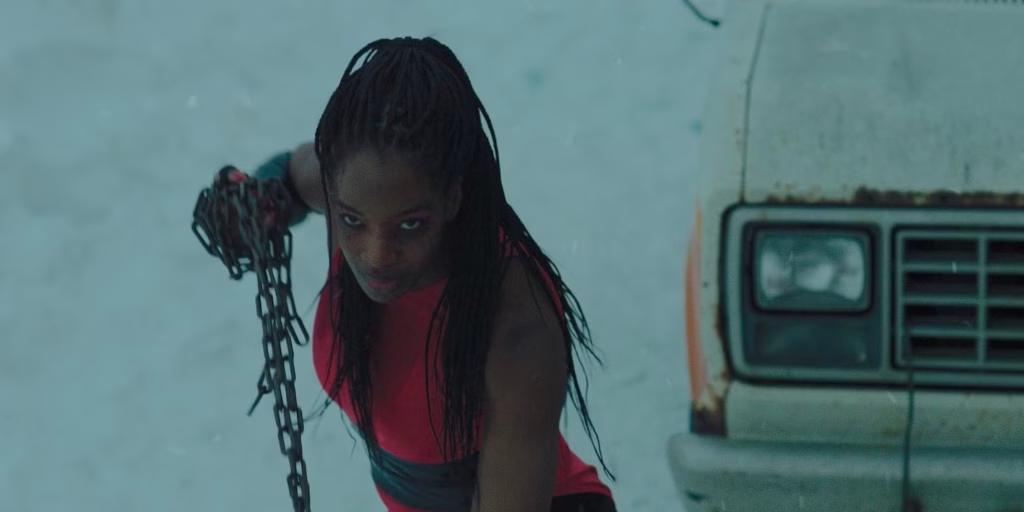
The film finds its strongest performer in Ayisha Issa as Miss Behave. A two-time International Brazilian Jiu-Jitsu Federation World Champion, Issa lends authentic physicality to her role, reminding us that the opportunity to give the most surprising performances in sports films are often genuine athletes. Unfortunately, disproving my point immediately is Chris Jericho. As Leader, Jericho demonstrates that being a wrestling superstar doesn’t automatically translate to dramatic acting. He might be electrifying in the ring, but that hasn’t followed him in his film work. Steven Ogg as Mean Joe Lean and Mo Adan as Enigma Jones provide decent supporting turns while Sara Canning‘s Kate the Great and What If‘s Jonathan Cherry’s sleazy manager Rusty deserve more fleshing out as full characters. Michael Eklund (Antlers) has made a career out of playing disturbingly intense psychos — you wish he and Jericho had switched roles.
Production designer Myron Hyrak transforms what appears to be an abandoned dormitory into a nightmarish arena where the ‘faces’ and ‘heels’ of wrestling take on terrifyingly literal meanings. Costume designer Tracey Graham deserves credit for creating distinct looks for each wrestler that tell their own stories, especially as many of them are in one costume throughout. At the same time, Ty Semaka and Josiah Buhler’s special practical effects deliver satisfyingly gruesome outcomes when the matches turn deadly. The budget constraints become most apparent during crucial moments that need more impact, though, leaving potentially spectacular sequences of violence feeling somewhat muted.
Where Dark Match struggles most is in its familiarity. Though the film’s commentary on exploitation in entertainment feels particularly relevant in our current climate of extreme content and viral sensations, the story beats follow a predictable pattern that anyone versed in cult-themed horror will recognize early on. Wrestling fans are legion, so while Lowell introduces an underlying critique of how far people in the industry will go for attention and success, the chaos of the final act gives him an easy way not to let the message reach its full potential.
For those who grew up believing in the magic of professional wrestling before learning about its faux showboating, Dark Match offers an interesting crossover between subcultures that likely warrants a viewing. The film understands its audience well and plays to the theatrical nature of the sport and its humble origins, as well as the visceral thrills of horror. However, like many independent productions in the heavyweight streaming era, where passion often outweighs polish, it may struggle while in the center ring to reach main event status.