Before summer blockbusters were massive spectacles of sound and fury orchestrated to sell streaming subscriptions or justify bulging budgets, they meant something. They were stories. Big ones, sure, but grounded in something real. Think E.T., Back to the Future, The Goonies, and The Iron Giant—films bore the creative fingerprints of Steven Spielberg, Ron Howard, Robert Zemeckis, or Richard Donner mixed adventure, wonder, and heart into something more than the sum of their special effects. The Electric State, the latest from the Russo Brothers and Netflix, desperately wants to be in that league, borrowing liberally from these proven playbooks. It has the expansive journey, the quirky robot sidekick, the menacing villain lurking in the background. What it doesn’t have is a soul.
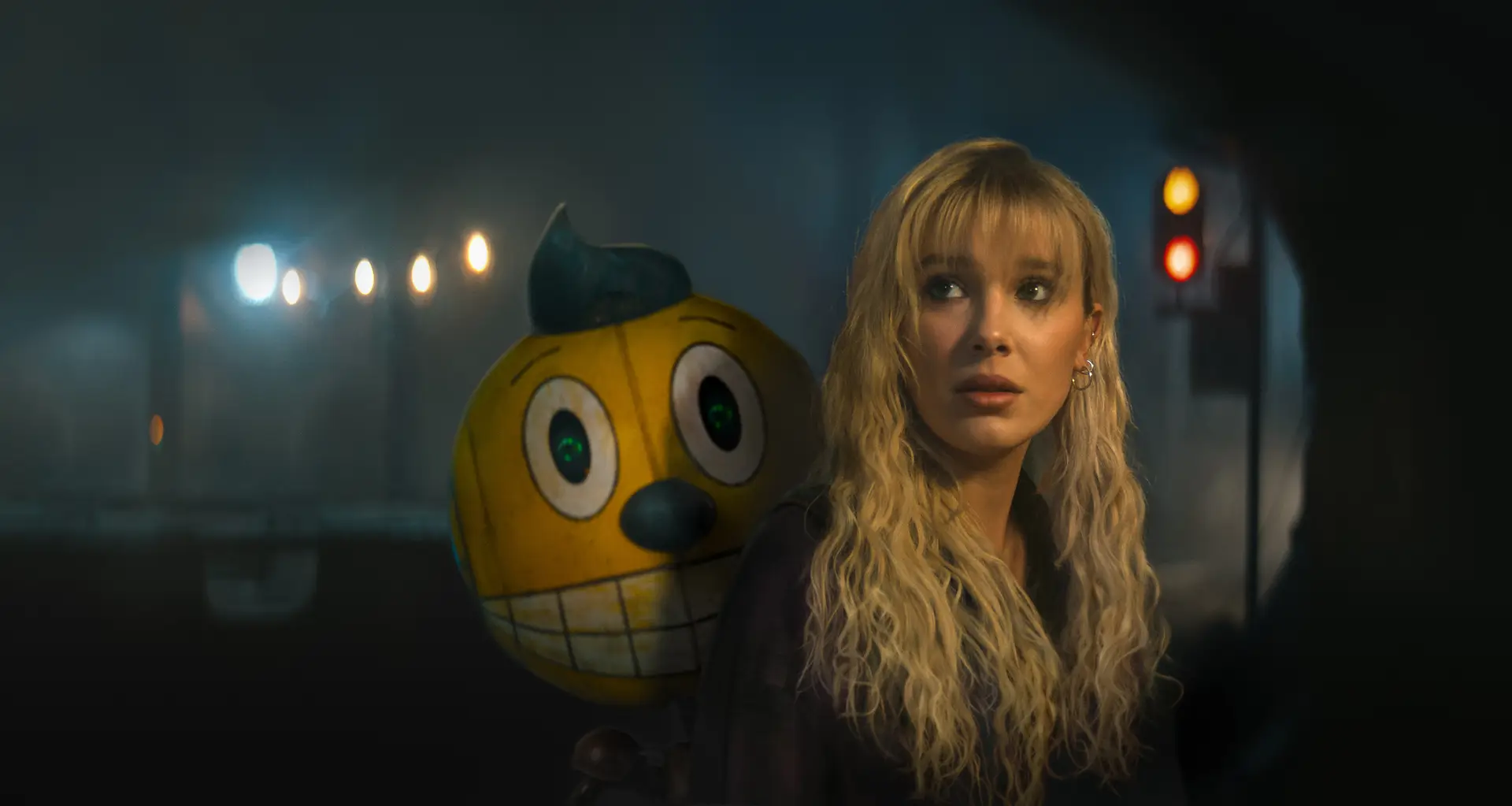
Based on Simon Stålenhag’s illustrated novel and set in an alternate version of 1990s America, where sentient robots once lived alongside humans before a failed uprising that resulted in their exile, the action follows Michelle (Millie Bobby Brown, Godzilla: King of the Monsters), an orphaned teenager whose life changes when she receives a visit from a mysterious robot named Cosmo. The mechanical visitor’s sweet demeanor is familiar to her, leading to a revelation that he’s being controlled by Christopher (Woody Norman, Cobweb), her genius younger brother she believed dead from a car accident years earlier. Determined to find where her sibling is being held and why, Michelle sets out across a vastly different American Southwest with Cosmo in tow.
Along the way, she reluctantly teams up with Keats (Chris Pratt, Jurassic World), a low-rent smuggler, and his wisecracking robot sidekick Herman (voiced by an unrecognizable Anthony Mackie, Elevation). Their journey takes them to the Exclusion Zone, a walled-off desert region where displaced robots have established their own community, and where forces far more sinister than expected lurk behind Christopher’s disappearance. When the world-domination-obsessed megalomaniac (a scenery-devouring Stanley Tucci, Supernova) gets wise to their plan, he dispatches a bounty hunter (Giancarlo Esposito, who, based on his recent appearance in Captain America: Brave New World, only plays bounty hunters now) to stop both human and robot from discovering the truth.
Usually a reliable screen presence, Brown struggles in The Electric State, burdened by a flat American accent that squashes her natural English charisma. Her performance feels wobbly, restrained by what appears to be constantly thinking about her line delivery instead of living in the role. Norman, a fellow Brit, is equally hobbled by the accent work, even though he was completely convincing previously in 2021’s C’mon, C’mon. Pratt, meanwhile, continues his trend of existing in films rather than acting in them. He goes through a collection of familiar mannerisms without depth or nuance. Watch how he scrunches up his face during a pivotal scene requiring tears, hoping for the best.
The supporting cast, at least, knows what kind of movie they’re in. Tucci, sporting ridiculous headgear (because in this alternate 1994, apparently, all tech needs to be worn like a Revlon hairdryer), leans into the camp. However, it’s a role he’s played before, and Esposito’s detached menace is effective, even if it feels recycled. The sheer volume of cameos (Woody Harrelson as a peanut-shaped robot, Jenny Slate as a fast-talking mail-bot, Brian Cox as yet another confused voice in the void, as well as Hank Azaria, Colman Domingo, & Alan Tudyk) adds to the overstuffed feel of the film and speaks to the volume of the film’s reported $320 million budget.
Yes, you read that right. 320 million dollars. That astronomical figure makes it one of the most expensive films ever made and is another reason the script’s hollowness is all the more irritating. However, you can see where the money was spent because the film is visually stunning. Stephen F. Windon’s cinematography captures both the limitlessness of the open road and the claustrophobia of a dystopian world continuing its steep decline.
The robots themselves—designed to resemble vaguely familiar cartoons and mascots—strike an uncanny balance between cute and unsettling. When action sequences arrive, they unfold with the technical mastery and expert staging you’d expect from directors who shepherded several of Marvel’s biggest and most impressive installments. As Alan Silvestri’s rousing music soars, the Russos create several sequences that shake you from the stupor you’ve settled into, only to be brought back down by Christopher Markus and Stephen McFeely’s patchy screenplay.
Strangely, The Russo Brothers’ work outside Marvel has been so shaky. While Avengers: Endgame remains a masterclass in blockbuster filmmaking, neither Cherry nor The Gray Man recaptured the same success. For filmmakers who have demonstrated on multiple prior occasions they can handle massive, interwoven narratives, the inability to figure out the tone of The Electric State becomes a curious puzzle. Sometimes, it wants to be a heartfelt coming-of-age adventure, sometimes a biting satire on a culture based on dominance, and sometimes a bleak meditation on loss. Instead of blending those elements seamlessly, it keeps switching gears and never finds its groove.
Moreover, for all its retro aesthetic and ambition as a sci-fi spectacular, The Electric State doesn’t seem interested in saying anything new. Introducing elements that might warrant a conversation, such as humanity’s overreliance on technology but fear of artificial intelligence and corporate greed winning out over basic decency, it never commits to any cause. Without giving our robots a compelling backstory (I found some of the background robots, like one salon-bot tragically desperate to give a haircut) intriguing, but never having seen them shiny and in their prime, we have no context as to what they meant to society before things went downhill. In that sense, they become a dingy bauble the film uses as an accessory instead of a cornerstone.
At 128 minutes (with nearly 10 minutes of credits), The Electric State overstays its welcome by at least 20 minutes. It exemplifies all that modern blockbuster filmmaking can achieve while demonstrating its frequent inability to make us care. When a film tries this hard to remind you of the classics, it also reminds you of how much better they were. The robots need WD-40, the leads need chemistry, and the script needs a heart.