


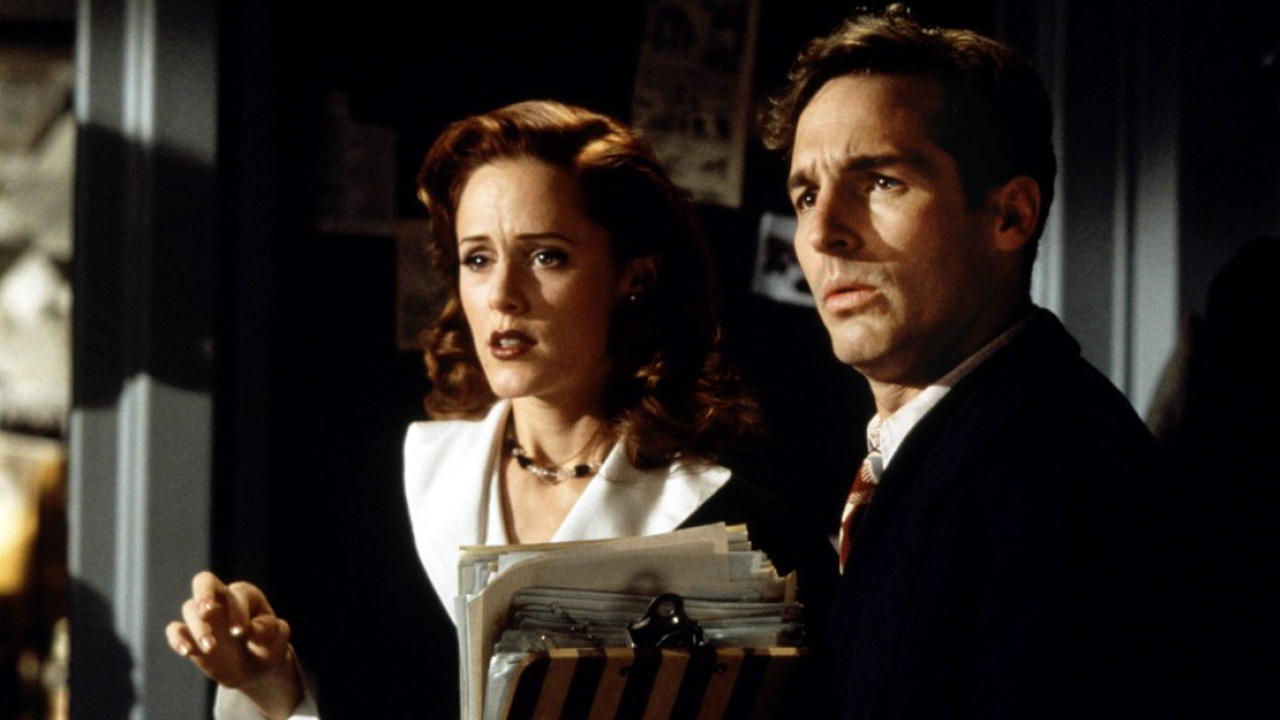
Synopsis: It’s 1939 and WBN, a fourth radio network, is about to debut across America’s airwaves. Unfortunately, one by one, the cast begins to die. Roger, a writer, must find the elusive killer while the survivors try to keep the radio station on air.
Stars: Brian Benben, Mary Stuart Masterson, Ned Beatty, George Burns, Scott Michael Campbell, Brion James, Michael McKean, Jeffrey Tambor, Stephen Tobolowsky, Christopher Lloyd, Larry Miller, Anita Morris, Corbin Bernsen, Rosemary Clooney, Bobcat Goldthwait, Dylan Baker, Billy Barty, Candy Clark, Anne DeSalvo, Bo Hopkins, Robert Klein, Harvey Korman, Joey Lawrence, Peter MacNicol
Director: Mel Smith
Rated: PG
Running Length: 108 minutes
Movie Review in Brief: Mel Smith’s screwball murder mystery suffers from fatal miscasting but retains enough period charm and ensemble energy to justify Kino’s handsome Blu-ray rescue.
Some films are born under bad stars. George Lucas conceived Radioland Murders during American Graffiti‘s writing phase, viewing it as homage to Abbott and Costello, particularly Who Done It? (1942). Universal greenlit it in 1973 alongside an “untitled science fiction film” (which became Star Wars), but development hell swallowed the project for two decades.
When Lucas finally revived it in 1993, promising Industrial Light & Magic’s digital matte technology could deliver spectacle on a modest budget, the result proved… complicated. Critics savaged it, audiences ignored it, even the Razzies couldn’t find a place for it, and it vanished quickly. Yet thirty years later, this screwball murder mystery deserves reappraisal as imperfect but charming—a relic of Hollywood’s willingness to gamble on oddball projects.
Chicago, 1939. Radio network WBN launches its inaugural broadcast, featuring live dramas, comedy acts, and orchestral interludes. Behind the scenes, chaos reigns as writer Roger Henderson (Brian Benben) navigates script rewrites and escalating tension with estranged wife Penny (Mary Stuart Masterson, Daniel Isn’t Real), the station’s secretary/assistant director. When employees start dying one by one, Roger and Penny must solve the murders while keeping the station broadcasting. Suspects include eccentric sound effects man Zoltan (Christopher Lloyd, Clue), military-minded owner General Whalen (Ned Beatty, Repossessed), slick announcer Dexter Morris (Corbin Bernsen), and toupee-topped director Walt Jr. (Jeffrey Tambor, The D Train).
Here’s the problem: Benben. A capable TV actor on Dream On, he’s catastrophically miscast as a screwball lead. Where Jon Hamm proved TV stardom doesn’t guarantee film charisma, Benben confirms it. Paired with Masterson—who understands exactly what movie she’s inhabiting—he’s outmatched, making veteran scene-stealers like Stephen Tobolowsky, George Burns (in his final film role), and Michael McKean seem overly broad by comparison. His performance anchors the entire enterprise when it needed someone who could fly.
The rest works surprisingly well. Mel Smith directs with energy befitting a British comedian/filmmaker who’d honed slapstick timing, and the script (combining Lucas’s favorite elements from multiple drafts by Jeff Reno, Ron Osborn, Willard Huyck, and Gloria Katz) zips along entertainingly despite tonal inconsistencies that plagued Howard the Duck (directed by Huyck). David Tattersall‘s cinematography (he’d shoot Lucas’s Star Wars prequels) keeps the camera in constant motion, dodging equipment and tracking increasingly zany situations. Peggy Farrell‘s costumes are sharp, while Gavin Bocquet‘s production design and Peter Russell‘s art direction create a beehive-like structure where limited sets feel expansive through clever angles and digital enhancement.
The ensemble cast delights beyond Benben’s limitations. Masterson shines with screwball energy the film desperately needs. The late great Anita Morris steals every scene. Veterans Burns, Beatty, McKean, Tambor, and Lloyd elevate material through sheer professionalism. Some roles are glorified cameos, others just walk-ons, but the energy is high throughout. The mystery itself holds together adequately, revealing its culprit with just enough clues scattered throughout.
Kino Lorber’s 2K scan from the 35mm interpositive looks terrific—the restoration honors a film more people dismissed than saw. The HD transfer is clean, with solid contrast and just the right amount of grain to preserve that period glow. The colors pop — golds, reds, and deep shadows give the whole film a lovingly artificial look. It’s a bit like watching a Looney Tunes cartoon brought to life. The new commentary by Bryan Reesman and Max Evry provides context, while Benben’s interview offers candid reflections on the production, his career, and the film’s impact. Both supplements acknowledge flaws while defending Radioland Murders as more than its reputation suggests.
I’ve always had a soft spot for this messy charmer. It’s overlong, tonally inconsistent, often exhausting, and hobbled by miscasting. All that being said, there’s something cozy about this murder mystery set during live radio’s golden age. I love that studios/boutique labels are continuing to rescue underseen films, even one as divisive as Radioland Murders. Even this loving tribute to a bygone era deserves its day—proof that flops can find second lives.
Looking for something? Search for it here! Try an actor, movie, director, genre, or keyword!
The MN Movie Man
Spoiler-free film critic on a mission to ensure your cinematic experience is unforgettable. Let's dive into the magic of movies together!
<script async src="https://widget.justwatch.com/justwatch_widget.js"></script>


