You don’t have to squint too hard to see the present in Nuremberg. James Vanderbilt’s sharply focused drama may be set in the immediate aftermath of World War II, but its urgency is unmistakably now. At a time when propaganda, denial, and strongman politics are once again grabbing headlines, this film feels less like history and more like a mirror.
Rami Malek (Bohemian Rhapsody) plays Douglas Kelley, a U.S. Army psychiatrist sent to evaluate top Nazi leaders before they’re put on trial for crimes against humanity. It’s supposed to be a clinical assignment. Instead, it becomes a psychological and moral chess match—especially with Hermann Göring (Russell Crowe, Unhinged), the highest-ranking Nazi still alive, and the one most determined to twist the trial into his final performance.
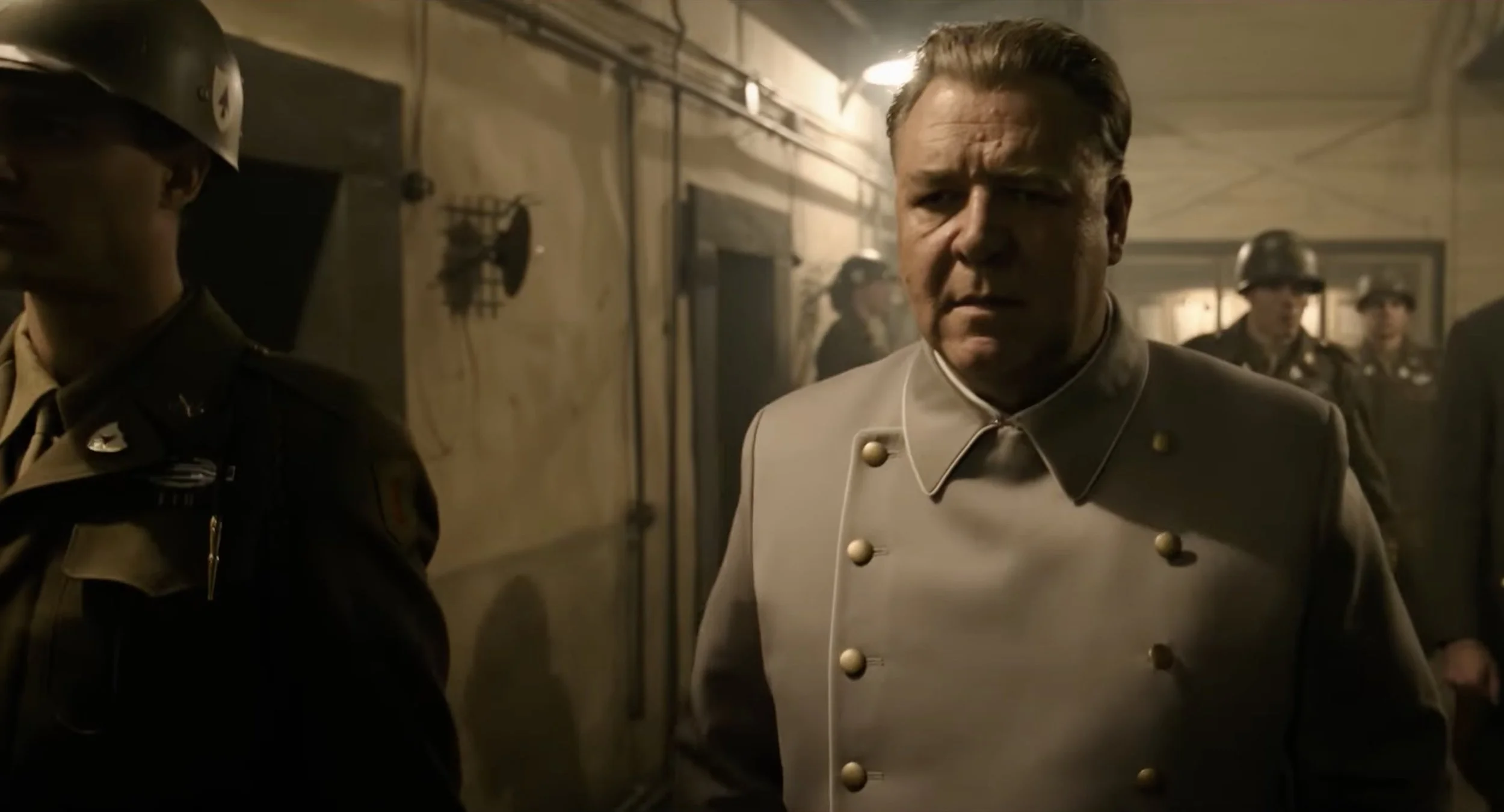
Crowe is the anchor here, and he’s tremendous—fully shedding the bloat of recent roles and finding something genuinely unsettling beneath Göring’s smug defiance. He plays the man as dangerously charismatic, a former mastermind now trying to exploit courtroom protocol and feigned civility to recast himself as something other than monstrous. And that’s what makes it so effective. He’s not frothing at the mouth—he’s persuasive. And that’s exactly how these movements endure.
Malek, to my surprise, more than holds his own. I’ve never quite warmed to his particular style—there’s always been something a little uncanny about him—but here he’s grounded and surprisingly human. His Kelley begins the film with clear boundaries and a sense of professional detachment, but watching Göring attempt to rewrite history in real time chips away at that control. You can feel him slipping, and Vanderbilt lets that unravel slowly. Malek is especially good in the quietest scenes: absorbing the reality of the camps, facing his own complicity, realizing how little distance there is between observation and participation.
The rest of the cast is strong, though some get more to do than others. Michael Shannon (Man of Steel) brings his signature haunted intensity to Supreme Court Justice Robert H. Jackson (Saltburn), leading the U.S. prosecution team. Richard E. Grant is compellingly measured as his British counterpart. And Leo Woodall (Cherry), in a smaller role as Sgt. Howie Triest, nearly steals the film in its final third with a monologue that punches straight through the courtroom procedure and hits something raw. It’s a performance that suggests he’s capable of even more—Hollywood, take note.
What makes Nuremberg more than just a solid period piece is that it doesn’t settle for moral clarity. It wants to explore how fascism festers—not just through violence, but through legal channels, political spin, and mass denial. One of the film’s most chilling suggestions is that trials like this might offer closure without justice, or worse, provide a spotlight for exactly the ideology they’re meant to extinguish. The story wisely sidesteps tidy catharsis, especially in its final scenes, which cast a shadow over Kelley’s postwar life and ask the uncomfortable question: was this victory, or just the start of a longer, slower failure?
Visually, the film is impressive. Dariusz Wolski shoots it with stark precision—there’s an icy grandeur to the sets that suits the emotional coldness of the subject matter. Tom Eagles’ editing keeps things moving, even with a hefty 148-minute runtime, and Brian Tyler’s score knows when to swell and when to sit back and let silence do the work. There’s one sequence, involving documentary footage from the camps, that’s deeply upsetting and impossible to shake. Vanderbilt doesn’t sensationalize it. He just puts it in front of you and refuses to let you look away.
If the film stumbles, it’s mostly in how it handles its female characters—who are, for the most part, wives, assistants, or emotional catalysts for the male leads. Lydia Peckham’s (Kingdom of the Planet of the Apes) journalist Lila, in particular, feels undercooked and unnecessary. That said, this is a story about war, power, and ideological seduction, and those things have always been written and rewritten by men. It’s no surprise that the script struggles to give women space inside that machinery—it just feels like a missed opportunity in a movie that’s otherwise working so hard to challenge assumptions.
What Nuremberg does best is make its relevance feel earned, not forced. There’s no clunky “look how this is still happening” dialogue—just carefully framed moments that make the parallels clear. Trials are still happening. People are still denying. Propaganda is still working. And silence, as ever, remains the most dangerous accomplice of all.