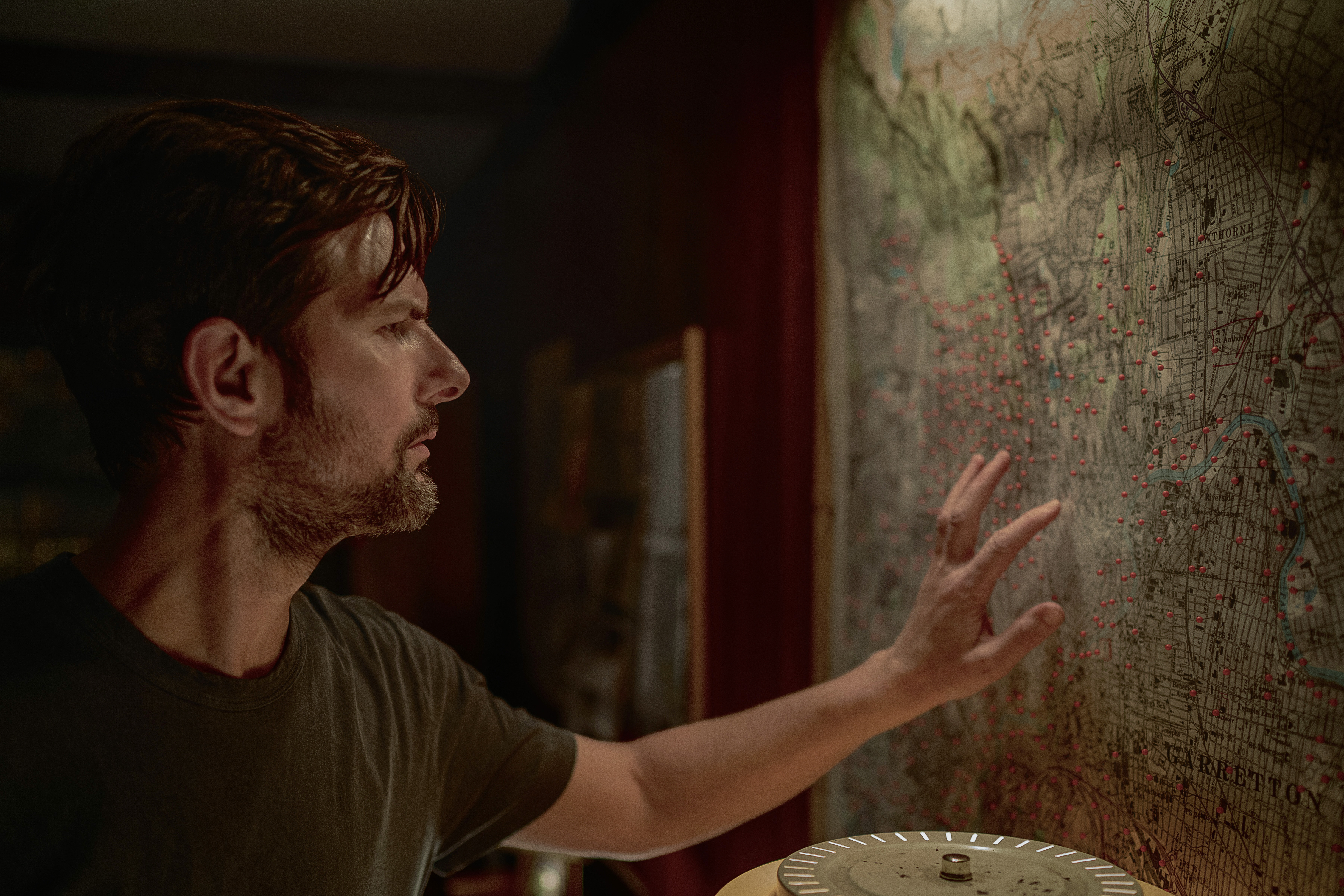
Synopsis: After his eight-year-old son is abducted, a widowed crime writer turns to the father he has spent years avoiding, a retired detective, and finds a link to a decades-old case and the convicted killer known as the Whisper Man.
Stars: Robert De Niro, Michelle Monaghan, Adam Scott, Hamish Linklater, Acston Luca Porto, Will Brill
Director: James Ashcroft
Rated: R (language, disturbing images, brief sexual references, some bloody violence, suicide)
Running Length: 111 minutes
Movie Review in Brief: James Ashcroft stages some genuinely unnerving sequences and the last act detonates with real force, but the script trades character for procedure and leaves Michelle Monaghan stranded. De Niro listens beautifully. Adam Scott never finds the weight.
The Whisper Man Review: Adam Scott's Very Busy Year
Adam Scott has been everywhere in 2026. He spent August shooting the third season of Severance, was out promoting the spooky Hokum in May, and hit SXSW in March with The Saviors. The Whisper Man nearly slipped past under all of that, which is a strange fate for a Netflix thriller starring Robert De Niro.
I’m a sucker for this genre. Scott had been so well cast in Hokum, as an ornery writer holed up in a haunted hotel. I expected something in that neighborhood here. The good news is that film works more often than it doesn’t. The bad news is that Scott isn’t the reason.
He plays Tom Kennedy, a widower who moves his young son back to his hometown. The place carries its own history of children murdered by a figure known as the Whisper Man. The killer was caught years ago. Then, right as Tom arrives, the killings start again, and his own boy becomes the target.
Netflix has a healthy list of things critics have been asked not to reveal, so that’s about as far as I should go on plot. What I can tell you is who made this.
Ashcroft Knows Where to Put the Camera
James Ashcroft directed Coming Home in the Dark in 2021 and The Rule of Jenny Pen in 2024 so you know from the start you’re in capable and slightly disturbing hands. He stages several intensely creepy sequences here with cinematographer Peter Deming, whose credits include Mulholland Drive and Twin Peaks: The Return. Deming knows how to make an ordinary room feel like it’s holding its breath.
The sound work does a lot of the heavy lifting too. Much of it turns on a set of old cassette tapes. There’s also one image involving a hand and a mail slot that I suspect will be invading some nightmares for a while.
Colin Stetson wrote the score and if you know his work on Hereditary, you know what he brings: sustained, physical dread that never announces itself as music. Christopher Tellefsen cut Moneyball and A Quiet Place. He keeps the investigation moving even when the script starts padding.
A Procedural With Nineties Bones
The adaptation by Ben Jacoby and Chase Palmer is straightforward and procedural. It reaches back to early-’90s thrillers like Copycat or the underseen Jennifer 8. I like those movies. The trouble is that the emphasis on ace police work comes at the expense of the people doing it.
Michelle Monaghan takes the worst of that. Her Detective Amanda Beck is the most reduced character in the film. We watch her leave a Quaker church at one point, presumably her own, and nothing further is made of it. That’s one of several moments where the screenplay could have given her a dimension outside her job description and simply declines to.
There are cliché red herrings. There’s clunky logistical exposition. And there’s a father-and-son relationship between Scott’s character and De Niro’s Pete Willis that the script keeps gesturing at without ever opening up. Ashcroft says in the production notes that the mirrored fathers and sons were what drew him to Alex North‘s novel in the first place. You can feel him reaching for it. The script doesn’t hand it to him.
De Niro Listens, and That's the Performance
De Niro is 83 and has very few lines here, and I’ve seen people call that underuse. I’d argue the opposite. He’s active and invested, listening hard. He takes in what Scott’s character says and shapes something specific out of it. He’s always been among the best at saying a great deal by doing very little, and this is a clean demonstration.
There’s also the imprisoned original killer (played by an A-lister I can’t reveal). That portrayal is surprisingly energetic, over the top and highly entertaining. It’s a stylized jolt of color in an otherwise bleak film, and it works precisely because everything around it is so restrained.
Scott, unfortunately, never finds his footing. The performance isn’t bad, but the role asks for an emotional weight he doesn’t reach. That gap widens as the story closes in on his son and his behavior gets increasingly less logical.
Then It Stops Being Scary
I can’t say much about the final third without wrecking it. What I can say is that the ending caught me off guard, and not because of the solution to the mystery. It’s how suddenly and violently the whole thing erupts.
That’s the moment The Whisper Man stops being scary and starts being frightening. Is it the payoff we’ve been anticipating? Perhaps. However, it is so vicious that you wish the entire movie had been that aggressive.
It’s a real distinction, and Ashcroft understands it. The film spends most of its length building dread. It works through investigation, atmosphere and the suggestion of something standing just outside the frame. When it finally lets the violence off the leash, it hits harder because we’ve been waiting.
Wait for a rainy day and put this on.
Looking for something? Search for it here! Try an actor, movie, director, genre, or keyword!
