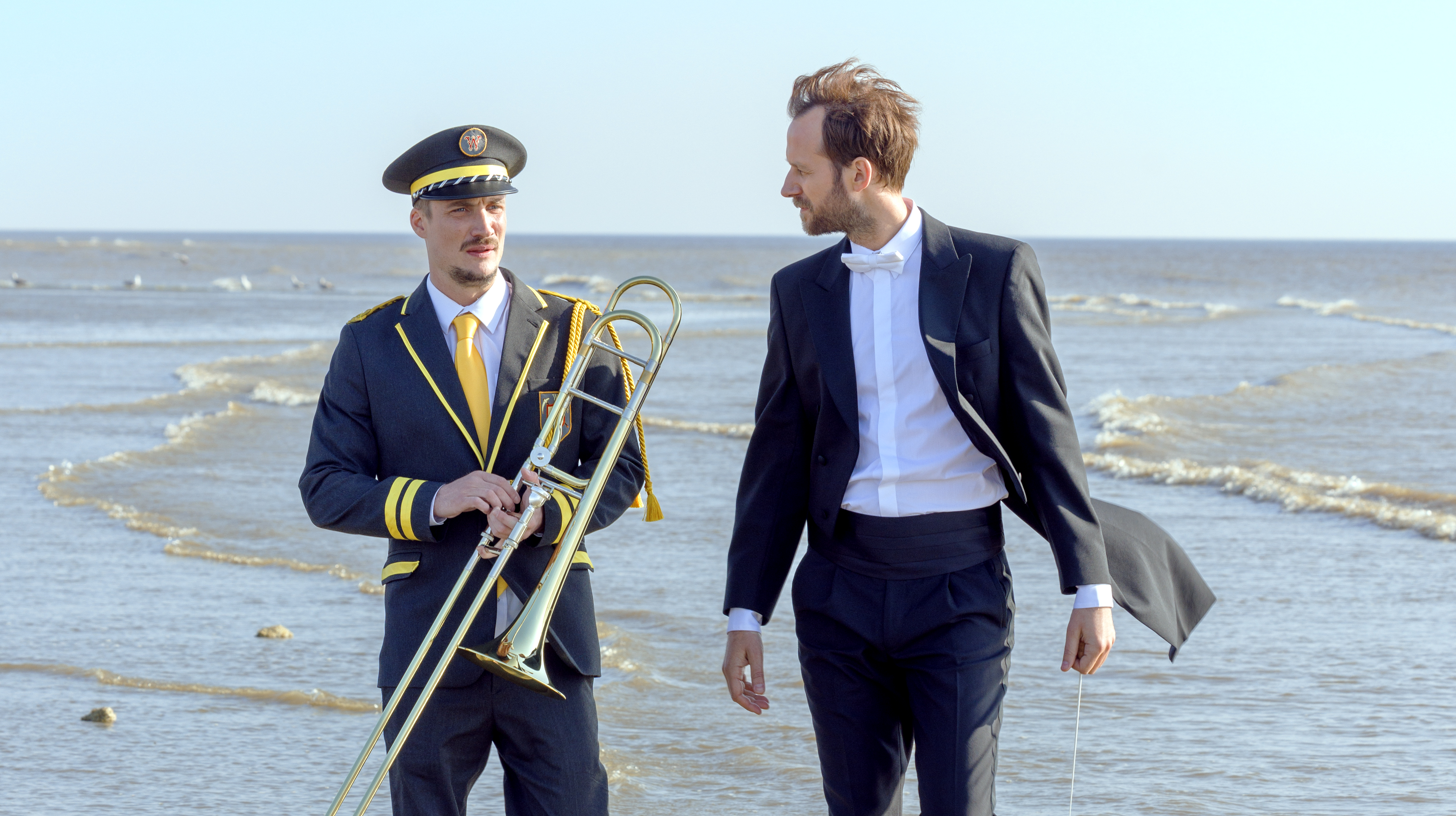
Synopsis: A celebrated orchestra conductor learns he was adopted when a leukemia diagnosis sends him looking for a bone marrow donor. His brother turns out to be a school cafeteria worker who plays trombone in a struggling municipal band in northern France.
Stars: Benjamin Lavernhe, Pierre Lottin, Sarah Suco, Jacques Bonnaffé, Ludmila Mikaël
Director: Emmanuel Courcol
Rated: Not Rated
Running Length: 103 minutes
Movie Review in Brief: A French crowdpleaser with a tender heart, a winning spirit and two performances you bond with almost instantly. It gives the tear ducts a squeeze at the end, and it earns every second of it.
The Marching Band Review: I Needed Convincing
C’est magnifique!
Here’s something you should understand about this job. Critics get sent requests for hundreds more movies a year than any of us could possibly cover. It’s a terrible problem to have. Especially for someone who loves film and wants to see as much as he can, from as many genres and countries as possible. That range is what keeps you honest.
There’s also the matter of balancing the personal against the professional. As my family reminds me on a regular basis, it’s just a movie. So I’ve gotten better at being selective, reading descriptions and watching previews to decide what makes the cut.
When I read the summary for The Marching Band, I’ll be honest: I needed more convincing. Then I watched the trailer and figured I had the measure of it. Fun, light, very French. Sure, why not.
I wasn’t prepared for the tender heart underneath.
Two Brothers, One Podium
The setup has the familiar ring of a story that’s been working over moviegoers’ tear ducts for decades. A celebrated orchestra conductor discovers he was adopted after a routine blood test reveals a serious illness requiring a bone marrow transplant. His only real hope is a blood relative. That search leads him to a younger brother, a working-class man caught up in a labor dispute in his small village. After some convincing, the brother agrees to donate.
Once the conductor recovers, he learns something harder. His parents had the chance to adopt his brother and chose not to. Guilt does what guilt does. He starts spending time with the man, discovers he plays in a local band, and wouldn’t you know it, that band needs a conductor.
Emmanuel Courcol is working from a script he tinkered with alongside four other writers. That may explain why the film can feel a little sewn together, with a few loose threads showing. Those imperfections never get in the way of its sincerity or the honesty of the performances.
Lavernhe Inward, Lottin Outward
Benjamin Lavernhe of the Comédie-Française takes most of his character’s emotion inward. He builds a soft-spoken man who turns decisive the moment music is involved, and the contrast is lovely to watch. He works beautifully opposite Pierre Lottin as his brother.
Lottin has real screen charisma and arrives as something quite different from what I expected at first meeting. He unfolds gradually into a warmth that makes the character easy to root for. He also shares some of the film’s best scenes with Sarah Suco, who plays a woman in the band he becomes drawn to. Their attraction is handled with a lightness that never tips into cuteness.
Lavernhe and Suco were both nominated for Césars, part of a haul of seven nominations that included Best Film and Best Original Screenplay.
The Band Is an Actual Band
Here’s the choice that makes the whole film work. Rather than hire background actors and teach them to mime, Courcol cast a real regional ensemble. The Harmonie des Mineurs de Lallaing is rooted in the mining history of the Hauts-de-France region.
Production spent two weeks in Lallaing and shot inside the band’s actual rehearsal space. Courcol’s stated goal was to make professionals like Suco and Jacques Bonnaffé indistinguishable from the musicians sitting beside them, and he gets there. The band isn’t faking the playing either. They perform the brass soundtrack themselves. They worked with composer Michel Petrossian on a track list running from classical through jazz to Dalida and Charles Aznavour.
The shoot became a local event. Residents remember it as a genuinely friendly few weeks. The project even pulled several former members back into the Lallaing ensemble who had drifted away years earlier. A film about a band saving a town ended up doing a small version of that in real life.
Maxence Lemonnier‘s cinematography stays close and warm without going soft, and Guerric Catala‘s editing lets musical numbers breathe rather than chopping them into highlights. Rafael Mathé‘s sets and Christel Birot‘s costumes draw the line between the conductor’s Paris and his brother’s Lallaing. Neither ever makes the working-class world look shabby.
March Over to the Theater
The road here is worth noting. Courcol’s original idea, years earlier, centered on a majorette in a northern brass band. That project collapsed, but the notion of a musical collective stayed with him. When he brought in co-writer Irène Muscari, the two of them found they were holding two separate premises. One was an elite Paris conductor facing a medical crisis. The other was a factory town fighting a closure. Rather than choose, they merged them.
In France the film crossed a million admissions, a rare milestone for a local release. It arrived here after winning audience awards at the Film Society of Lincoln Center and the American French Film Festival. Greenwich Entertainment finally brought it to American arthouses two years after Cannes. That tells you something about how slow the pipeline for foreign-language crowdpleasers has become.
The Marching Band isn’t above giving those tear ducts a firm squeeze in its finale. It earns it, because everything before it was in service of putting on one hell of a show.
Looking for something? Search for it here! Try an actor, movie, director, genre, or keyword!

Leave a Reply