

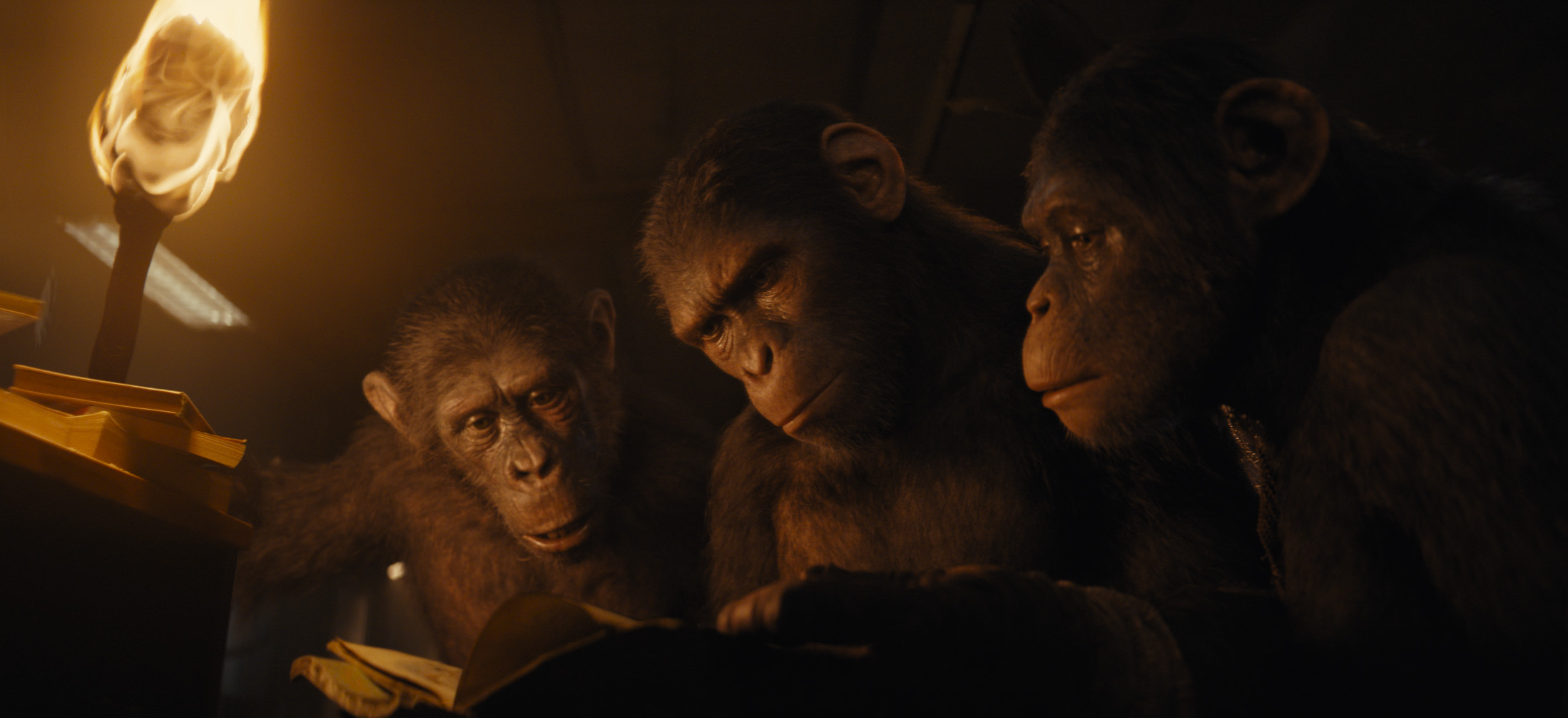
Synopsis: Many years after the reign of Caesar, a young ape goes on a journey that will lead him to question everything he’s been taught about the past and make choices that will define a future for apes and humans alike.
Stars: Owen Teague, Freya Allan, Peter Macon, Eka Darville, Kevin Durand, William H. Macy, Dichen Lachman
Director: Wes Ball
Rated: PG-13
Running Length: 145 minutes
It all began with the novel: 1963’s La Planète des Singes by French author Pierre Boulle. Boulle’s book was first adapted into the landmark film Planet of the Apes in 1968, starring Charlton Heston and Roddy McDowell. That classic tale of highly intelligent apes who treated humans as the ones who should be put in cages would set a new standard for the sci-fi genre, expanding ideas of what was possible to achieve on a technical and thematic level. Four sequels, a television series, a Tim Burton reimagining in 2001, and a modern trilogy reboot followed, keeping the Apes ever in the cinematic vocabulary across generations of pop culture enthusiasts.
Concluding with 2017’s War for the Planet of the Apes, the thought-provoking trilogy ended on an emotionally sound note after consistently challenging audiences to ponder humanity’s place in the order of the universe. It was groundbreaking filmmaking rich in allegory (as the original Heston film was), and now, after a seven-year hiatus, the series has reemerged with Kingdom of the Planet of the Apes. The beginning of a proposed new trilogy is yet another visual wonder that cements this franchise as capable of producing emotionally gripping entertainment while upending the natural order of how we view heroes and villains.
Set generations after Ceasar’s epic rebellion, the apes freed during the time after a virus changed the balance of power between humans and primates have broken off into clans and established civilizations on top of what were once thriving metropolises. Humans, meanwhile, have dwindled in the shadows and devolved into feral beings unable to speak. Screenwriter Josh Friedman (Terminator: Dark Fate) picks up the action with Noa (Owen Teague, You Hurt My Feelings), a chimp coming-of-age in a colony that excels in raising falcons. Preparing for a ceremony where he will finally take his place alongside his parents and other adults in the society, the celebration is interrupted by raiders brandishing advanced weapons, taking his community hostage, and leaving him for dead.
Determined to find his family and be reunited with his friends, he sets off to land occupied by Proximus Caesar (Kevin Durand, Abigail). This bonobo has assumed monarch status, reinterpreting the teachings of the original Caesar to fit his plans for further dominating his fellow primates. Joining him on his quest is wise orangutan Raka (Peter Macon), a devotee of Caesar’s belief in unity, and a young human scavenger they name Nova (Freya Allan, Gunpowder Milkshake). A former annoyance of Noa, Nova soon turns into an asset when they are captured and brought face to face with Proximus, revealing a plan that has implications far beyond the scope of their settlement.
Once again, working with the magicians at Wētā FX, the producers of Kingdom of the Planet of the Apes have pulled out all the stops to start this new chapter with a bang. Wētā’s craftsmanship elevates their top-notch filmmaking standards. It’s unparalleled and truly breathtaking, especially considering the presence of humans in the film is next to nil. It’s wall-to-wall primates, and each has been given a distinct personality through the performers, their physicalities, and mannerisms all painstakingly created through motion-capture magic, and the results are astonishing. Teague, in particular, delivers a complex, emotionally rich performance that transcends the boundaries of his digitally rendered exterior. Durand, meanwhile, is an imposing figure as the primary antagonist, his authoritative presence giving Proximus a chilling sense of menace.
The technical achievements of the visual effects and motion-captured performances would be enough to keep your eyes busy, but cinematographer Gyula Pados (Million Dollar Arm) gives us a gorgeously shot film on top of it all. While much of the film is shot against a green screen (and looks like it at some awkward moments), Pados takes full advantage of Disney’s Australian studios, where the rest of the movie was made. It all adds up to a film that never once feels like it was largely manufactured; rather, it is entirely believable as an overgrown version of the world and cities we occupy today. Extra points to production designer Daniel T. Dorrance and costume designer Mayes C. Rubeo (Thor: Ragnarok) for working in tandem to complete the film’s futuristic look without resorting to clichéd dystopian drudgery.
For all its technical marvels, though, the film’s true power is in its capacity to stir you emotionally. Director Wes Ball capably handles the action sequences and lets us know that he has that under control early on. He still ensures there is equal time to explore themes of tribalism, injustice, prejudice within one’s community, and the yearning for connection, which has been a running motif throughout the Apes franchise. Bringing a fresh perspective to the series, Ball intertwines human drama with primal survival, exploring a meditation on hatred and fear and how we bond to break that cyclical nature.
At the cusp of a summer bound to see the release of several soulless blockbusters, one can’t help but feel a sense of gratitude for Kingdom of the Planet of the Apes and the way it continues to redefine the boundaries of science fiction storytelling, uniting us in our shared humanity. A commendable continuation of the series, it’s enlightening as a commentary on leadership and legacy and vividly challenges the ongoing struggle between domination and harmony.
Looking for something? Search for it here! Try an actor, movie, director, genre, or keyword!
The MN Movie Man
Spoiler-free film critic on a mission to ensure your cinematic experience is unforgettable. Let's dive into the magic of movies together!
<script async src="https://widget.justwatch.com/justwatch_widget.js"></script>Subscribe now to keep reading and get access to the full archive.


Leave a Reply