Sending successful prodigals back to their roots is one of the most-loved traditions in film. Facing up to a past they thought they’d outgrown is an opportunity for reflection through nostalgia, and it’s why warm-hearted films like Sweet Home Alabama and Garden State continue to be found and embraced. Okie follows a darker, less sentimental path. Here, a once-struggling writer who struck it big by mining his hometown’s quirks returns to the community he profited from—only to find that neither he nor the locals he left behind long ago are prepared for the reunion.
This compact drama follows Louie (Scott Michael Foster), whose literary success stems from a series of novels built upon the lives of his childhood companions. Returning home following his father’s death, he’s forced to confront Travis (Kevin Bigley, The Wretched) and Lainey (Kate Cobb), the unwitting characters whose experiences he transformed into pastoral poetry for profit. His return isn’t fodder for page-turning wistfulness but rather an odd swirl of old grudges and awkward apologies as he realizes that the real lives he fictionalized might hold a few harsh surprises for him.
A modest meditation on creative exploitation that never quite reaches the biting critique it could have delivered, Okie attempts to stir the pot on the ideals of the American small town. Dragged from gathering to gathering, Louie feels the pangs of guilt and regret, even as his small-town neighbors sharpen their own sense of justice in the face of his past exploitation. But as his grip on reality begins to blur, Louie begins to question: are these people just playing along, or do they have something more sinister in store?
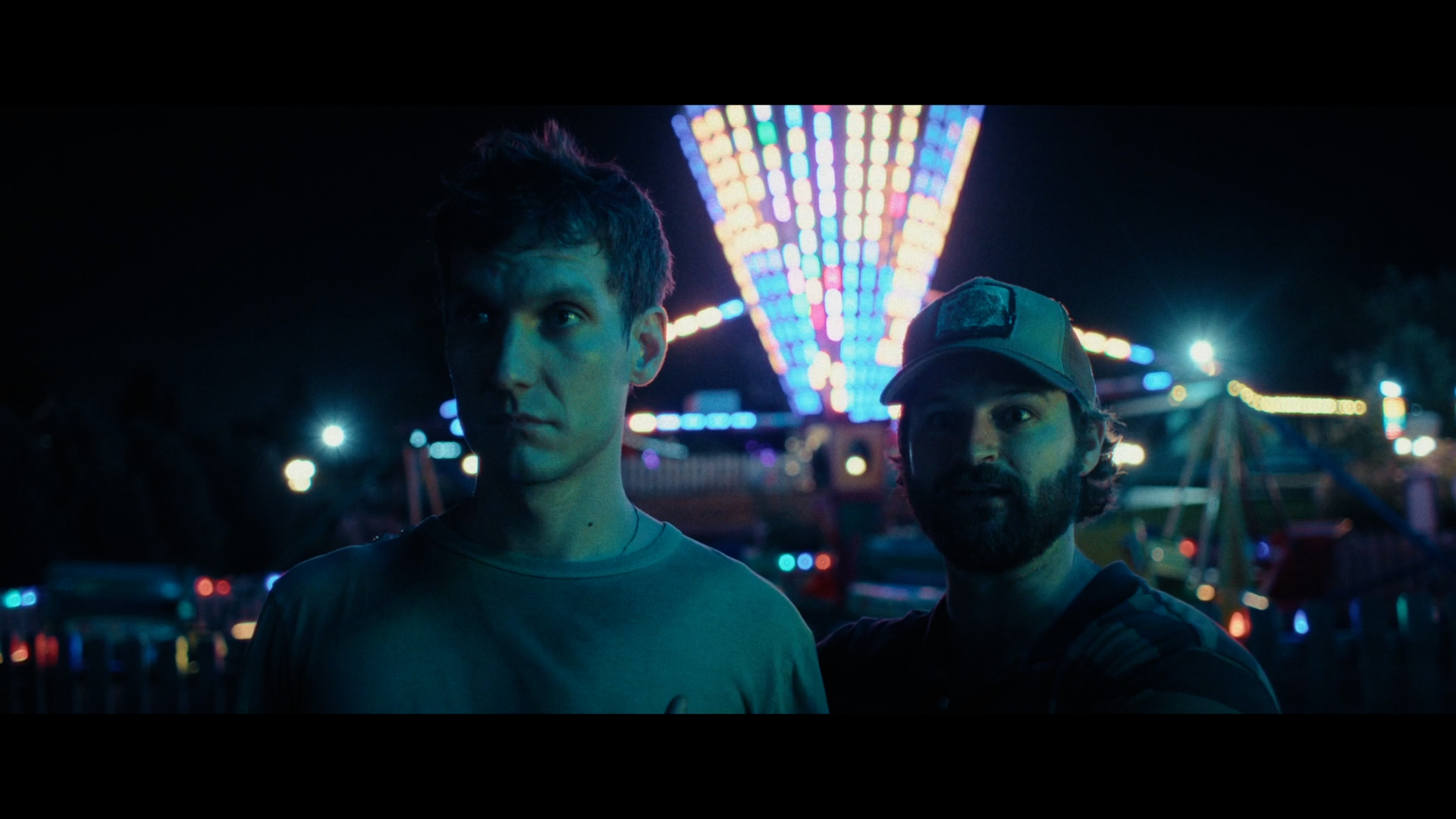
Foster brings an appropriately uncomfortable energy to Louie, capturing the awkwardness of someone who’s outgrown their roots while remaining forever defined by them. His portrayal hits just the right notes of pretentiousness (his electric car is brought up often) and unease, making him a protagonist you aren’t entirely comfortable rooting for but find intriguing all the same. Bigley’s Travis (forever in a drop arm tank) serves as an effective foil, equal parts charismatic and confrontational, while Cobb (also the director) strikes an intelligent balance with Lainey, Louie’s former flame walking the tightrope between friend, judge, and jury with quiet intensity. The supporting cast, including Josef Bette, Michael Waller, and Dan J. Johnson, form a community of people whose lives feel authentic even when the plot mechanics strain credibility.
Cobb’s direction brings a personal, unpolished feel to the setting (rural Illinois), making it feel intimate and oppressive—a place Louie can’t escape yet doesn’t belong to. Leaning into the earthy tones and rugged charm of small-town America, the familiarity of the visuals provides an anchor when the increasingly surreal elements emerge as Louie begins not to be able to discern where his reality begins and the fictional life he’s living (a fiancée exists peripherally). However, this psychological thread that begins with a few ensnaring curls ultimately leads to a narrative roundabout rather than a satisfying final destination.
At 83 minutes, Okie somehow feels both rushed and stretched thin. The premise—a writer profiting from appropriated stories—echoes contemporary discussions about voice, authenticity, and creative ownership. These themes resonate nicely as Louie confronts the reality that the lives he fictionalized for profit might hold more harsh truths than he imagined. The screenplay (from Bigley, which gives the entire film a homegrown, “let’s make a movie” feel) introduces an ironic fallout of betrayed trust as Louie’s subjects come to terms with how he’s exploited their experiences. Yet just as these concepts gain traction, the film shifts focus, leaving potentially more substantial commentary unexplored.
In a way, Okie works as a kind of anti-homecoming story, subverting the usual feel-good tropes of the genre because Louie’s return isn’t a time for sepia-hued reminiscence but a darker twist on the expected. It’s an enjoyable enough ride, bolstered by committed performances and a strong sense of place, even if it can’t find the footing to make a lasting impact. What remains for the viewer are a few interesting, if ultimately lightweight, grace notes to a familiar tune that never quite manages to compose a new song.


Leave a Reply