Oscar nomination day is always an exhilarating milestone for movie lovers. It’s the culmination of months spent watching films, making bold predictions, and experiencing the rollercoaster of certified locks, unexpected snubs, and delightful surprises. While I appreciate all the categories, I find myself particularly drawn to two: Best Documentary Feature Film and Best International Feature Film. These may not always grab the most attention, but the films showcased here often offer a chance to step outside the mainstream and explore fresh perspectives. In a time when the world feels increasingly vast, yet our viewpoints risk becoming narrower, these categories remind us how film can bridge division and celebrate our shared humanity.
That’s the power of cinema, after all. It can transport us, immersing us in unfamiliar worlds and sensations. Maura Delpero’s Vermiglio, Italy’s submission for the 2025 Academy Awards for Best International Feature Film, certainly accomplishes the former. Its wintry landscapes and quiet rhythms pull us into the heart of a remote alpine village during the waning days of World War II. But while the film is visually captivating and admirably restrained, its impact feels muted, leaving a distance that can be increasingly hard to bridge.
Set in the snowbound town of Vermiglio, Delpero’s story (created in part as a tribute to her late father) centers on a Sicilian deserter, Pietro (Giuseppe De Domenico), who seeks refuge in the isolated community. His arrival in the film’s opening moments stirs the stagnant lives of the village schoolteacher Caesar (Tommaso Ragno), his family, and particularly his eldest daughter, Lucia (Martina Scrinzi). What begins as a quiet disruption to their routine unfolds into a meditation on family, tradition, and the subtle but inevitable tremors of change.
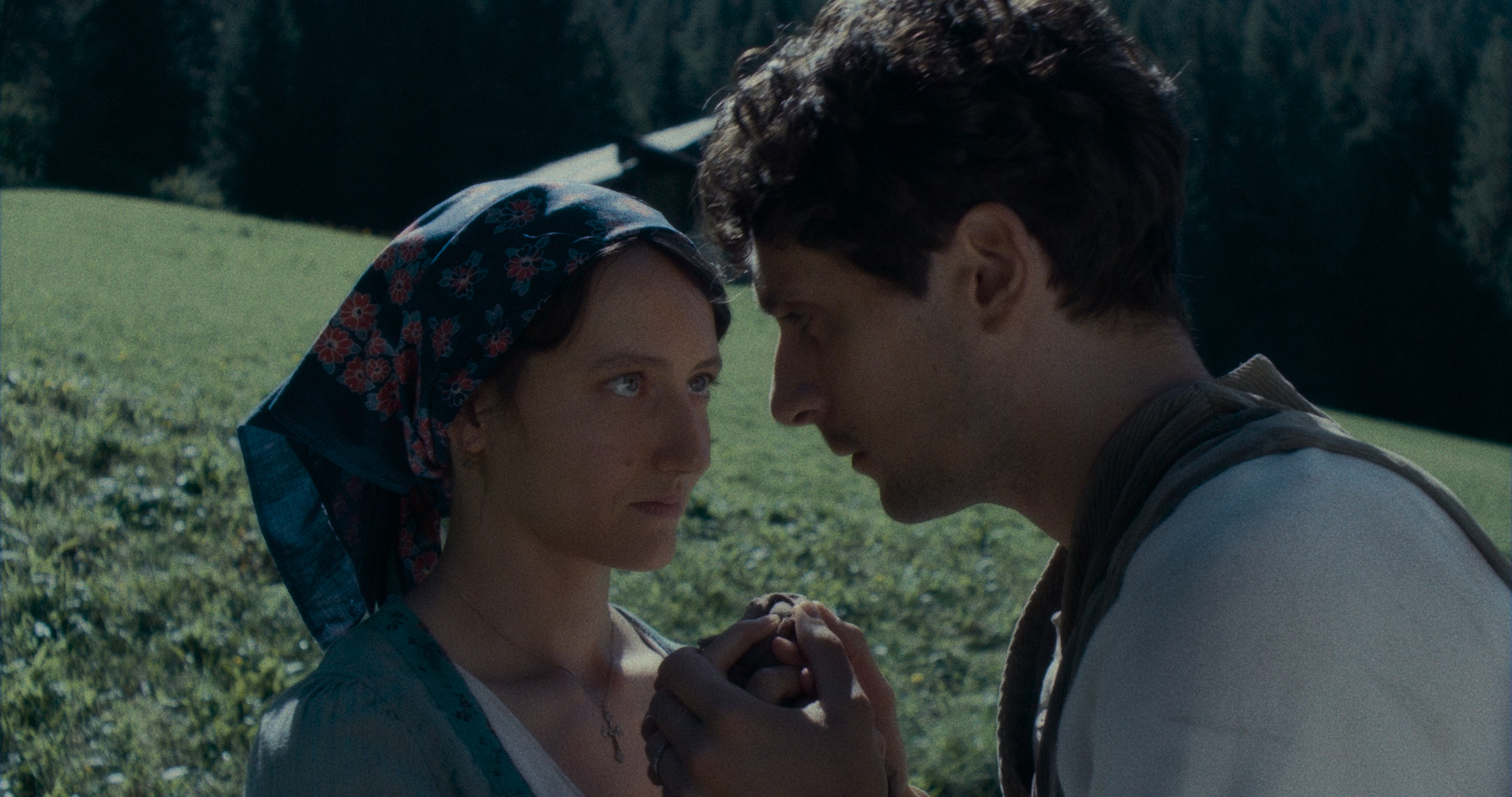
Visually, Vermiglio is stunning, and it’s almost a shame to watch it on anything other than a huge theater screen. Cinematographer Mikhail Krichman transforms the Alps into a wonderland of frostbitten beauty. The film’s transitions from winter to spring are rendered with a painterly precision, the changing landscape not so subtly mirroring the gradual shifts in the characters’ lives. Snow-draped mountains and tangled woods evoke a sense of both isolation and timelessness, grounding the story in a world that feels at once specific and universal. Yet, as beautiful as these images are, their chilliness extends beyond the frame. While the film invites admiration for its artistry, it often keeps the viewer at a considerable arm’s length.
The characters, too, are skillfully drawn but not always easy to connect with. As Caesar, Ragno captures a man hardened by duty and tradition, his withholding nature shaping the lives of those around him. Ragno’s performance is layered and compelling, but the character remains detached, his moments of tenderness fleeting. Lucia played with quiet resolve by Scrinzi, offers a more relatable perspective, yet even her arc feels understated to a fault. Rachele Potrich, as Ada, is particularly captivating as the second eldest daughter caught between expectation and her own unspoken burgeoning yearning. Potrich’s performance brings depth to Ada’s quiet struggle, hinting at the untapped potential in a life constrained by the era’s rigid boundaries on familial hierarchy and gender norms. The family dynamics are rich with possibilities, but the film’s deliberate restraint leaves them underexplored.
Pietro’s arrival and his modest connection with Lucia provide the narrative’s central thread, yet their relationship never fully blossoms into something tangible. Instead, Vermiglio leans heavily on implication, letting glances and silences carry the weight of its story. While this subtlety is admirable, it contributes to the film’s coolness. Layered in Andrea Cavaletto’s richly detailed costumes, there’s a sense that the characters’ inner lives are just out of reach, leaving the viewer to piece together fragments without ever feeling fully immersed in their struggles or desires.
Delpero’s meticulous approach to craftsmanship is undeniably rooted in Italian neorealism, but where the greats of that movement found raw power in their simplicity, Vermiglio sometimes feels overly composed. Its deliberate pacing and sparse dialogue demand utter patience, rewarding careful observation but offering little in the way of catharsis. Editor Luca Mattei’s restrained cuts and the natural soundscape—crunching snow, murmured voices, the occasional distant bell—enhance the film’s immersive quality, yet the absence of a traditional score stresses the distance that’s been created.
Watching Vermiglio is an undeniably intellectual experience, but ultimately, it feels like a puzzle box, intricately constructed but deliberately withholding its rewards. The moments of connection and revelation are there, but they’re fleeting, buried beneath mounds of restraint. This may score high with viewers who appreciate meditative storytelling and understated drama, but for others, it may prove as chilly as its snowbound setting.