There’s something universally triggering about the thump-thump-thump of bass reverberating through your walls at 2 AM or the thunderous stampede of upstairs neighbors practicing what sounds like competitive Irish dancing while you’re trying to decompress with a good book. Haven’t we all gritted our teeth wondering if the confrontation is worth the inevitable awkwardness or, worse, backlash? This rage we rarely act on but always feel is a shared horror of the modern age, and Restless, the debut feature from British director Jed Hart, bites into this raw nerve with sharp teeth, turning a simple premise into a tightly wound British suburban thriller (now there’s a genre for you!) that dances on the edge of satire and is as much about isolation as it is about insomnia.
As these films often do, Restless opens with relative peace. At night, a woman gets into her car, takes several deep breaths, and begins a drive to the woods. There, with a focused resolve, she starts digging (A hole? A grave? We aren’t sure.) while classical music drowns out the dirt pitched to the side. It’s a bleak, tongue-in-cheek nod to the British gangster films of John Mackenzie or Ben Wheatley and Scorsese’s mob dramas; however, the reference is meant as less of a tribute and more of a tone-setter. This isn’t a film that draws its energy from untethered chaos but a relatable pressure cooker reflecting our increasingly fractured society where basic courtesy feels extinct, and everyone operates from a “me first, screw everyone else” mentality.
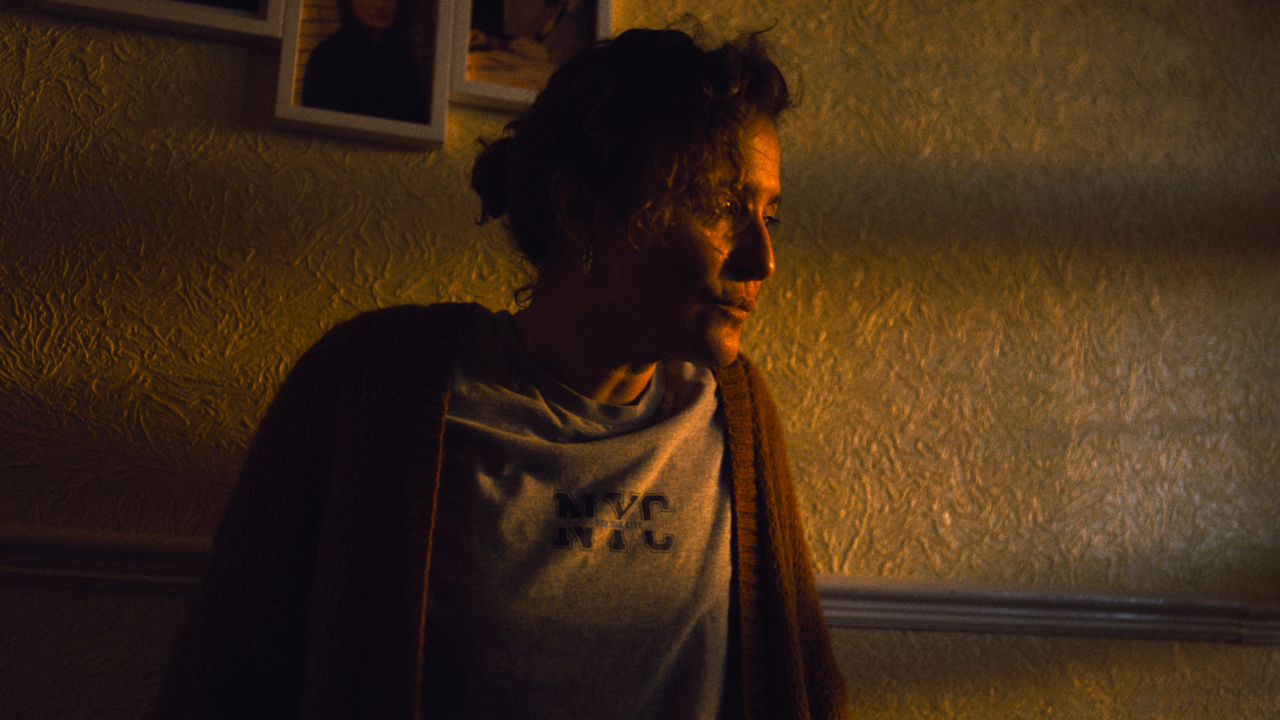
From there, we rewind one week to meet Nicky (a superb Lyndsey Marshal), a care worker stuck in a slow spiral of a life that’s beginning to close in around her. Her son’s off at university, her parents, who lived next door, have recently passed, and she’s quietly unraveling while spending evenings eating homemade cake, listening to her father’s favorite classical FM station that she at one time abhorred, and falling asleep watching games of snooker along with her cat. Then Deano (Aston McAuley, Rocketman) moves in next door.
Armed with club speakers and a stream of drunken guests, Deano is a human jackhammer in ripped jeans. Loud, entitled, and impossible to ignore, he’s occupying the flat her parents lived (and died) in, which only adds insult to the injury of sleepless nights he inflicts on Nicky. Deano’s late-night parties and all-night bedroom antics are impossible to ignore, the music and moaning vibrating through the thin plaster and forcing Nicky to attempt countless measures to sleep through the noise. When her polite requests to turn it down are laughed off, Nicky’s fuse begins to smolder, and a cold war starts to heat up.
What begins as passive-aggressive retaliation between neighbors from different generations escalates into full-blown, absurd psychological warfare. And what makes Restless so effective is that it doesn’t hand you a hero. Marshal’s Nicky is not simply a victim pushed too far. She’s lonely and brittle and escalates things in ways that are bizarre, wholly unwise, and darkly hilarious (warning: never accept baked goods from someone you are arguing with). You don’t root for her so much as flinch and watch because there’s admittedly a thrill in her descent, a twisted sense of principle that makes her unplanned retaliation feel equal parts catharsis and cry for help.
Barry Ward (Extra Ordinary) brings a welcome softness as Kevin, Nicky’s tentative romantic interest. Showing up almost like a rom-com distraction, we realize later that he’s been positioned as a subtle accelerant to her downward turn. Their awkward chemistry is believable and a little sad, like two lone souls attempting to align but caught in vastly different orbits. Though well-meaning, his presence becomes another weight pressing down on her increasingly fractured psyche.
Marshal’s performance is the electric key to the film’s success, capturing the awkward pivots from mousy compliance to reckless defiance with remarkable precision. Every micro-expression cracks the surface at just the right moment, showing the volcanic frustration underneath. Watching her go from caring for elderly patients at work to plotting acts of madness toward Deano is comical one moment but strangely heartbreaking in almost the same breath. McAuley is equally impressive, turning what could’ve been a cartoon antagonist into someone haunted by his failures. You get the sense that this new home represents a new lease on freedom, possibly even success, and being told to turn the volume down on his life feels like slipping back into the regretful hole he crawled out of. He’s not just inconsiderate; he’s afraid to yield because compromise means collapse.
Hart’s script is clever about this kind of moral murk. Nicky and Deano both reach a point where they are convinced of their righteousness and find themselves incapable of stepping back. That’s where Restless finds its deadly sting of commentary. This isn’t a noise complaint gone nuclear resulting in horrific violence; it’s about how easy it is for ordinary people to turn monstrous when empathy dries up, and they are pushed beyond their ability to care. The film’s quintessential Britishness—evident in the bureaucratic indifference of authorities, the reluctance of neighbors to get involved, and the dry humor amid bleakness—adds the necessary authentic texture that American interpretations of similar stories often entirely miss.
David Bird’s cinematography deserves particular praise for trapping viewers inside Nicky’s narrow world. You get a tight, claustrophobic feel from the shots of low ceilings, tight hallways, cramped attics, and windows that never quite open enough. When the action moves outside, the expanse of the open spaces feels deceptive, like a freedom from the pressurized tension that doesn’t actually exist.
For all its precision and expertly calibrated discomfort, Restless stumbles at the finish line when, after 80 minutes, Hart opts for a tidy resolution after spending most of the runtime refusing to give easy answers. After watching two people nearly destroy themselves through their stubborn refusal to find middle ground—a dynamic that mirrors our broader political dysfunction—the thoughtfully constructed moral haziness gets abandoned for a hollowly conventional ending. It doesn’t fully undo the experience but pulls a punch that might have been good to land. Sometimes, the messiest stories deserve messier conclusions.
Despite this misstep, Restless is a striking debut. It’s funny in a grimacing way, smart without being smug, and unsettling because it feels so entirely possible. We’ve all been Nicky. We’ve all known a Deano. And maybe that’s what makes the film so sticky: it turns the familiar into a nightmare, not through fantasy, but through an understanding of how modern incivility poisons even the most basic human interactions.