There’s something irresistibly American about the myth of the getaway driver—silent, skillful, constantly one gear shift ahead of doom. It’s a fantasy born from Bullitt and perfected in Drive, the notion that behind the wheel lies freedom itself. Shawn Simmons’s Eenie Meanie understands this romance intimately, then asks a more complicated question: what happens when the driver wants to park permanently?
For anyone who still views cars as weapons before transportation, Eenie Meanie arrives like validation on four wheels. Written and directed by Simmons, creator of the cult TV series Wayne, this $50 million Hulu original has no qualms about tossing a Dodge Charger into a casino or skidding muscle cars across manicured lawns. The film has the swagger of a theatrical release, but struggles to reconcile its third-act drama with its pedal-to-the-metal antics. Simmons knows precisely how to orchestrate the chaos of car chases, but he’s also after something more grounded: a character study about a woman with muscle memory for speed and a deep hunger for stillness.
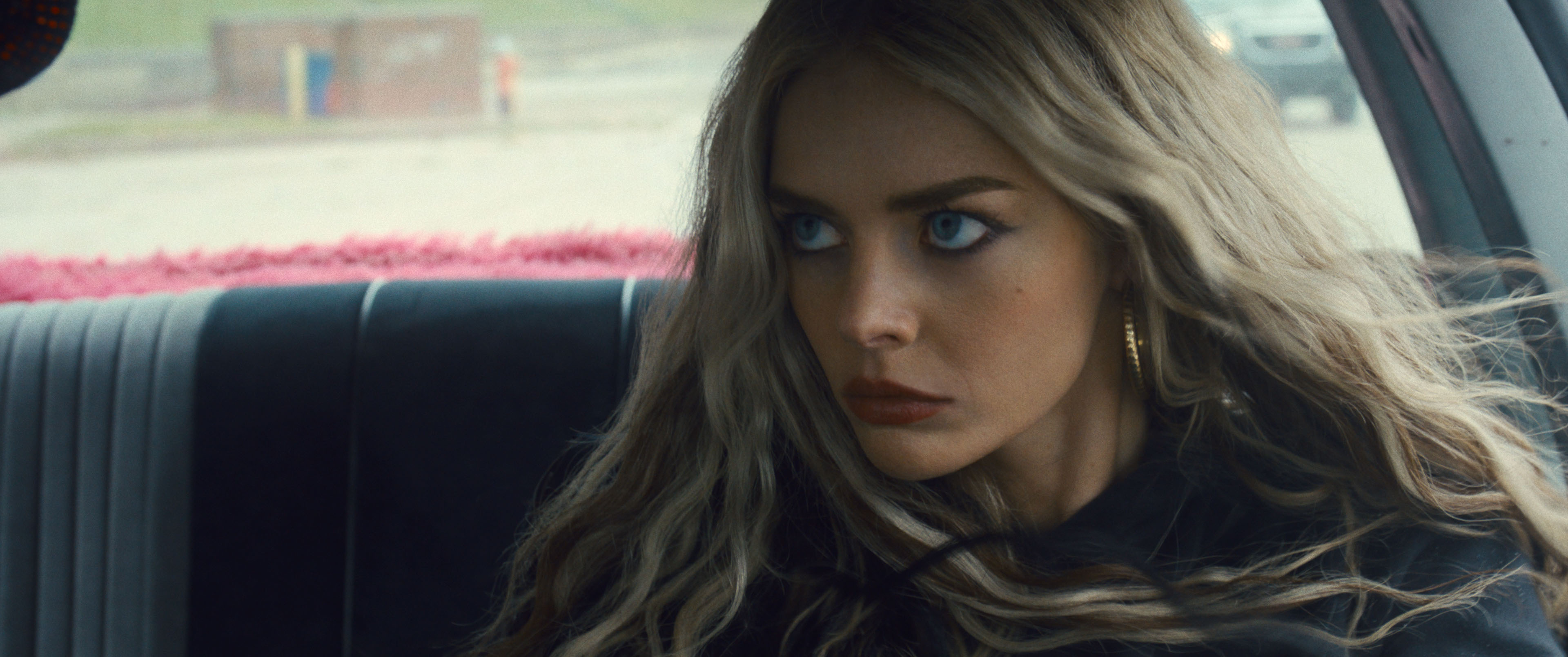
That woman is Edie Meaney (Samara Weaving, Ready or Not), and she has traded her steering wheel for a teller window, working at a Cleveland bank while attending night classes in pursuit of respectability. But respectability has a way of catching up to one’s past, and normalcy doesn’t last long in movies like this.
After surviving a bank robbery that awakens dormant instincts, Edie discovers she’s pregnant by John (Karl Glusman, Civil War), her chaos-magnet ex-boyfriend who specializes in catastrophically bad timing. When crime boss Nico (Andy Garcia, Mamma Mia! Here We Go Again) comes collecting on John’s astronomical debt, Edie finds herself behind familiar wheels for one supposedly final job: stealing a display Dodge Charger loaded with $3 million right out of a casino tournament.
What immediately strikes you about Eenie Meanie is its commitment to automotive authenticity. These aren’t the physics-defying fantasies of Fast & Furious but gravel grinding chases where every scrape and dent carries weight. The mid-film casino sequence, staged with minimal CGI and maximum debris, is a highlight. Weaving wrestles the Dodge like it’s a wild animal while hubcaps, slot machines, and egos explode around her. Cinematographer Tim Ives keeps the camera close to the action, often placing Weaving and Marshawn Lynch (a former NFL star, playing rival driver Perm Walters) squarely behind the wheel, thereby erasing doubts about whether the actors are performing their stunts.
Weaving continues her streak of making flawed material better simply by showing up. She has long been one of the most interesting performers of her generation, capable of folding wry humor, bruised vulnerability, and feral intensity into a single beat. Her Edie carries herself with the bruised swagger of someone who’s survived worse than whatever today might bring, but Weaving never lets us forget the exhaustion beneath that competence.
Glusman makes John insufferable in just the right ways, embodying a manchild whose every impulsive decision has collateral damage. Weaving’s chemistry with Glusman works because it’s frayed and familiar; he plays John as a walking bad decision, more intensity than depth, the kind of man who burns bridges just to see the fire. Garcia chews on his gangster dialogue with a wink, while Randall Park (The Residence), Jermaine Fowler (Sting), Kyanna Simone (Ma), and Steve Zahn (Your Place or Mine) all make strong impressions in their limited screen time. Lynch (80 for Brady) is surprisingly great, bringing a kind of deadpan madness to the wheel, treating car chases like combat sports. That he doesn’t get more screen time is one of the film’s few casting sins.
The supporting craft categories significantly elevates the proceedings. Ives’ cinematography captures both the sweat of precision driving and the brutal violence that punctuates Edie’s world. Bobby Krlic’s (The Haxan Cloak) pounding score underlines the anarchic glee. At the same time, production design creates a convincing portrait of blue-collar Cleveland populated by characters who’ve learned that survival requires morally flexible career choices.
Where Eenie Meanie stumbles is in its schizophrenic storytelling approach. Simmons loves both the operatic violence of pulpy crime cinema and the intimate character work of indie drama, but struggles to blend these sensibilities coherently. Scenes of genuine emotional complexity bump awkwardly against moments of cartoonish brutality.
The film peppers in storylines about Edie’s absent father, her toxic tether to John, and whether love justifies loyalty to someone who repeatedly fails you. All have potential, but the screenplay rarely develops them past surface-level gestures. More frustratingly, too many plot developments hinge on men making catastrophically poor decisions that Edie must then solve. It’s disappointing to watch such a capable character repeatedly clean up messes she didn’t create, especially when the film positions itself as an empowerment vehicle through expertise.
Simmons’s television writing background shows in the dialogue’s punchiness and the ensemble’s natural rhythms, but the narrative construction feels more episodic than cinematic. Tonal whiplash abounds as scenes of graphic violence brush up against glib comedy, only for sudden dramatic subplots to derail momentum. For a film that markets itself as a heist thrill ride, the third act undercuts tension by resolving conflicts too neatly and pulling away from the anarchic energy that gave its first half spark.
It’s not hard to see why Eenie Meanie, despite its glossy production value, bypassed theaters for a Hulu debut. The film’s inability to choose between being a gritty character study and a candy-coated action romp makes it a tough sell. Yet it’s better crafted than much of what limps into multiplexes on any given weekend, and Weaving’s performance alone is worth the detour. For Weaving, this represents another strong entry in a career that deserves bigger spotlights. For Simmons, it’s a promising debut that suggests future projects might better balance his competing instincts.
The film may sputter and backfire as it heads toward its finale, but every so often, it finds a gear that sings. For now, this is a film best described as a rest-stop diversion—momentarily exciting, a little messy, but not the kind of trip you’ll regret taking.