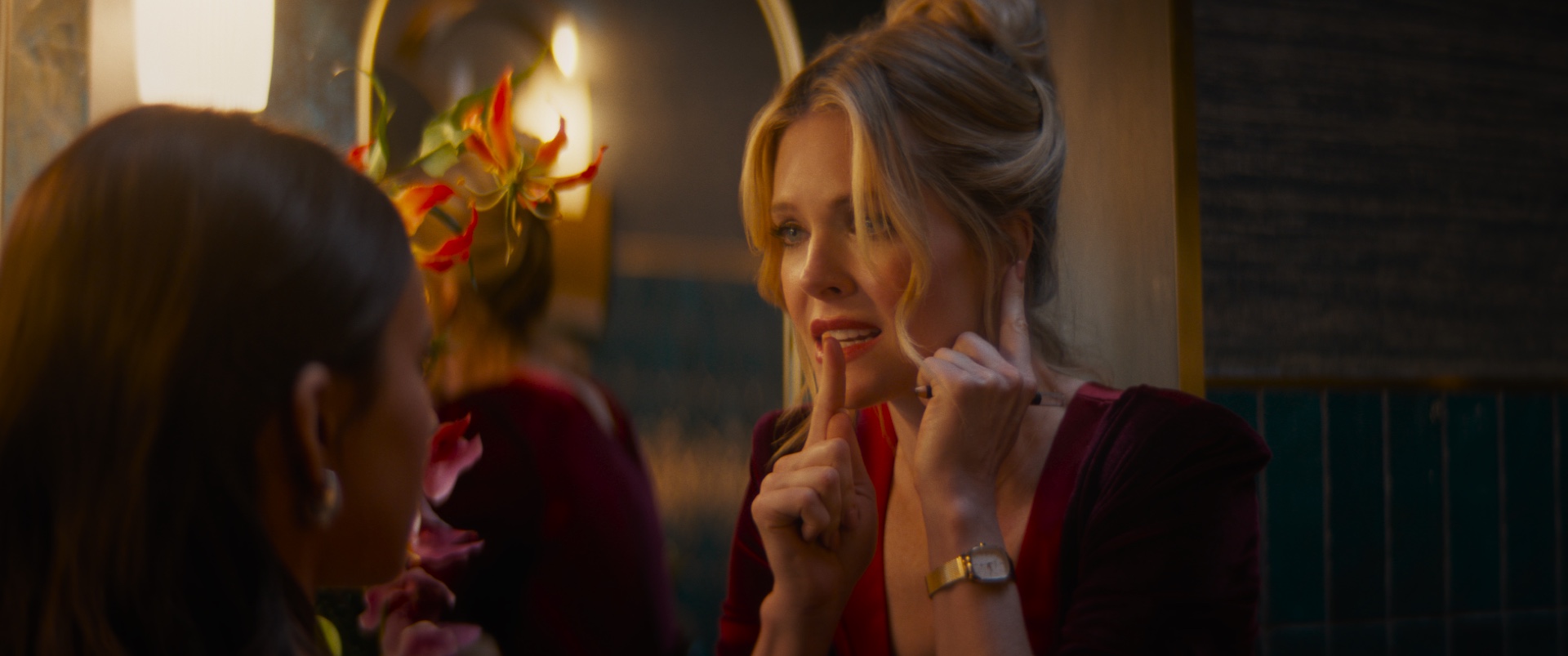
One message can change everything. This simple truth provides the foundation for Drop, a taut technological thriller that joins the proud tradition of audience-pleasing B-movies placing women in jeopardy and challenging them to fight their way out. Think Single White Female or The Hand That Rocks the Cradle transplanted into our hyper-connected digital era.
There’s a specific flavor of thriller that thrived in the late ’80s and ’90s—where a woman in peril unravels a mystery in real time, usually while being terrorized by a stranger with a landline. Drop, the latest from Blumhouse and director Christopher Landon (Happy Death Day), swaps the rotary phone for AirDrop, but the concept remains deliciously familiar: take one relatable protagonist, trap her in a high-stakes, high-rise nightmare, and watch her try to survive it in heels.
Meghann Fahy (Your Monster) plays Violet, a widowed mom on her first date in years. Her match, Henry (Brandon Sklenar, Midway), is handsome, polite, and has booked a table at a swanky restaurant 38 floors above Chicago. Things are going fine—until Violet’s phone buzzes with a message from an anonymous number. Then another. Then a threat. Someone’s watching her. Someone who knows her son and sister are at home, and who’s more than happy to hurt them if Violet doesn’t follow every twisted instruction. Oh, and she absolutely cannot tell her date.
It’s ridiculous, obviously. And that’s part of the fun. Drop understands the kind of movie it is—a single-location thriller with an escalating premise that might buckle under scrutiny but rides its momentum like a rollercoaster at night. You don’t need to believe every beat; you just need to stay buckled in.
Landon establishes a masterclass in sustained tension, trapping viewers alongside Violet in a luxurious restaurant that transforms into a psychological prison. The camera frequently frames Fahy against the Chicago skyline through floor-to-ceiling windows, visually reinforcing her isolation despite being surrounded by diners. Each new notification brings fresh dread, escalating the stakes with every buzz.
Fahy is fantastic here. Her role demands a slow, controlled unraveling, and she handles it like a pro. As Violet tries to keep up polite conversation while silently spiraling, you can see the micro-adjustments in her face, posture, and breathing. It’s the kind of tension that only works when the actor is completely dialed in—and she is.
Sklenar, meanwhile, plays the world’s most patient man. Seriously, his date is acting weirder than a David Lynch dream sequence, and he doesn’t flinch. He makes Henry sympathetic, never gullible—a neat trick given how much the film asks him to just… go with it. Together, they have believable chemistry that never tips into rom-com territory but keeps the stakes personal. The supporting cast is peppered with welcome faces, including Violett Beane (Death and Other Details) as Violet’s younger sister and babysitter of her son, and Gabrielle Ryan and Jeffrey Self as the well-meaning restaurant staff who each get a moment to shine (or squirm).
Landon—best known for genre hybrids like We Have a Ghost and Scouts Guide to the Zombie Apocalypse—keeps things tight and mostly grounded. He knows how to ratchet up suspense with clean, economic staging. The screenplay by Blumhouse regular scribe Jillian Jacobs and Non-Stop‘s Chris Roach stays just ahead of predictability, even if the third-act reveals don’t quite land.
About that ending: it’s solid, but not mind-blowing. Once the mystery texter’s identity is revealed, you realize it makes sense—sure—but it’s not particularly bold or original. The film peaks in its middle act, where you’re still guessing who’s behind it, what they want, and how far Violet will go. The final stretch leans too heavily on horror movie tropes. While it never totally derails, it loses the sharp control of its setup.
Still, for a PG-13 thriller, it hits harder than you’d expect. And while the tech angle will definitely date the movie fast—future audiences will laugh at how stressed everyone gets over an iPhone feature—it works for now. Drop uses modern anxiety (privacy, surveillance, hyper-connectivity) in an old-school format: the ticking-clock bottle episode.
Is it a rewatchable classic? Not really. But as a one-and-done night out at the movies, it gets the job done. Suspenseful, well-acted, and smart enough not to treat the audience like idiots, it’s a reminder that you don’t need a sprawling universe or a $200 million budget to create something gripping. Sometimes, all it takes is a good actress, a bad signal, and a really uncomfortable dinner.