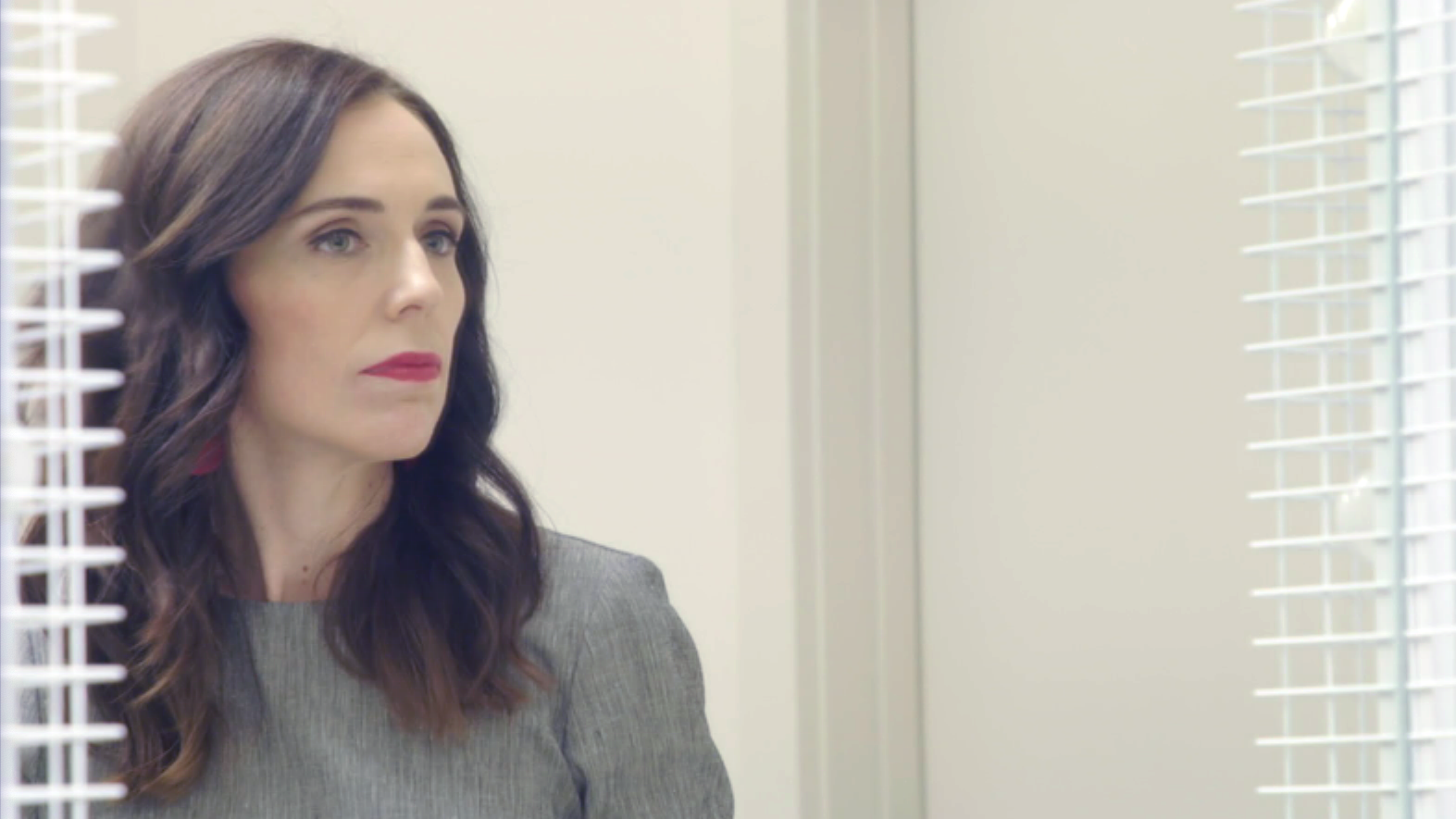
There’s a moment early in Prime Minister when Jacinda Ardern, seated casually at home, reflects that “optimism is true moral courage.” It’s the sort of line that might sound like campaign rhetoric in another context. Here, it lands differently. For five years, Ardern led New Zealand through mass violence, a global pandemic, and economic disruption, often under intense scrutiny. What this documentary makes clear is that her optimism wasn’t branding. It was a governing principle, sustained at real personal cost.
Co-directed by Michelle Walshe and Lindsay Utz, Prime Minister avoids both exposé-style sensationalism and reverent portraiture. Instead, it offers something harder to pull off: a grounded look at how leadership actually functions when empathy isn’t treated as a weakness, and when decisiveness coexists with doubt.
The film opens not with Ardern’s rise, but with her 2023 resignation. From there, it moves backward through the defining moments of her tenure. The Christchurch mosque massacre. The COVID-19 response that drew international attention. Relentless political pressure. These events are familiar, but the documentary resists packaging them as a highlight reel of crises. What emerges instead is a leader who appears strikingly ordinary amid extraordinary circumstances—tired, thoughtful, occasionally frustrated, and deeply attentive to consequences rather than appearances.
Much of the film’s power comes from its unusually intimate access, including footage recorded by Ardern’s partner (now husband), Clarke Gayford. His presence allows the camera into spaces political documentaries rarely reach: kitchens, cars, late-night conversations where decisions don’t resolve neatly. When Gayford gently presses Ardern to talk through moments of backlash or self-doubt, it becomes clear how much internal questioning never reached the public sphere. These scenes are quiet and unadorned, but they reveal the accumulated weight of public service more effectively than any dramatic confrontation could.
Walshe brings a sharp political sensibility to the material, while Utz’s editorial experience—particularly her work on Miss Americana and American Factory—keeps the narrative disciplined. Together, they focus on governance rather than mythology. Ardern is framed neither as savior nor failure, despite being cast by critics as everything from the “anti-Trump” to an overempathetic idealist. When public patience with her collaborative, evidence-driven approach wore thin, she stepped aside. The film treats that decision not as collapse, but as an acknowledgment of limits—something rarely afforded to political leaders onscreen.
The production mirrors that restraint. There are no dramatic graphics or insistent musical cues guiding the viewer’s emotions. Gayford’s handheld footage dominates the visual language, lending the film a lived-in quality that suits its subject. When pivotal moments arrive—Ardern’s address after Christchurch, pandemic briefings, private admissions about exhaustion—they resonate because the film trusts the material to carry its own weight.
Rather than framing Ardern as someone driven by ambition, the documentary repeatedly suggests the opposite. She often appears reluctant, even uncomfortable, with the role she occupies, yet unwavering in her commitment to doing what she believes is right. That tension defines much of her tenure: swift gun reform after national tragedy, science-led pandemic policies in the face of backlash, and economic decisions that carried no painless outcomes. The film doesn’t smooth over the cumulative strain of these choices or the public fatigue that eventually followed.
While rooted in New Zealand politics, the film’s relevance extends well beyond them. Watching Ardern navigate prolonged crisis with transparency and restraint feels instructive in a political climate dominated by spectacle and grievance. Her instinct to de-escalate, to explain rather than inflame, and to prioritize collective welfare over personal standing feels almost rare. The documentary never editorializes this contrast, allowing viewers to draw their own conclusions.
That restraint is part of what makes the film quietly provocative. It isn’t partisan, but it does raise an uncomfortable question: why does competence paired with empathy feel so unusual? By refusing to lecture, Prime Minister invites reflection rather than prescribing answers.
Ultimately, the film succeeds because it resists simplification. Ardern is presented as capable but uncertain, principled but exhausted, aware of both her influence and her limits. Her resignation reads not as defeat, but as self-knowledge—an act of political clarity rather than retreat.
As both a political biography and a study of leadership, Prime Minister offers lessons that outlast the moment it documents. Kindness as strength. Transparency without performance. Decision-making grounded in evidence rather than applause. In capturing these qualities without romanticizing them, the film stands as one of the year’s most thoughtful political documentaries.