The marketing campaign for 28 Years Later was genius. It started with an early trailer borrowing from Rudyard Kipling‘s haunting “Boots” to create a sense of urgency that felt like a march toward unavoidable madness. Eighteen years after 28 Weeks Later, these promo glimpses promised a worthy return to the gnarly terror that made Danny Boyle‘s fever-pitched original 28 Days Later such a global phenomenon.
In 2025, we’ve lived through our own global pandemic and this should have made a sequel feel urgently relevant, right? We’ve all seen empty streets and experienced societal fragility firsthand. Instead, what should feel like a homecoming plays like an unfortunate intervention. Boyle and original screenwriter Alex Garland (Civil War) deliver a frustratingly uneven continuation that wastes nearly two decades of fan anticipation.
A gruesome prologue brings the uninitiated up to speed and introduces a young blonde boy named Jimmy who watches in horror as rampaging ghouls decimate his family and neighbors. He escapes, but only narrowly, running into the unknown. Picking up three decades after the Rage virus first devastated civilization worldwide, survivors on a quarantined Scottish tidal island have maintained a precarious normalcy.
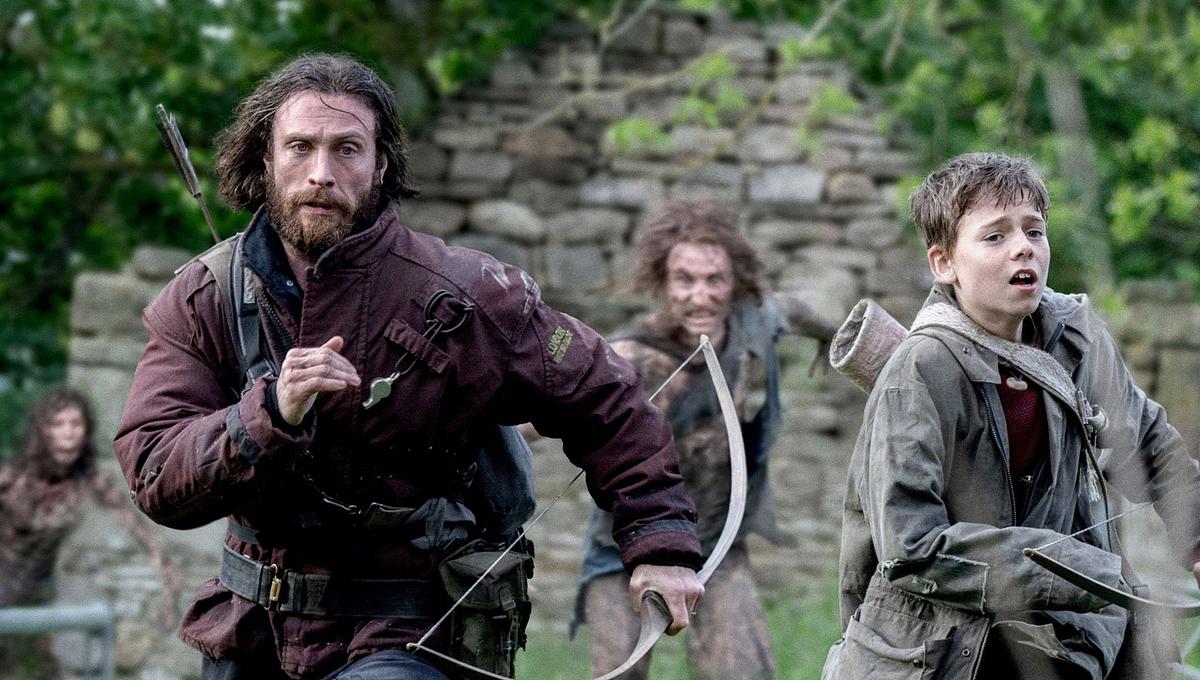
When Jamie (Aaron Taylor-Johnson, Bullet Train) and his twelve-year-old son Spike (Alfie Williams) venture beyond their sanctuary into the infected mainland so Spike may have a first kill rite of passage, they discover that both the virus and its victims have evolved in disturbing ways.
For some of the infected, the virus has amplified their chemical make-up, working like steroids in their system and making them brutal giants who aren’t as easy to take down as your run-of-the-mill Rage-r. These “alphas” are smarter too, plotting their attack and letting underlings be sacrificed like pawns as part of a larger endgame. Jamie and Spike encounter one while away from their island and it won’t be the last one we’ll see over 115 minutes.
When Spike learns that an exiled doctor (Ralph Fiennes, The Grand Budapest Hotel) is still living in the nearby vicinity, he is determined to find answers to what may be ailing his mother Isla (Jodie Comer, The Last Duel). She has been suffering from a mysterious illness that may or may not be connected to the original outbreak.
Boyle’s return behind the camera should have been cause for celebration, but his hyperkinetic approach proves catastrophic for horror storytelling. Working again with cinematographer Anthony Dod Mantle, his Oscar-winning collaborator from Slumdog Millionaire, Boyle unleashes every visual trick in his arsenal: frenzied editing, chaotic camera work, and POV shots that leave viewers more dizzy than dread-filled. The decision to shoot primarily on iPhones, while technically impressive, becomes a gimmick that is half innovation and half distraction.
The infected have “evolved” into completely nude, rubber-limbed, cave-dwelling creatures who charge directly at the cameras with tongues extended and primal screams. When these “ragers” attack, Mantle’s multi-angle iPhone shots and editor Jon Todd‘s frenetic stuttering cutting chop the terror into hyperactive, indecipherable fragments. Your brain stops managing fear levels and starts processing confusion—a fatal flaw for horror. The film delivers heinous gore, including spines yanked out still attached to the head, Predator-style, but the scare factor is diminished by editing that rarely allows moments to breathe before jump-cutting away.
Boyle’s talent for finding interesting actors hasn’t gone away but this talented cast feels underutilized in roles that feel slack and blunted. Comer, usually a powerhouse, plays Isla as either hazed and confused or explosively aggressive, with these episodes of near-heroism never fully explained. There’s a kernel of complexity Garland is hinting at with an unwell woman struggling to maintain humanity in a world gone feral, but the script doesn’t develop Isla beyond bullet points. Taylor-Johnson fares slightly better as Jamie, though his emotional range is hard to measure because of limited screentime. He’s dominant in the first half and largely offscreen for the rest. Williams brings earnestness to Spike that occasionally tips into overly sugary territory, particularly during a climactic breakthrough that lands awkwardly rather than emotionally.
Fiennes appears midway through as Dr. Ian Kelson, a banished physician who covers himself in iodine (to mask his smell) and has constructed fascinating sculptures from, uh, discarded materials. Best of all is that Fiennes seems to know precisely what movie he’s in, grounding the lone wolf madness he’s kept hidden under wraps with a theatrical flair. His scenes, shot against Carson McColl and Gareth Pugh‘s stunning production design, offer glimpses of the more thoughtful horror film hiding beneath Boyle’s increasingly frantic direction and Garland’s screenplay that ping pongs from idea to idea without ever reaching a comfortable place to land.
The film’s biggest missed opportunity lies in its post-pandemic context. We’ve all experienced isolation, social breakdown, and questions about who deserves to survive. This sequel could have explored those themes with the wisdom of lived experience, but instead offers familiar beats executed with diminishing returns. There’s social commentary about survival ethics and generational trauma, but Boyle and Garland never dig deep into any of these ideas, as if the movie wants to say something important but can’t decide what or how.
The bewildering finale abandons narrative satisfaction for franchise setup. Jack O’Connell makes a last-minute appearance that feels like the beginning of a better movie shoehorned into this one’s ending. Instead of closing emotional loops or providing satisfying character arcs, the film takes a hard turn into sequel-bait mode. It was meant to be a pleasant surprise but news that 28 Years Later: The Bone Temple was in the can (directed by Nia DaCosta, Candyman) and coming in early 2026 landed with less impact due to this strange coda.
Nearly seventeen years of development hell shows in the finished product, which feels both overstuffed with ideas and strangely hollow emotionally. 28 Years Later isn’t brainless—it’s something perhaps worse: nebulous. After decades of waiting, this return to Boyle and Garland’s infected Britain feels like a missed opportunity wrapped in competent but misguided filmmaking. The world has changed since 28 Weeks Later, and this sequel had the chance to explore those changes meaningfully. Instead, it offers a grimly stylized, emotionally distant misfire that mistakes velocity for genuine terror.