Synopsis: The host of a popular paranormal podcast becomes haunted by terrifying recordings mysteriously sent her way
Stars: Nina Kiri, Adam DiMarco, Michèle Duquet, Keana Lyn Bastidas, Jeff Yung, Sarah Beaudin
Director: Ian Tuason
Rated: R
Running Length: 93 minutes
Movie Review in Brief: undertone is a slow-burn auditory horror film that earns its dread the hard way — through sound design, a committed lead performance, and a premise that understands exactly what kind of fear it’s after. Nina Kiri is a real find. It doesn’t fully cross the finish line, but it gets close enough to matter.
Review:
There is a specific kind of dread that lives in headphones. Not the dread of a loud noise or a sudden flash — the dread of something just audible enough to make you question whether you heard it at all. That is the dread that undertone is built on, and writer-director Ian Tuason understands it in his bones. If you’re willing to meet Tuason’s film on its own terms, any review of undertone is going to be one horror fans will want to listen to carefully.
A Dying Mother, a Paranormal Podcast, and a House That Listens Back
Evy Babic (Nina Kiri, Fingernails) is caregiving for her dying mother in the childhood home. It is a thankless, isolating existence. The only thing keeping the silence from swallowing her whole is the paranormal podcast she co-hosts with her friend Justin (Adam DiMarco, Overcompensating). The show is The Undertone, and it’s where Evy plays the resident skeptic to his open-minded believer.
When Justin receives an anonymous email containing ten audio files, the two play them on air. The recordings follow a couple named Mike (Jeff Yung, The Shrouds) and his pregnant partner Jessa (Keana Lyn Bastidas) as they document strange sounds in their home at night — nursery rhymes that do not quite sit right, silences that feel occupied, voices that seem to be saying something just beyond what you can make out.
As the files grow more disturbing, the distance between what Evy is hearing through her headphones and what is happening in the house around her begins to collapse. Evy and her mother are the only two characters shown on screen for the entire film. Everyone else — Justin, the callers, the doctors, Evy’s absent boyfriend — exists only as a voice in her ear. That is a formal choice that takes the film’s isolation from a feeling into a structure.
Kiri Carries the Weight
There is a particular skill required to play one of these roles — a character who spends most of a film reacting to people we cannot see, building chemistry with voices that the audience only half hears. Done badly, it reads as performance in a vacuum. Done well, you forget the scaffolding entirely.
Kiri does it well. She plays Evy as someone whose skepticism is less a personality trait than a coping mechanism — a way of keeping the world at a manageable distance while her mother slowly dies in the room upstairs. When the distance starts to close, when the horror in the audio files starts rhyming with the horror in her house, Kiri does not tip into hysteria. She just gets quieter. That is exactly the right call, and it makes the film’s final act hit harder than it might have with a more theatrical performance.
Michèle Duquet plays Mama in a near-comatose state for (most of) the entire film, and it is worth pausing to acknowledge how much discipline is required for that assignment. The physical commitment she brings to breath control, to the way a face changes when it is slowly inching toward death, adds a layer of creepiness to scenes that require her to do almost nothing. The waiting for Mama to do something — anything — becomes one of the film’s more reliable engines of tension.
DiMarco as Justin is solid, though there is a faint seam in some of the film’s more emotionally urgent exchanges. It’s easy to see why. This is an updated theatrical version of undertone, reconfigured after A24 acquired it — the original cut that premiered at the Fantasia Film Festival back in June featured Kris Holden-Ried in the role. Kiri’s work was not redone for the reshoots, which makes complete sense, and DiMarco does a professional job of syncing up with rhythms he was not originally part of. Most of the time it is invisible. Occasionally, in a moment that needs maximum charge, something feels slightly off-frequency.
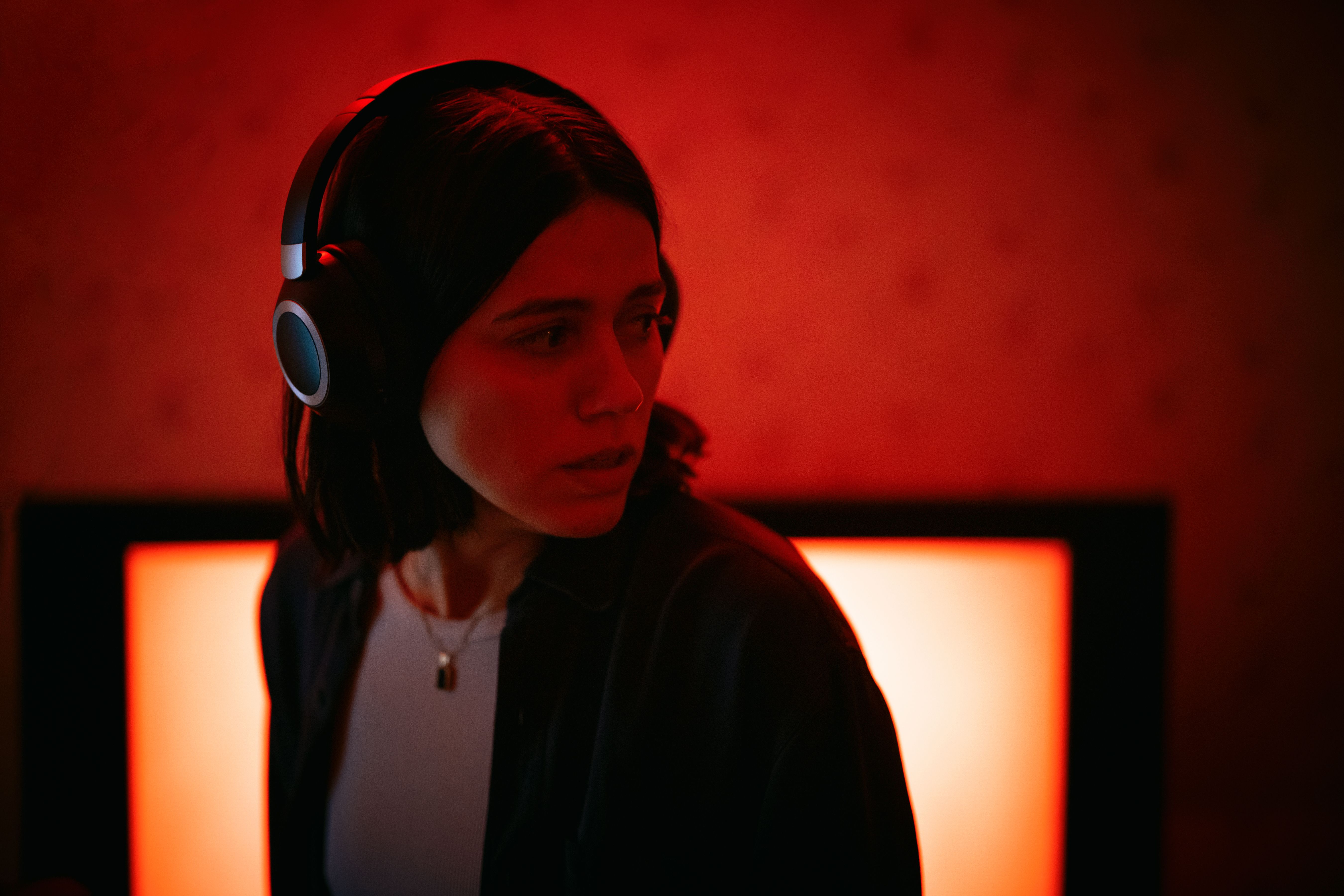
The Sound Does the Lifting
The sound team deserves special recognition here, because undertone is essentially a sound design film wearing a horror film’s clothes. Tuason wrote audio direction directly into the shooting script — where things come from, which direction they travel, how close they feel — and the finished mix rewards a good theater system in kind. The Dolby Atmos expansion takes what is already an unusually spatial listening experience and makes it genuinely multidimensional. Take my advice, see this in a theater with the best-equipped sound system available — it’s worth it.
The film opens with a tea kettle that could take a year off your life in the right room. But what Tuason is actually going for is something more patient than that — deep, low-register sounds that engage the body before the brain, audio that seems to ask questions it does not quite answer. There is a phenomenon called audio apophenia, the tendency to hear hidden meanings in reversed or distorted sounds, and the film deploys it shrewdly. The scarier passages of undertone work because you, the listener, are the one creating the horror. The film just sets the conditions.
Sound mixer Dane Kelly‘s audio files — recorded ahead of production so Kiri could react to them honestly on camera for the first time — are the film’s most effective ingredient. Composer Shanika Lewis-Waddell brings a score that moves between lush and dissonant with real intelligence, and Graham Beasley‘s cinematography, shot on an Alexa Mini LF, finds the claustrophobic angles that a small two-story house offers to a patient camera. Production designer Mercedes Coyle transforms Tuason’s actual childhood home — the house where he nursed both parents through end-of-life care — into a space that feels simultaneously familiar and wrong. The iconography creeps up on you.
Patience Required
Here is where undertone runs into a problem that is not entirely of its own making. The horror market as of late has not shown a lot of tolerance for films that take their time. (See 2025’s Presence as an example.) The scares have to come fast and furious or else a certain contingent is already on their phones, looking for the next thing to doom-scroll. undertone asks for a meaningful amount of patience before it delivers, and the slow-burn setup is intentional. For a certain kind of viewer, it’s also deeply effective. For the phone-checkers, the film’s refusal to accelerate is going to register as a failure to execute.
I am firmly in the first camp. But I understand the second. There is a stretch in the second act where the rhythms flatten slightly and the film’s conceptual tightness loosens just enough to let doubt in. Tuason has a clear vision of where he is going — the finale brings genuine invention to its visual tricks and pays off the sound design’s long setup — but the journey between setup and payoff has a few dead spots that a tighter edit might have closed.
The real ceiling on undertone is the gap between what it promises and what it fully delivers. The premise is sharp, the lead performance is excellent, and the sound work is some of the best craft in a horror film this year. It is just a film that is slightly better as a concept than as an experience — and even then, only by a margin.
The Bigger Picture
Produced for $500,000 and sold to A24 in a seven-figure deal that marked the largest acquisition of a Canadian film in history, undertone is a genuine micro-budget success story. Tuason is already attached to write and direct the next Paranormal Activity film, which tracks — his instincts for audio-based dread and the specific claustrophobia of a single location are exactly what that franchise needs.
He drew on his own experience caring for both parents through terminal illness to write Evy’s story, and that specificity shows. undertone is not a film about grief as abstraction. It is a film about what it feels like to be trapped inside someone else’s dying, with nothing to do but wait and listen. The horror that creeps in around the edges of that is almost redundant — the premise already contains everything it needs.
If you have a taste for the strand of micro-horror that treats fear as a texture rather than a delivery mechanism — films where the terror lives in what the camera refuses to show and what the sound refuses to explain — undertone is in that tradition and does it with real skill. So will anyone who has spent time in a house where someone is dying and knows what silence sounds like when it is full of something you cannot name. undertone is worth hearing out.
Looking for something? Search for it here! Try an actor, movie, director, genre, or keyword!
