Synopsis: After being laid off, a paralegal begins babysitting his psychiatrist’s granddaughters, and falls for their mother.
Stars: Amanda Peet, Matthew Shear, Alessandro Nivola, Judd Hirsch, Bob Balaban, Andrea Martin, Zosia Mamet, Jessica Harper, Holland Taylor, Sheng Wang
Director: Matthew Shear
Rated: R
Running Length: 91 minutes
Movie Review in Brief: Amanda Peet gives the best performance of her career — and won the SXSW Special Jury Award to prove it — in a sharp, funny, and surprisingly honest New York romantic dramedy. Matthew Shear’s debut is the kind of movie that knows what it is and nails it.
Review:
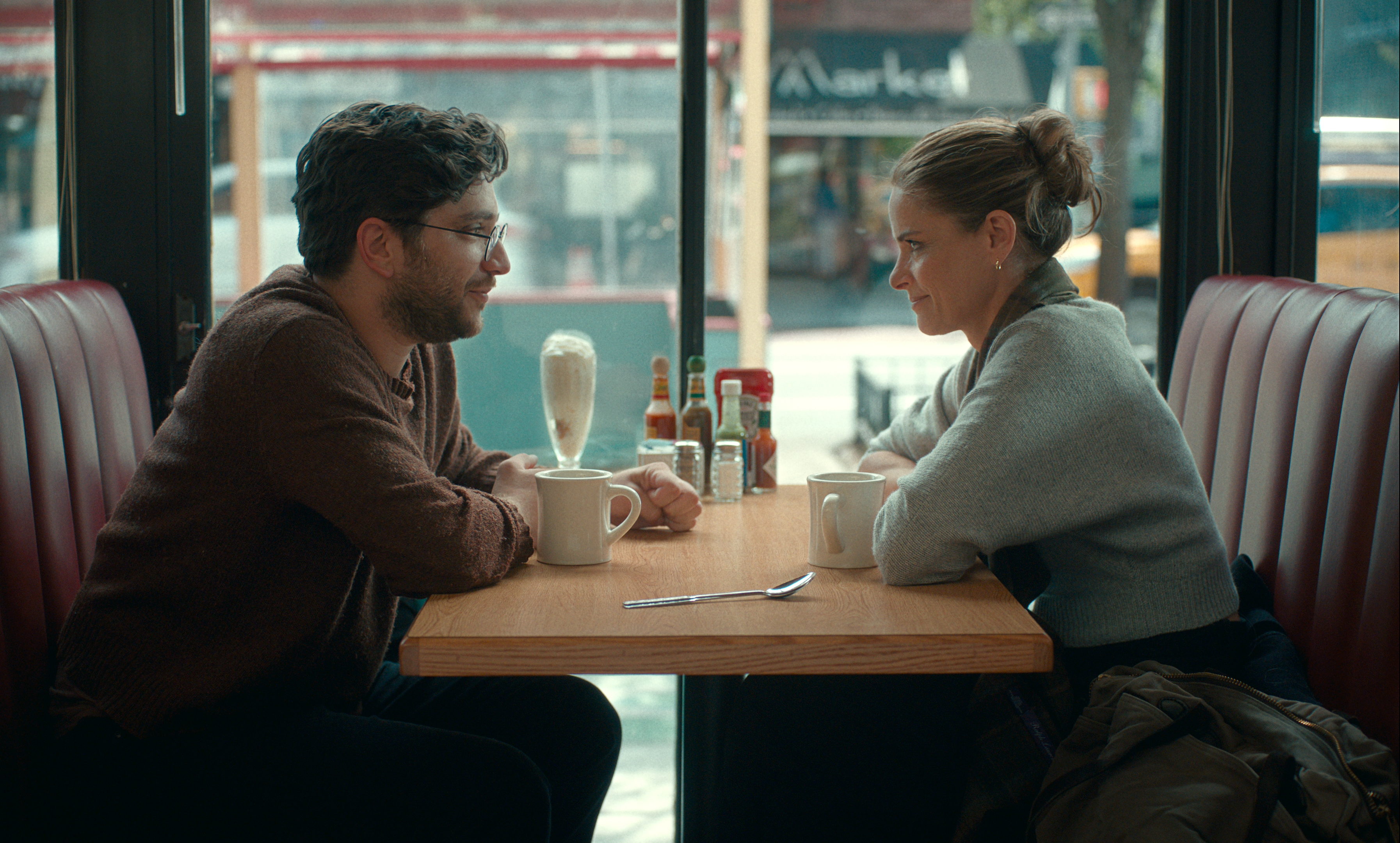
There is a scene in Fantasy Life where Amanda Peet sits across from someone she should not be falling for, and she does absolutely nothing. No actorly signaling. No meaningful glance to tip you off. She just exists in the moment, and somehow that stillness tells you everything. It is one of the best things I’ve seen from her, and I say that as someone who already thought she was pretty legit. And what writer-director-star Matthew Shear has built around her is sneakier and sweeter than it first lets on.
The Manny, the Actress, and the Summer That Changes Everything:
After losing his paralegal job, Sam Stein (Shear, Mistress America) has a panic attack and stumbles sideways into a summer gig babysitting his psychiatrist’s three granddaughters. The girls’ mother, Dianne (Amanda Peet, The Way Way Back), is an actress whose career has quietly stalled. When Sam meets her, she’s a woman in a marriage to a touring rock bassist named David (Alessandro Nivola, The Brutalist) that no longer fits the way it once did.
When David heads abroad on tour, Sam joins the family on Martha’s Vineyard for the summer. What follows is one of those films where nothing dramatic technically happens and yet everything changes. It is a story about two people in the wrong place at the right time, and the remarkable thing is that Shear never lets it take the easy exit.
The autobiographical roots run deep here. Shear drew on his own years working as a “manny” for Manhattan families while navigating depression and anxiety — and that experienced specificity is exactly what keeps the film from feeling like a pretentious genre exercise. Sam and Dianne both carry chronic mood disorders, and the film finds its drama not in crisis but in the everyday, slightly absurd comedy of people managing themselves as best they can while also managing their feelings for each other.
A Supporting Cast That Does Everything Right
Shear has assembled one of the best supporting ensembles a small film has had in a while. Judd Hirsch (The Fabelmans) and Andrea Martin as Nivola’s parents (Hirsch is Sam’s therapist). Bob Balaban and Jessica Harper (Nightbitch) as Peet’s. Holland Taylor (Quiz Lady) as Peet’s psychiatrist with an unfortunate front-row seat to her patient’s summer complications.
Martin (My Big Fat Greek Wedding 2), as reliably as ever, is a near-perfect comedy instrument. But it is Balaban who draws the biggest laughs. Peet’s father has taken a deep and specific dislike to Sam, and the way Balaban (80 for Brady) plays it is less an aristocratic dismissal and more open hostility. Every scene he is in has an extra charge and is hugely funny. Shear also gets easy mileage from Zosia Mamet and Sheng Wang in smaller roles — this is a film where even the margins are inhabited by people who feel genuinely present.
The script, too, has a real snap to it. Shear finds a joke in two words where another writer would need six lines and a reaction shot. His work here is in the tradition of the best New York talky comedies — there is a clear Baumbach influence (In addition to Mistress America, Shear has also appeared The Meyerowitz Stories), but Fantasy Life is not an imitation. It has its own rhythm, its own specific world.
Peet, At Her Best
It is not a stretch to say this is the best work Amanda Peet has ever done. The 2025 SXSW jury agreed — she took home a Special Jury Award for her performance alongside the film’s Audience Award win. She plays Dianne as a woman who has gotten very good at managing her own disappointment. The acting career went silent when she wasn’t looking. The marriage is not bad, exactly, but it is fraying in the specific way things splinter when two people stop reaching toward each other.
Peet does not play any of this as complaint. The depth is all below the surface, and she lets Shear’s writing take her there without overexplaining a single beat. Critics like to call this kind of acting, especially from women, ‘brave,’ but it’s truly a demonstration of an actor doing their homework and getting to know their character, and being vulnerable enough to show those findings in front of the camera.
What the film gets most right is that it does not take the easy shortcut of making David a creep so that Dianne gets permission to want something else. Nivola plays him as a complicated person in a complicated marriage, which means the conscious choice Peet’s character has to make carries real moral weight. That is intelligent writing for smart performers, and both of them honor it.
The question buried in the title is one worth sitting with. Fantasy Life. Whose? Sam’s, hoping for a future that keeps stretching just beyond reach? Dianne’s, wanting the career back alongside a family she loves? Or is the fantasy the simpler, more unsettling one — that “normal” is a destination you can actually arrive at?
Craft That Stays Out of the Way
Cinematographer Conor Murphy shoots this as a New York movie even when the characters leave it. The Martha’s Vineyard stretch retains the specific warmth of a city summer transplanted to the shore. Production designer Katie Fleming and set decorator Lauren Nester give the interiors a sense of accumulated life.
Christopher Bear‘s score slides alongside Peet and Shear as each of them battles something the other cannot fix. Costume designer Samantha Rattner does understated but precise work — Dianne’s wardrobe in particular tells a story of someone who used to dress for an audience she no longer has. Editor Ian Blume keeps everything at a crisp 91 minutes that never drags.
Fantasy Land, in Reality
A dinner scene near the end does the work a lot of films throw at this structural moment — secrets surface, tensions crack — and it does not dissolve into the expected chaos. The film holds its nerve. If I am being honest, the only real knock is that Fantasy Life occasionally feels slightly too controlled for what its characters are going through. A few more rough edges might have made the ending hit even harder.
Fantasy Life earned its festival accolades the honest way — by being the kind of film that sneaks up on you and sticks around. It is one of those smaller movies that knows exactly what it wants to be and, for the most part, becomes it. Peet is the reason to go. Shear built something worth going back to.
Looking for something? Search for it here! Try an actor, movie, director, genre, or keyword!
