Synopsis: Six guests are anonymously invited to a strange mansion for dinner, but after their host is killed, they must cooperate with the staff to identify the murderer as the bodies pile up.
Stars: Eileen Brennan, Tim Curry, Madeline Kahn, Christopher Lloyd, Michael McKean, Martin Mull, Lesley Ann Warren, Colleen Camp, Lee Ving
Director: Jonathan Lynn
Rated: PG
Running Length: 97 minutes
Movie Review in Brief: Jonathan Lynn’s Clue is a masterclass in ensemble comedy: seven brilliant performers, a script sharp enough to support three endings, and a pace so relentless you’ll miss jokes on the first viewing. Forty years later, nobody has played this game better.
Review:
For many years, there was a Christmas Eve tradition in my house. My parents would set me up with our VHS copy of Clue while the adults finished dinner and conversation, and by the time the tape rewound, everyone was ready to open presents. I could have watched anything. I watched Clue. Every single year. I’m not sure when it stopped being a holiday tradition and became a personality trait, but here we are. I can quote this movie down to the facial tics and nasal sniffs.
And I watched it again recently at a 40th anniversary screening hosted by the ageless Lesley Ann Warren, and all 97 minutes flew by like they always do, the audience around me laughing in all the same places I’ve been laughing since I was a kid in front of that television.
If you’re reading this Clue review because you’ve never seen it: I envy you. You’re about to have a great time. If you’re reading it because you love it as much as I do: pull up a chair. We have things to discuss.
From Cluedo to Cult Classic
The board game Cluedo was invented in England by Anthony Pratt in 1944 and licensed to Parker Brothers for the American market as Clue in 1949. Turning it into a movie was the kind of idea that sounds like a boardroom punchline until the right people get involved.
Producer Debra Hill (Halloween) acquired the rights as early as 1981, with celebrated writer P.D. James reportedly attached to write a screenplay with multiple endings. John Landis developed the multi-ending concept further and was set to direct, claiming he invited Tom Stoppard, Stephen Sondheim, and Anthony Perkins (the latter two had collaborated on another whoduit, 1973″s The Last of Sheila) to write the script at various points. The screenplay was ultimately finished by Jonathan Lynn, a British playwright and screenwriter turned director (Nuns on the Run and My Cousin Vinny) who was then invited to direct as well.
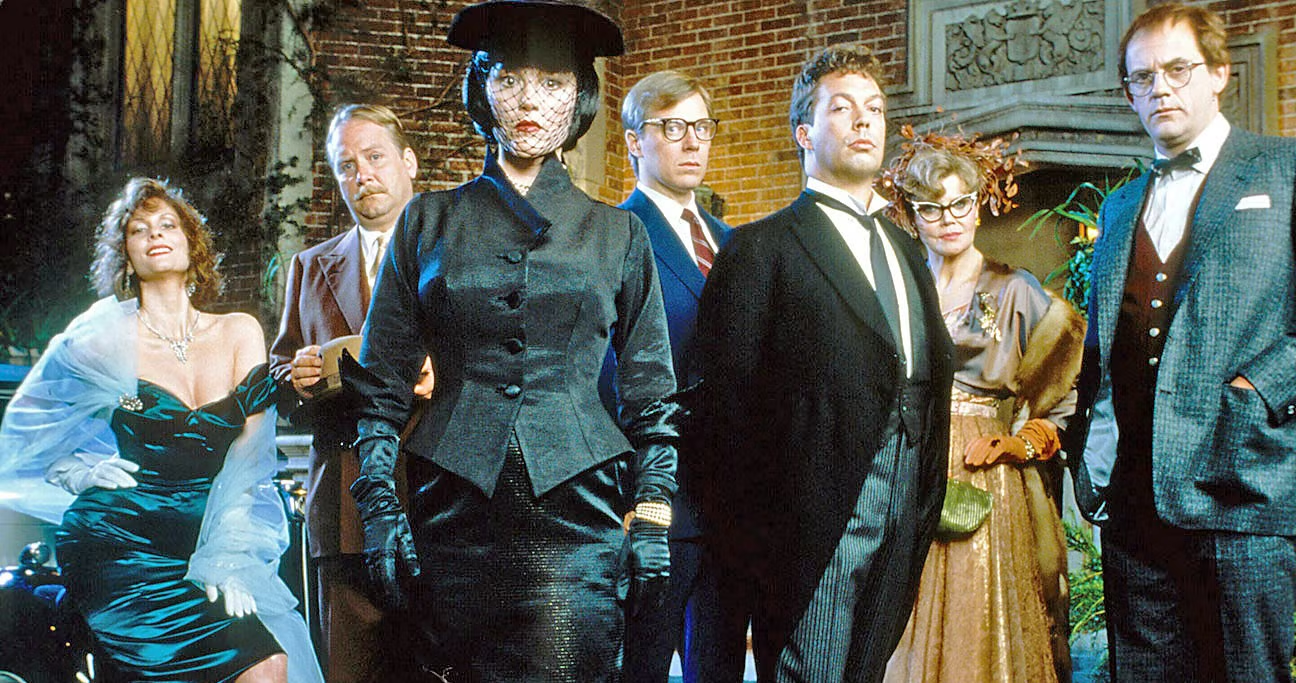
The result is a film set in 1954 New England, where six strangers, each given a pseudonym from the board game, are invited to a secluded mansion for dinner. There’s Colonel Mustard (Martin Mull, Cutting Class), Mrs. White (Madeline Kahn), Mrs. Peacock (Eileen Brennan, Murder by Death), Mr. Green (Michael McKean, Radioland Murders), Professor Plum (Christopher Lloyd, Nobody), and Miss Scarlet (Lesley Ann Warren, Color of Night). Their host, Mr. Boddy (Lee Ving, frontman of hardcore punk band Fear), has been blackmailing all of them. The butler, Wadsworth (Tim Curry, The Rocky Horror Picture Show), has a plan to expose him. The lights go out. A body hits the floor. And then things get complicated.
Spoiler warning: This piece discusses all three endings of Clue. The film is forty years old and the endings are integral to understanding its brilliance, so here we go.
An Ensemble That Fires on Every Cylinder
The entire cast received the same salary and billing, and that equity shows in every frame. Nobody is jockeying to be the lead. This is a company of stars who understand that the machine works only if every part moves in sync, and the result is one of the most seamless ensemble comedies ever put on screen.
The women, I’ll say it plainly, are slightly stronger than the men, and they accumulate more laughs per capita. Brennan gets more comedy out of her misbehaving headwear than Lloyd gets from 75% of his scenes, though Lloyd’s irascible Professor Plum catches fire in the final act. Kahn is, of course, unforgettable. Her “flames” monologue, famously improvised, is one of the great comic moments in movie history, and she lets it build with the kind of precision that only looks spontaneous when you’re this good.
Warren is having the time of her life as the good-time-gal madam Miss Scarlet, and the fact that she was originally cast as Mrs. White before Carrie Fisher dropped out of Miss Scarlet (to enter treatment) is one of those happy accidents that reshapes a film for the better. Colleen Camp’s (The Deliverance) Yvette is a delight, playing the French maid with a wink and physicality that gives the film a whole additional energy.
Mull’s deadpan delivery is surgical and seriously funny. McKean plays the straight-laced worrier wound so tight you expect him to snap, and when the final ending reveals exactly why Green has been so nervous, it’s the perfect payoff. And then there’s Curry, so perfectly cast as the butler who “butles” but always knows more than he’s letting on. Curry is the engine of the film’s final act, recreating the entire evening at breakneck speed, and he makes it look effortless. The visitors round out the night beautifully: a confused motorist, a suspicious cop, and a singing telegram girl played by Jane Wiedlin of the Go-Go’s, in another of the film’s most quoted moments, who doesn’t even get a good tip.
Three Endings and the Gamble That Backfired
Here’s where I think Clue stumbled during its initial run. Paramount released the film to theaters with one of three possible endings, and the audience knew going in whether they were buying a ticket for Ending A, B, or C. The gamble was that the film would be strong enough to bring people back multiple times. It wasn’t a bad bet in theory. In practice, once was enough for most viewers, including critics. Janet Maslin of The New York Times said the film dragged after its opening. Gene Siskel called the multiple endings a “gimmick.” Roger Ebert gave it two stars and said the cast spent most of their time looking frustrated. (Proof positive that critics have their off days or are perhaps not the target audience for each and every film they see.)
The film grossed $14.6 million against a $15 million budget. Not a disaster, but not a hit. And then home video happened. When Clue arrived on VHS, all three endings were edited together sequentially, and that’s how many of us saw it for the first time. The Blu-ray offered the option to watch one ending (randomly chosen), all three, or the full home entertainment cut. And I actually prefer all three together, because seeing how easily the script pivots among suspects demonstrates the strength of Lynn’s writing up to the reset button. The puzzle works in every configuration. That’s not a gimmick. That’s craft.
A fourth ending was filmed but never officially released. Descriptions exist in the now rare and ultra pricey novelization and the Clue Movie Storybook. Fan edits have surfaced online, but it’s never appeared on any official release. Maybe one day.
Every Sting, Every Crash, Every Locked Door
A friend pointed out to me on my last viewing just how punctual John Morris’s score is, and now I can’t unhear it. Morris is right on top of every mood shift, every laugh line, every moment the floor drops out. Stings land with toothy smiles and flinches. Horns blare when danger rounds a corner. The score feels like it’s being composed on the spot, springing directly from the action onscreen, and that’s the kind of invisible work that elevates a good comedy into something you want to rewatch forever.
The production design deserves its own applause. The entire mansion was built on soundstages 17 and 18 at Paramount, and according to Warren, Lynn wanted it to feel so real that when the cast ran up the stairs, they actually had to haul up that grand staircase. Authentic 18th and 19th century furnishings were rented from private collectors, including pieces from the estate of Theodore Roosevelt.
The exterior shots of Hill House was a mansion in South Pasadena. It was enhanced with matte paintings by Syd Dutton in consultation with the legendary Albert Whitlock, making the house appear much larger than it was. That mansion was destroyed by fire in 2005, though it has since been rebuilt with the original front gate and retaining wall still standing.
Warren, speaking highly of the creative process of filming Clue, told us that Lynn screened His Girl Friday for the cast as inspiration for the rapid-fire delivery, and you can feel it. The dialogue overlaps, interrupts, and accelerates without ever losing clarity. Victor Kemper’s cinematography keeps the frame packed without becoming cluttered, and Michael Kaplan’s costume design nails the 1950s period while giving each character a distinct visual personality. This is a visually and sonically precise film, a board game experience that Lynn understood down to its last playing piece.
Forty Years Later, Still the Best Game in Town
Eileen Brennan. Martin Mull. Madeline Kahn. Bill Henderson. Kellye Nakahara. Howard Hesseman. All gone now. It gets harder with each reunion event, each anniversary screening, to see how many chairs sit empty around a table that once held so much talent and laughter. But that’s what films do. They hold people in place. Every time I press play, Brennan’s hat is still misbehaving. Kahn is still catching fire. Mull is still reeling in shock over a chandelier falling and nearly killing him.
A remake has been in various stages of development for years. Gore Verbinski was attached in 2009. Ryan Reynolds optioned it in 2018. Jason Bateman circled it. James Bobin was announced as director. Most recently, TriStar Pictures and Sony are developing a new adaptation with screenwriter Shay Hatten and, gulp, Josh Gad. I hope whoever makes it thinks carefully about how necessary it is when a perfect game of Clue has already been played. To even consider casting now would be futile but Warren thinks Scarlett Johansson would make a great Miss Scarlet.
Clue is a rainy day movie that can help cure a cold, change your attitude, or keep you busy until it’s time to open presents. It’s a film that deflated early into its run in 1985 but has been winning ever since. Every time I’ve seen it in a theater, it’s been packed and the experience is like a quadruple-strength booster of Vitamin D: pure joy, pure energy, pure proof that the best comedies don’t age, they just find bigger audiences.
Communism was just a red herring. But this movie? This movie is the real thing.
Looking for something? Search for it here! Try an actor, movie, director, genre, or keyword!