Synopsis: Christ’s last week on Earth is told by a group of travelers who arrive in modern-day Jerusalem on a tour bus.
Stars: Ted Neeley, Carl Anderson, Yvonne Elliman, Barry Dennen
Director: Norman Jewison
Rated: G
Running Length: 106 minutes
Movie Review in Brief: Norman Jewison’s 1973 Jesus Christ Superstar remains a blazing, emotionally raw masterpiece powered by three volcanic performances from Ted Neeley, Carl Anderson, and Yvonne Elliman. Fifty years on, the fire still burns bright.
Review:
I was twelve years old, sitting in a theater with my parents, watching a touring production of Jesus Christ Superstar starring Ted Neeley as Jesus and Carl Anderson as Judas. It was 1992, nearly two decades after they’d committed those performances to film, and both men sang like they had something left to prove. I didn’t fully understand everything I was watching that night. I didn’t need to. What I understood was that voices could do things I’d never felt before, that a story I thought I already knew could rearrange itself inside me and land somewhere completely new. That production cracked open a door. I walked through it and never came back.
I became a stage kid after that. A Broadway subscriber. A musical theater nerd who knew every lyric, every note, every crescendo in this score before I could drive. I saw Neeley and Anderson together again, and separately, and with other performers stepping into those roles. None of them ever matched what those two did when they shared a stage. Anderson passed away in 2004. Neeley, now in his eighties, still tours with a farewell show built around a brand new print of the film. Some things, apparently, you just don’t retire from.
So understand: when I tell you that Norman Jewison’s 1973 film version of Jesus Christ Superstar is a masterpiece, I’m not tossing that word around casually. This is a movie I struggled with for years before I had the tools to meet it where it lives. Watching it again recently, I was staggered by what Jewison and co-writer Melvyn Bragg pulled off. Shockingly, I also realized I’d never written a review of it so this is the definitive Jesus Christ Superstar movie review I’ve been building toward since that fateful day in the early ’90s.
Note: This piece discusses the full plot of Jesus Christ Superstar, which is based on the Biblical Passion narrative.
The Bus Stops Here
A bus rolls up to the Negev Desert. Out pour a group of young performers, hauling crosses and costumes and the unmistakable energy of people about to do something dangerous with something sacred. They dress. They stretch. They…become. And then Andrew Lloyd Webber and Tim Rice’s rock opera begins, and for the next 106 minutes, these sweaty, sun-baked bodies tell the story of the last seven days of Jesus Christ entirely through song.
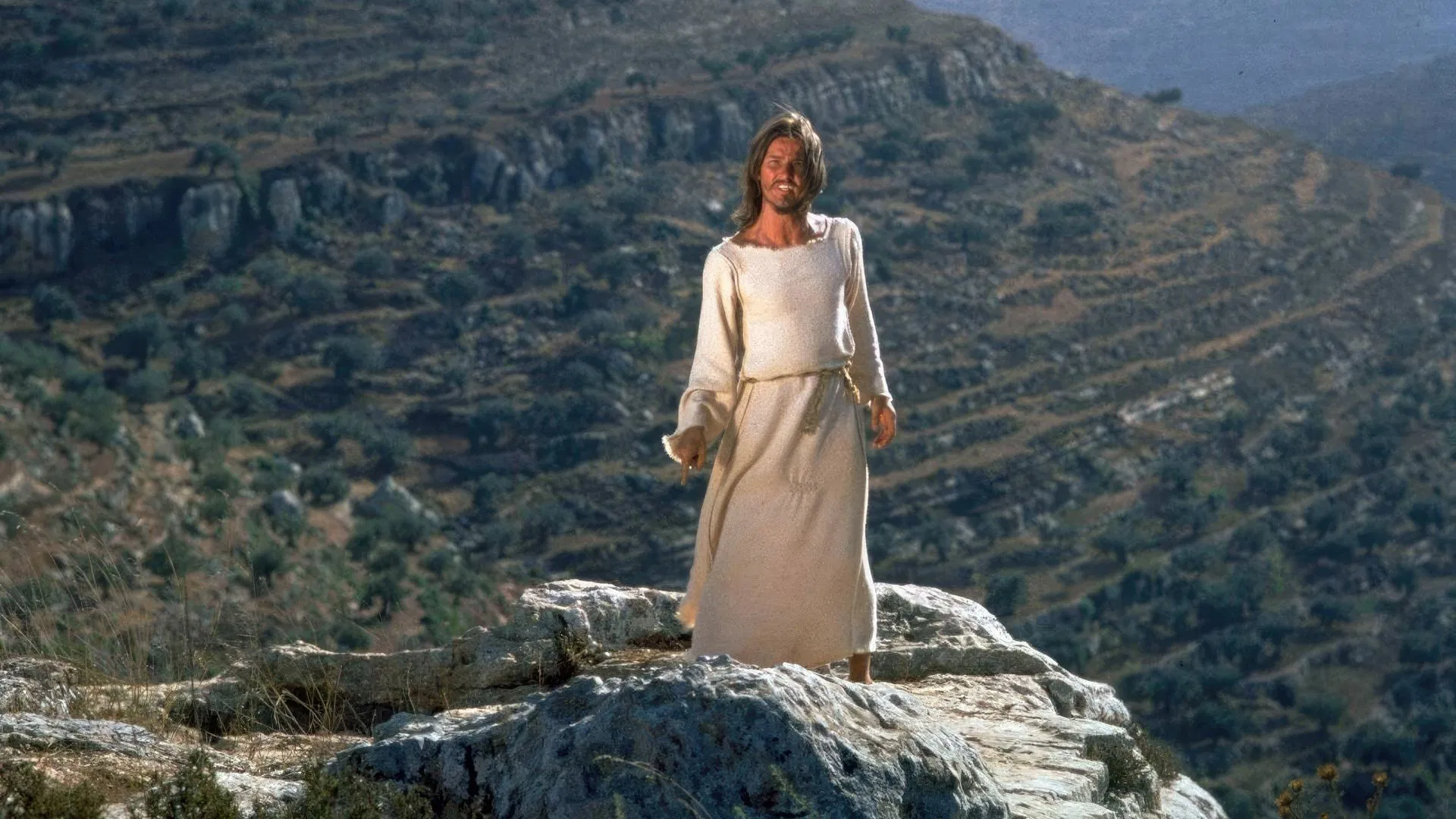
This framing device is everything. Jewison understood that the Broadway staging, as inventive as it was, couldn’t translate directly to the screen. Rather than attempt to replicate the spectacle, he stripped the story down to its bones and rebuilt it in the Israeli desert, filming at over twenty locations including the ancient Nabataean city of Avdat, the caves of Beit Guvrin, and the ruins of Herodium.
The result is a Jesus Christ Superstar that feels both timeless and completely of its moment. Tanks roll past in the distance. Machine guns appear alongside ancient market goods. Soldiers in modern military dress occupy the same frame as apostles in robes. The tension between eras isn’t a gimmick. It’s the point.
And Jewison follows through on the conceit. When the story ends, the cast boards the bus. Most of them climb on without looking back. But the actress playing Mary Magdalene lingers at the door, her gaze pulling toward the desert one last time, searching for something she can’t quite name. She takes her seat. The bus pulls away. And if you’re counting heads, you’ll come up one short. It’s the single most devastating choice Jewison makes in the entire film, and he does it without a word of dialogue.
Voices That Could Split Stone
Let’s start with Anderson, because the film does. He opens with “Heaven on Their Minds” and within thirty seconds you understand exactly why Judas is the engine of this story. Anderson’s voice is smooth and urgent, his focus absolute. He pulls you toward his line of thinking before you’ve had time to decide whether you agree with him. By the time he reaches the title number in the finale, arriving in a blaze of white fringe and righteous fury for one of the all-time great musical entrances, it’s full-body chaos. Anderson’s Judas has crossed over from the beyond to ask his mentor one last bravura question, and the answer he gets is silence. I’ve seen dozens of Judases perform “Superstar.” None of them have touched what Anderson does here.
Ted Neeley, meanwhile, plays Jesus as a man who knows exactly what’s coming and can’t stop it. His showpiece is “Gethsemane (I Only Want to Say),” a soliloquy that ranks among the most demanding pieces ever written for a male musical voice. Neeley doesn’t just climb that mountain. He detonates at the summit. The note he hits, the scream that tears out of him as he surrenders to a fate he didn’t choose, will leave you radiating shivers. Both men were nominated for Golden Globes. Both deserved to win. That the Academy didn’t find room for wither of them among its nominees remains, fifty years on, genuinely baffling.
Then there’s Yvonne Elliman as Mary Magdalene. Elliman had been with the show since the original concept album and Broadway run, and yet her performance of “I Don’t Know How to Love Him”, filmed gorgeously by director of photography Douglas Slocombe, sounds like the first time she’s ever considered the thought. It’s haunting, intimate, and the best the song has ever been performed by anyone, anywhere. She earned her Golden Globe nomination, setting the gold standard for how to sing the tune with power and passion, without the need for overpowering vocal flourishes.
The supporting cast is equally sharp: Barry Dennen brings a snide, conflicted authority to Pilate, Bob Bingham’s basso profundo Caiaphas rattles your chest, Larry Marshall’s Simon Zealotes is a live wire of misplaced revolutionary energy, and Josh Mostel’s campily fey King Herod steals his single number (as every good Herod should) with gleeful abandon.
Craft Worthy of Its Own Hymn
Douglas Slocombe’s cinematography functions as its own performer. The location photography commands full attention, and the way Slocombe frames these actors against the massive structures of the Israeli landscape constantly reminds you how small these figures are against the weight of what they’re doing. Better still, Slocombe and Jewison ensure that Robert Iscove’s choreography is captured in full. Legs and feet are never cut off. You see every movement. Numbers like “Simon Zealotes” and the finale involve dozens of bodies moving in every direction, and you never lose your place. Slocombe’s work deservedly earned a BAFTA nomination and won the British Society of Cinematographers Award.
Yvonne Blake’s costumes are thoughtfully calibrated to the characters and the film’s deliberately indeterminate time period. Everything feels functional and theatrical at once, juxtaposed against the simplicity of Neeley’s base garment. Blake gets one opportunity to go all out, during the “Superstar” finale, and she delivers an explosion of sparkle, fringe, and fabulousness that matches Anderson’s volcanic energy beat for beat. Jewison, who has said he was hired partly because the producers saw his last name and assumed he was Jewish (he’s not), wrangles every element with a sure hand. The film never drags. The pacing never falters. For a sung-through rock opera with no spoken dialogue, that’s a feat worth acknowledging.
Controversy, Legacy, and That Empty Seat on the Bus
Jesus Christ Superstar has courted controversy since before the first curtain went up. Some Jewish groups called it antisemitic. Some Christian groups called it blasphemous. Tim Rice didn’t help matters when he said, “We don’t see Christ as God but simply the right man at the right time at the right place.” The musical was banned in South Africa for being irreligious and in Hungary for distributing religious propaganda, proving that it was equally capable of offending across ideological lines.
And yet. Pope Paul VI saw the film and openly loved it, telling Jewison he believed it would bring more people to Christianity than anything before it. The film grossed $24.5 million against a $3.5 million budget, making it the highest-grossing musical of 1973. It won the David di Donatello Award for Best Foreign Film and a BAFTA for Best Soundtrack. It won a 2012 Huffington Post competition for Best Jesus Movie. Filmmaker Atom Egoyan has cited it as a formative influence on his understanding of cinema. It’s still being staged around the world, with a London Palladium production starring Eurovision breakout Sam Ryder opening in June 2026.
Sure, there are lines that make me cringe a little. “One thing I’ll say for him, Jesus is cool” has never not sounded awkward. But this is overwhelmingly a film that treats its subject with what Simon Zealotes might call “power and the glory.” It takes the story seriously by refusing to take it reverently. It finds the humanity in figures who’ve been calcified by centuries of tradition, lets them sweat and argue and doubt and break, and gives them music that makes those cracks feel like windows.
All these years later, it holds up brilliantly. I remain grateful to my parents for buying those tickets in 1992, grateful to Neeley and Anderson for what they gave on that stage and on this screen, and grateful to a twelve-year-old kid who didn’t understand what he was watching but was smart enough to feel it. That bus pulled up to the desert fifty-three years ago. I’m still on it.
Looking for something? Search for it here! Try an actor, movie, director, genre, or keyword!
