SPOILER-FREE FILM REVIEWS FROM A MOVIE LOVER WITH A HEART OF GOLD!

From the land of 10,000 lakes comes a fan of 10,000 movies!

Wile E. Coyote Takes on ACME: Movie Review

Synopsis: After enduring years of catastrophic product failures at the hands of ACME, Inc., a tenacious, unemployed coyote uncovers a corporate cover-up and spearheads an unhinged battle against the multinational conglomerate that’s been blowing him up in the name of profit. Also, there’s a roadrunner. And dynamite.
Stars
: Will Forte, Lana Condor, Tone Bell, Luis Guzmán, Martha Kelly, P.J. Byrne, John Cena, Eric Bauza, Kenneth Choi, Candi Milo, Jim Cummings
Director
: Dave Green
Rated
:PG
Running Length
: 103 minutes
Movie Review in Brief: Wile E. Coyote finally gets his day in court, and the movie built around it is handsome, well made and permanently unsure who bought a ticket. Cena is stiff, Forte is perfect casting, and Steven Price’s meeping choir is worth the price alone. A film nearly erased by a corporation, starring the most persistent underdog in animation history.

Coyote vs. Acme Review: The Underdog Gets His Day in Court

In 1990, The New Yorker published a piece of deadpan legal fiction by Ian Frazier in which Wile E. Coyote sued the ACME Company for $38.75 million after eighty-five separate products failed spectacularly enough to leave him injured, unemployed and unable to perform his chosen profession as a predator. The joke was that, if you stopped and considered the cartoons for long enough, Wile E. actually had a pretty good case. Thirty-six years later, somebody actually made the movie.

That joke is important because Coyote vs. Acme is, at its best, almost exactly what you would expect a feature-length version of Frazier’s idea to be: a Looney Tunes movie written by people who have thought very carefully about why Wile E. Coyote keeps getting blown up. The problem is that the original joke was aimed at The New Yorker reader, the cartoons were aimed at everybody, and the resulting movie never quite decides where those two audiences are supposed to meet.

Exhibit A: The Plaintiff Has a Pretty Good Case

After decades of being blown to bits by bombs, flattened by anvils, mangled by magnets, battered by boulders and hurled off every cliff in the Southwest, Wile E. Coyote finally decides that enough is enough. With billboard accident lawyer Kevin Avery (Will Forte, MacGruber) in his corner, he takes ACME Corporation to court, putting the company’s seemingly endless parade of defective products on trial. Also, there’s a Road Runner. And dynamite.

The screenplay, credited to Samy Burch (May December) from a story by Burch, James Gunn and Jeremy Slater, makes the smart choice of treating the lawsuit as an actual lawsuit. This isn’t simply an excuse to string together old cartoon gags. There is discovery. There is evidence. There are corporate lawyers protecting their client. There are witnesses. There is a judge. At one point, the Tasmanian Devil takes the stand. It’s a surprisingly straight-faced legal drama, which is both the film’s most interesting idea and the beginning of its identity crisis.

Dave Green (Earth to Echo) has said Michael Mann’s The Insider was his north star, and while that sounds ridiculous until you see the movie, I understand what he means. Coyote vs. Acme wants its corporate conspiracy to have actual stakes. ACME isn’t simply a company that makes funny products that explode. It’s a giant corporation that has repeatedly sold dangerous products to a customer who has nowhere else to shop.

That’s essentially Frazier’s original joke expanded to feature length. His 1990 piece took the logic of the cartoons and applied the language of product liability to it; the movie does the same thing, only now somebody has to carry that joke for 103 minutes. And that’ spells trouble, because Wile E. Coyote was never designed to carry 103 minutes

Exhibit B: Who Is This Suit Actually For?

The strangest thing about Coyote vs. Acme isn’t that it’s bad. It isn’t. It’s well made, intermittently funny and occasionally quite charming. My biggest thought while watching it, though, was the same one that kept returning throughout: Who exactly is this for? A seven-year-old isn’t going to know what tort law is. A fifteen-year-old probably isn’t buying a ticket to see Wile E. Coyote sue a corporation. And the adults who will recognize the New Yorker joke, understand the corporate satire and appreciate the film’s legal-drama construction may be wondering why they’re watching a PG movie about a coyote’s product-liability lawsuit. 

That’s the problem with so many of these live-action/animation Looney Tunes hybrids. They keep assuming the characters need to be elevated into something more sophisticated than the thing that made people love them in the first place. Space Jam got away with some of this because the original understood that Michael Jordan was the straight man and the Looney Tunes were there to be the Looney Tunes. Space Jam: A New Legacy and other attempts at expanding the brand have tended to confuse sophistication with adding more “stuff.”

Coyote vs. Acme makes a similar mistake in the opposite direction. It is smarter than it needs to be for children, but not quite sharp enough to become the adult comedy it occasionally seems to want to be. You can almost feel the movie searching for its audience, and once it realizes it hasn’t quite found one, it doesn’t know how to course-correct.

Exhibit C: The Silent Witnesses

There is, however, one genuinely fascinating experiment happening underneath all of this. Wile E. Coyote and the Road Runner are not speaking characters. They never have been. Their entire relationship has been built on movement, timing, expression, anticipation and the increasingly elaborate ways in which Wile E.’s plans go wrong. Making Wile E. the leading character in a feature therefore creates a problem that most animated movies never have to solve: How do you give a silent character enough personality to carry a story without ruining what makes him work?

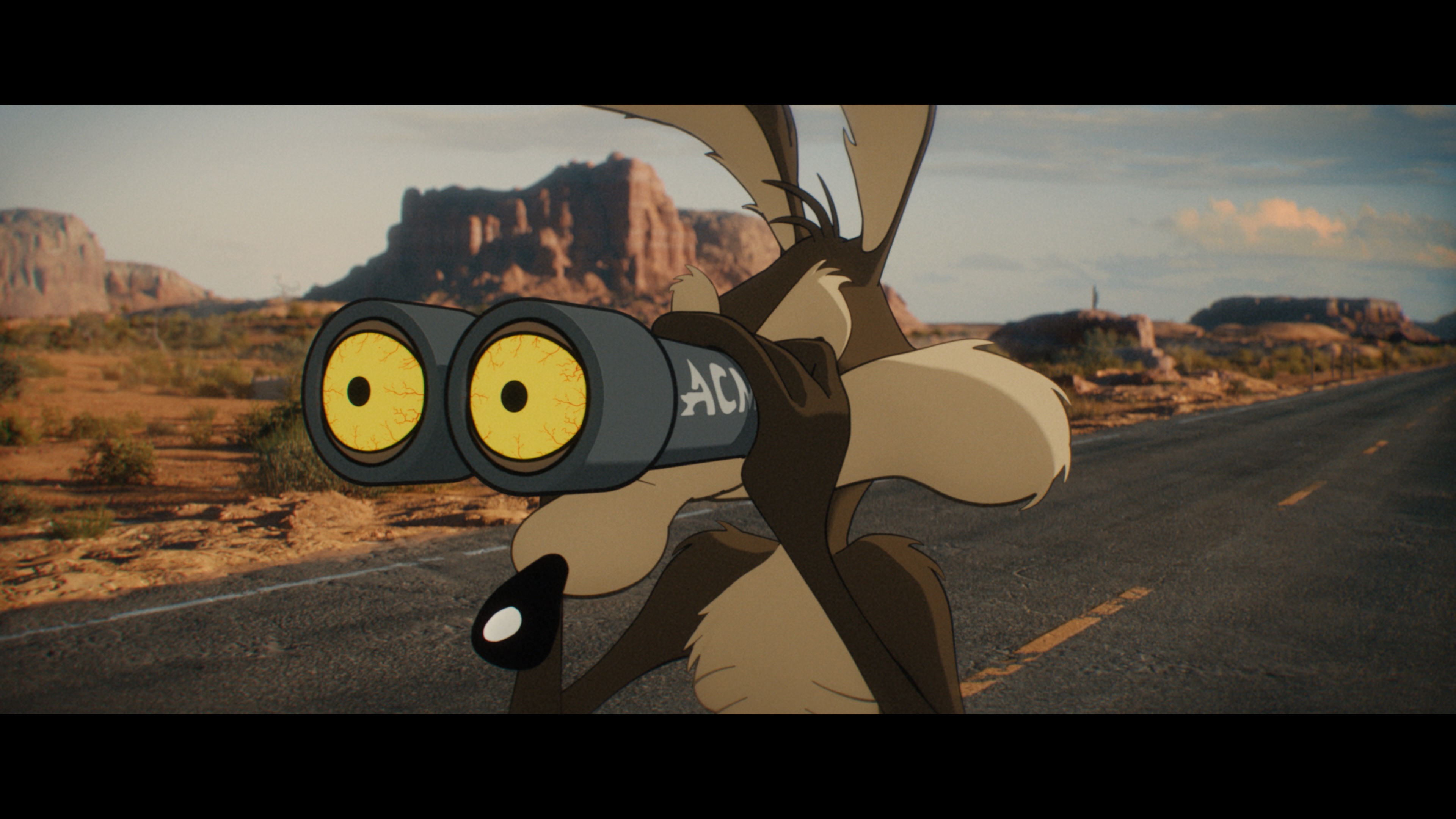
Thankfully, Wile E. never suddenly starts talking. He communicates through gestures, expressions and hand-lettered signs, and the decision is remarkably effective. The joke doesn’t wear out nearly as quickly as I expected. The animators give him a surprising amount of emotional nuance, and the human actors have to learn to play off him rather than simply waiting for their animated scene partner to deliver a line. That makes the scenes between Wile E. and Road Runner particularly interesting.

Beneath all the explosions, there has always been an odd little friendship between these two. They have spent seventy-five years chasing each other, and neither seems particularly interested in what happens if the chase actually ends. The movie occasionally understands that, and those are the moments when Coyote vs. Acme becomes something more than an elaborate lawsuit. Wile E. has spent his entire existence trying to catch the Road Runner, but what happens if the thing you’ve spent your entire life pursuing is also the thing that gives your life structure? That’s a surprisingly melancholy question to find hiding inside a Looney Tunes movie.

The rest of the roster is used more sparingly than you might expect. Tweety gets a few good moments, while Sylvester is essentially a blink-and-you’ll-miss-him appearance. Peter Lorre gets a substantial role as an ACME scientist, and hearing that unmistakable voice attached to a character in this universe is one of the film’s genuine pleasures. Foghorn Leghorn gets more to do, unfortunately, because his animation is among the least convincing in the movie. He looks like the character everyone remembered at the last minute after the film had already been sitting in a vault. Eric Bauza, who voices several characters, does solid work throughout.

Among the humans, Forte is perfectly cast as a sad-sack strip-mall lawyer whose hair seems to have given up before he did. Lana Condor brings a nice energy to their uncle-and-niece relationship, and there are flashes of the star quality that would become more apparent in her later work. John Cena, (Fast X), meanwhile, is about as subtle as a falling safe, while P.J. Byrne turns the obnoxiousness up several notches beyond the recommended setting. I never understand why actors do this in movies for younger audiences. It might read in a live room, but on screen it usually just gets louder and more irritating.

Exhibit D: Some Assembly Required

Technically, there is much less to complain about. Brandon Trost‘s cinematography isn’t especially showy, but it does something important: it gives the animated characters a believable physical environment to inhabit. The live-action world never feels like a background pasted behind Wile E. and Road Runner. The desert sequences have room to breathe, and when the Road Runner appears, the film suddenly gets an injection of color and movement. The city and courtroom material is another story. Too much of the film takes place in a beige world of offices, conference rooms and courtrooms, and the visual palette becomes nearly as muted as Wile E.’s sandy-brown fur.

The animation itself is the bigger achievement. Rather than turning Wile E. into a photorealistic creature or radically redesigning him for a 3D world, Green and his team worked to preserve the basic shape and personality of the Chuck Jones character. DNEG’s visual-effects team worked with 2D artists who created drawn poses and expressions as guides for the 3D animation. The production even developed a process called “sketchviz,” in which artists drew key poses over rough edits before those drawings became reference for the finished animation. You can feel the work. Rather than treating the Looney Tunes characters as visual effects that would simply be dropped into a live-action frame, the production had to figure out how they would actually perform inside it.

And then there’s the fact that Wile E. was actually there. Rather than having the actors perform opposite a tennis ball or an empty patch of green screen, puppeteer Dave Barclay and his son Duncan built a full-size Wile E. Coyote for the set. Barclay, whose credits include Who Framed Roger Rabbit, performed the character in a green suit that was later removed digitally. That matters. Forte and Condor aren’t imagining a character in the room.They’re reacting to one. It’s the kind of production detail that makes me wish the movie itself had been as consistently inventive as the people who made it.

Steven Price‘s score is another highlight, particularly a wonderfully ridiculous choral version of the Road Runner’s “meep meep” set to the “1812 Overture.” It’s exactly the sort of musical joke that understands the absurdity of taking Looney Tunes seriously without making the mistake of thinking seriousness and humor are opposites.

Exhibit E: The Movie Is Exhibit A

Then there’s the part of Coyote vs. Acme that is impossible to ignore now. This movie was filmed and finished in 2022. Warner Bros. shelved it in 2023 and initially intended to take a tax write-off rather than release it. Even worse, the filmmakers weren’t even told until after the movie was complete that this was happening. Public backlash followed. #ReleaseCoyoteVsAcme became a real campaign. Other filmmakers and industry figures spoke out. The movie sat in limbo while potential buyers circled. Eventually, Ketchup Entertainment acquired it.

And suddenly the movie’s story is sitting uncomfortably close to its own premise.

Wile E. Coyote spends the film taking on a corporation that has the resources to crush him. He is the little guy trying to convince somebody bigger and more powerful that his life, his injuries, and his years of being treated as disposable actually matter. Meanwhile, Coyote vs. Acme was itself treated as something that could be written off. That doesn’t magically make the movie better. It shouldn’t. A production history can’t repair a weak joke or make a two-hour story out of characters better suited to six-minute shorts. But it does change the emotional texture of watching it.

There’s something unexpectedly affecting about seeing Wile E. refuse to stay down when you know the movie itself spent several years in a similar position. The character has always been funny because he gets destroyed and gets back up. That’s the gag. That’s the entire gag. Except maybe it isn’t. There has always been something a little sad about Wile E. Coyote. He is almost pathologically convinced that the next attempt will work.

Every failure becomes evidence that he simply needs a better plan, a better product, a better angle, a better rocket, a slightly larger stick of dynamite. He doesn’t know how to quit. And perhaps that’s why the character has lasted. Not because we want him to catch the Road Runner. Not even because we particularly want his elaborate schemes to succeed. We recognize the ridiculous optimism of somebody who has been knocked flat a thousand times and still thinks the next idea might be the one.

In 2026, that gives Coyote vs. Acme an accidental emotional resonance it couldn’t possibly have anticipated when it was being made. The movie is about a corporation trying to dismiss an underdog’s grievances. Its own existence became a story about whether a completed piece of creative work would be dismissed by a corporation. Those two things aren’t identical, and I wouldn’t pretend they are. But eventually the parallel becomes difficult to unsee.

The Coyote kept getting back up. So did the movie.

Verdict: Still Running

The irony is that Coyote vs. Acme is probably most successful when it stops trying to make Wile E. Coyote into something he isn’t. He doesn’t need to become a leading man. He doesn’t need to talk. He doesn’t need a giant cinematic universe around him. He just needs to keep going.

That’s what makes the movie’s long road to the screen strangely appropriate. Wile E. has spent three-quarters of a century being blown up, flattened, humiliated and sent tumbling into the desert, only to dust himself off and start planning the next attempt. Coyote vs. Acme went through its own version of the same routine before finally making it out of the vault.

The movie may never quite figure out who it was made for, and its decision to build a feature around characters who were never meant to carry one remains its biggest miscalculation. But there is something fitting about Wile E. Coyote finally getting his day in court after all these years. He has always been very good at surviving the fall.

Apparently, so is his movie.

Looking for something?  Search for it here!  Try an actor, movie, director, genre, or keyword!

Subscribe to Blog via Email

Enter your email address to subscribe to this blog and receive notifications of new posts by email.

Join 5,235 other subscribers
Where to watch Coyote vs. Acme