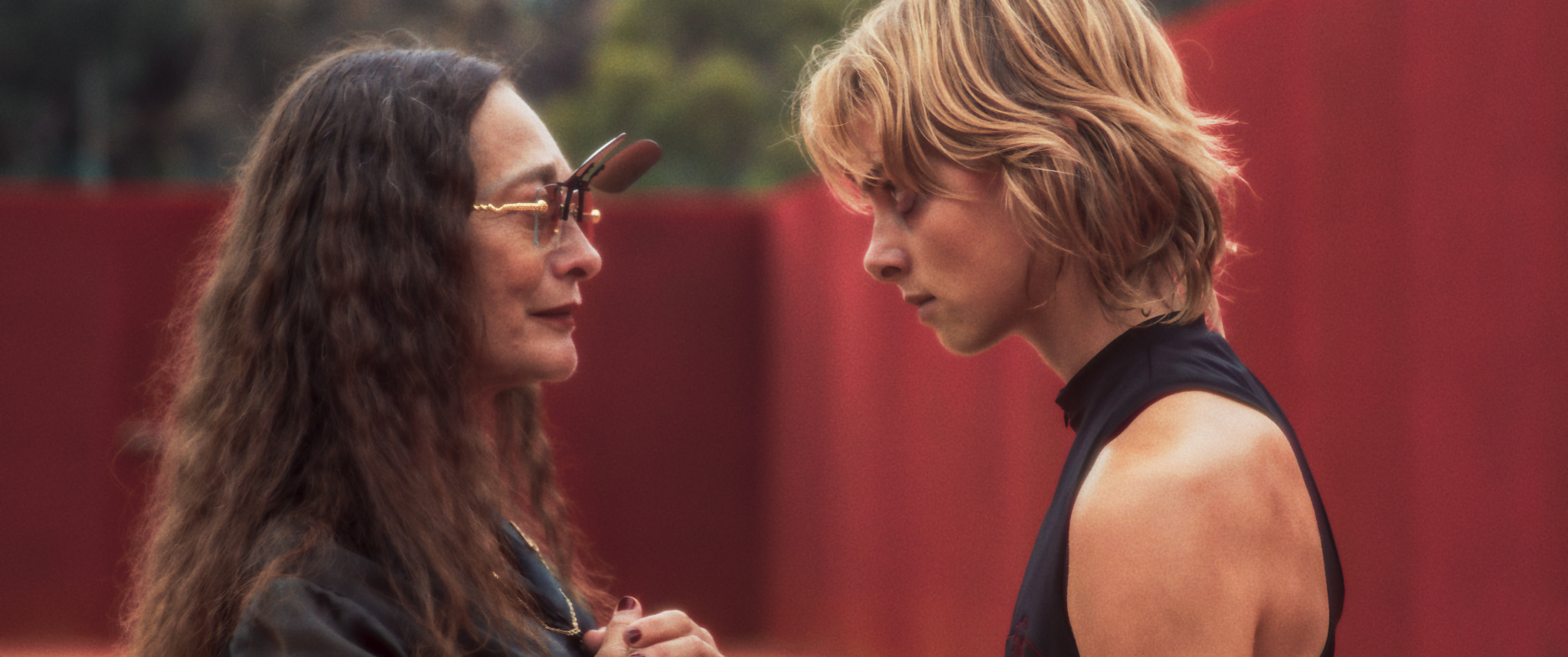
Synopsis: Sophie is admitted to an elite tennis academy hidden deep in the south of Europe, where she has to handle fierce competition and the school’s increasingly sinister undercurrents. What starts as a competitive rite of passage turns into a choice between becoming the player she has always wanted to be and keeping her empathy.
Stars: Sandra Guldberg Kampp, Elina Löwensohn, Tracy Gotoas, Lily Taïeb, Juliana Vieira Guerra, Helena Zengel, Lucie Zhang, Vincent Romeo, Zlatko Burić
Director: Nikias Chryssos
Rated: Not Rated
Running Length: 94 min
Movie Review in Brief: Bloody Tennis has an academy setting ripe for horror but very little idea how to make its cruelty compelling. Uneven performances, distracting dialogue, and weak momentum turn the promising setup into a laborious experience.
Bloody Tennis Double Faults on Horror and Satire
An elite tennis academy ought to be fertile territory for horror. You’ve got young athletes trained to treat exhaustion as progress, adults with control over their futures, and a competitive culture that can turn friendship into a liability. Bloody Tennis takes those ingredients, adds grotesque imagery and a conspicuously sinister institution, and somehow produces very little momentum. I kept waiting for its nasty streak to become an argument about ambition. Mostly, it remained a nasty streak.
Writer-director Nikias Chryssos won Best Director in the Horror competition at the recently completed Fantastic Fest, a distinction I have a hard time reconciling with what I watched. Awards aren’t instructions for how to feel, of course, but this particular result left me checking whether we’d all been issued the same movie. A tennis nightmare with no follow-through. It’s mean, muddled, and a absurdly long sit for a film running only 94 minutes.
This Academy Should Come With a Waiver
Sophie (Sandra Guldberg Kampp, Wildland) enters a prestigious academy tucked away in southern Europe, hoping to become the player she’s always wanted to be. The environment presents the expected rivalries and demands, along with less ordinary reasons to worry about the people overseeing her training. Mary Tyrone (Elina Löwensohn, Nadja) presides over a school where the pursuit of greatness quickly begins looking like a terrible bargain. (That no one makes a Tennessee Williams joke, at all, about Mary Tyrone is when I knew the film had zero sense of humor.)
The idea that athletic success might require sacrificing empathy is worth exploring. A competitive institution can reward the very behavior that makes living inside it intolerable. Here, though, the film moves so quickly to making the place grotesque that it leaves little room to understand the seduction. Why would somebody want to remain in this environment beyond the fact that the premise needs her there?
The academy setup invites immediate and obvious comparison with Suspiria, but borrowing the notion of a dangerous school isn’t enough. You need an atmosphere that draws the audience in, characters whose choices matter, or a formal confidence that makes the nightmare compelling on its own terms. I didn’t find enough of any of those to keep the film moving. Plus, it looks like an absolute dump.
The Cast Cannot Agree on the Game
Kampp leads an international ensemble that includes Tracy Gotoas, Lily Taïeb, Juliana Vieira Guerra, Helena Zengel, Lucie Zhang, Vincent Romeo, and Zlatko Burić. There’s talent in that group, which makes the lack of a shared performance style particularly frustrating. Some scenes suggest camp, others strain toward psychological intensity, and the exchanges rarely convince me that the characters are responding to one another within the same reality.
The dialogue often sounds detached from the performances, with a quality that struck me as poorly matched post-synchronization. I can’t establish who recorded what or whether every distracting line was dubbed, but I can describe the result: speech that repeatedly pulls attention away from the scene instead of helping it come alive. That’s an execution problem, not a reason to blame an international cast for working in English.
The men are so aggressively coded as creeps that their presence supplies little uncertainty. You can practically hear the warning sirens before they’ve done anything. Making an institution visibly predatory may establish the threat, but it also limits the tension if every adult announces the same thing and the script offers no persuasive reason for anybody to miss it.
Cruelty Is Doing All the Heavy Lifting
The treatment of the young women bothered me more than the individual gross-out effects. A film can depict a system that devalues female athletes while still giving those athletes an interior life. Too often, Bloody Tennis seems more interested in arranging humiliations and unpleasantness than in what Sophie and the others make of them. The satire needs a clearer point of view if the cruelty is going to mean more than another opportunity to be ugly.
Animal cruelty also features in the film, and viewers sensitive to that material should know it’s present. I won’t describe the sequence, but it contributed to my sense that shock was standing in for invention. The movie wants credit for taking things too far without doing enough work to make the excess interesting.
Cinematographer Constantin Campean and production designer Merlin Ortner give Chryssos a setting in which elite discipline and grotesque behavior can collide. Jim Williams, whose credits include Raw and Titane, supplies the score. Those names suggest possibilities the finished film doesn’t fulfill. Anselm Koneffke’s editing never establishes the forward pressure I needed, and the abrupt changes in tone make the runtime feel longer rather than more unpredictable.
Ninety Four Minutes Is a Very Long Match
The academy could have made a viciously funny target for a horror film about competitive culture. Instead, the clashing performances and distracting dialogue keep pulling scenes apart, while the treatment of the women asks cruelty to stand in for insight. With so little forward momentum, the film makes ninety-four minutes feel like a match nobody knows how to end.
I’m happy to follow a horror film into bad taste when it has the confidence, wit, or sheer nerve to make the trip worthwhile. This felt closer to cheap exploitation wearing a prestigious-school uniform, with very little pleasure in the absurdity and even less control over the experience. It’s hateful toward its women and hardly kinder to its audience. Bloody Tennis left me with what the sport calls love: absolutely nothing.
Looking for something? Search for it here! Try an actor, movie, director, genre, or keyword!

Leave a Reply