
Movie Review
The Holy Boy (La valle dei sorrisi)
8/10
TLDR
Paolo Strippoli’s The Holy Boy turns a simple embrace into something deeply unsettling. In a picture-perfect Alpine village, a teenager can take away everyone’s pain, and the townspeople have become far too comfortable letting him do it. Michele Riondino and newcomer Giulio Feltri are excellent, the photography and score are gorgeous, and the final stretch is genuinely shocking. It takes its time getting there, but this is the kind of folk horror that gets under your skin and stays put.
Where to watch: On Shudder November 27
The Facts
Synopsis: A grieving P.E. teacher moves to an isolated Italian mountain village where residents gather weekly to be embraced by a teenage boy who can seemingly take away their suffering. When the teacher begins questioning the miracle, the village’s cheerful facade starts to crack.
Director: Paolo Strippoli
Stars: Michele Riondino, Giulio Feltri, Paolo Pierobon, Romana Maggiora Vergano, Sergio Romano, and Roberto Citran
Rated: Not Rated
Running Length: 122 minutes
The Thoughts
I’ve reached the point where the name Paolo Strippoli is enough to get my attention, which isn’t something I can say about every filmmaker working in horror these days. Some directors know how to deliver a good scare; Strippoli seems especially interested in making us suspicious of things that are supposed to make us feel safe. A friendly face, a picturesque village, the promise that somebody can ease your suffering. He takes those comforts and turns them ever so slightly until you’re no longer sure whether you want to accept the invitation or run in the other direction. His latest film to reach American audiences, The Holy Boy (La valle dei sorrisi), might be his most disturbing variation on that idea yet. Imagine being offered a hug that could take away all your pain. Now imagine living in a town where everyone expects you to keep hugging people until there’s nothing left of you.
My first encounter with Strippoli was A Classic Horror Story, which he co-directed with Roberto De Feo, but it was The Spiral at TIFF that really made me sit up and pay attention. That film’s unsettling portrait of a privileged mother determined to hold on to her position was one of my festival favorites, finishing as my first runner-up for the Midnight Madness People’s Choice Award, just as it did in the official voting. Since then, Italy selected it as its submission for Best International Feature at the Oscars, and New Line Cinema picked it up for an American release and an English-language remake. So you can imagine my delight when I realized that The Holy Boy, the film Strippoli made just before The Spiral, was coming to Shudder. Apparently, he’s determined to make me uncomfortable at least once a year, and I’m becoming very grateful for it.
Welcome to the Happiest Town
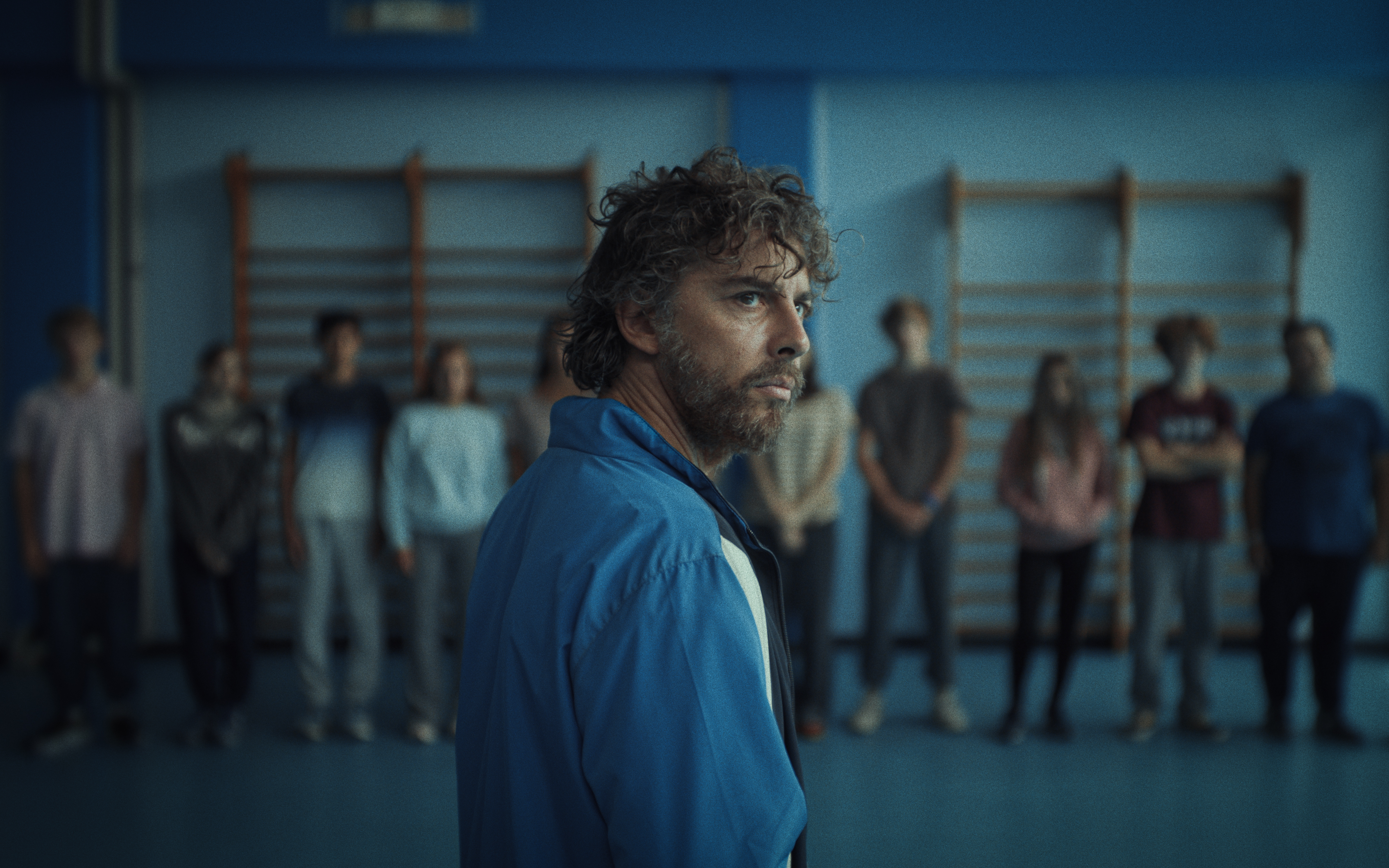
The setting is Remis, a postcard-perfect village tucked into the Italian Alps and reputed to be the happiest place in the country. That should probably be your first warning. Sergio Rossetti (Michele Riondino), a former judo champion beginning a new job as a physical education teacher, arrives carrying so much grief and self-loathing that he’d be difficult company even in a town where people were allowed to have a bad day. He drinks too much, keeps others at a distance, and has the weary air of someone who’s stopped expecting much from life. The sunshine, mountain air, and picturesque streets do very little for him, especially because everyone he meets seems suspiciously cheerful. You’d think someone might at least complain about the weather, but apparently nobody in Remis received that memo.
A young barmaid named Michela (Romana Maggiora Vergano) eventually introduces Sergio to the source of the town’s unusual contentment. Once a week, residents gather to receive an embrace from Matteo (Giulio Feltri), a withdrawn fifteen-year-old whose touch can supposedly relieve them of grief, worry, and pain. The experience is deeply personal, and the villagers treat it with the reverence usually reserved for a religious ceremony. Sergio, who has enough emotional baggage to fill several buses, naturally has his doubts. But after his own encounter with Matteo, even he begins to feel something shift. As he grows closer to the boy, however, he starts seeing how thoroughly the entire community has built its well-being around this one teenager, and how little anyone seems to care what the arrangement is doing to him.
That’s the cruel little idea driving The Holy Boy. The horror isn’t merely that Matteo possesses a supernatural gift, or even that the gift may have darker consequences than anybody admits. It’s that the townspeople have become so dependent on feeling better that they’ve stopped asking what happens to the person making it possible. His father, Mauro Corbin (Paolo Pierobon), controls access to him, the residents return week after week for their relief, and Matteo’s wishes seem to matter less than the needs of everybody standing in line. Sergio recognizes a child who’s being consumed by the expectations of adults, and his impulse to help sets the story on a path that leads somewhere considerably nastier than the town’s charming tourism brochures might suggest.

Good Vibes, Bad Intentions
Strippoli blends folk horror, religious devotion, psychological dread, and a particularly ugly form of communal selfishness without making the supernatural feel like an attraction dropped into an otherwise ordinary setting. He allows the ritual to become part of the village’s weekly routine, which is precisely why it gets so uncomfortable. Nobody seems to think it’s strange anymore. Nobody wants to question the process, because questioning the process might mean losing access to it. It reminded me of Midnight Mass, where a seemingly miraculous gift becomes the center of a community’s faith, and there’s a touch of The Wicker Man in the way outsiders are encouraged to accept customs that should raise an eyebrow or two. But Strippoli gives the concept his own twist. There are no elaborate pagan costumes required here. A warm embrace can be all the ceremony you need.
What stuck with me was how recognizable the underlying temptation feels. Who wouldn’t want to put down the worst thing they’ve ever experienced, even for a little while? In the press notes, Strippoli explains that the idea grew from our many efforts to escape discomfort, from holistic practices and pharmaceuticals to psychotropic drugs and religion. There isn’t anything wrong with wanting relief, of course, but the film asks what happens when relief becomes an obligation, sadness becomes socially unacceptable, and somebody else is expected to absorb whatever we don’t want to feel. In an era of relentless “good vibes only” messaging, a town that outsources its grief to one exhausted teenager doesn’t seem nearly as fantastical as I’d like it to.
It also gives the film an uncomfortable emotional honesty. Sergio isn’t a perfect rescuer arriving to expose a village of fools. He’s damaged, angry, and looking for relief himself, which makes his growing concern for Matteo more complicated than a simple battle between good and evil. His suspicion of the town coexists with an understandable attraction to what it offers. The residents aren’t all cartoon villains, either. They can be kind, generous, and genuinely grateful, right up until someone threatens the thing they’ve decided they cannot live without. That’s the sort of horror Strippoli seems especially good at: the moment when ordinary people discover just how far they’ll go to preserve their own comfort.
Paradise Has a Price
The filmmaking is beautiful, which only makes the growing dread more effective. Cristiano Di Nicola’s cinematography gives the Alpine setting the sort of luminous, open-air beauty that usually sends you searching for hotel rates. Filmed around Tarvisio and Sappada in Friuli-Venezia Giulia, the village appears almost aggressively inviting, from its sunlit streets to the mountains rising beyond the rooftops. There’s no need for Strippoli to hide everything in darkness when the most disturbing things can happen in broad daylight. The score by Federico Bisozzi and Davide Tomat is equally impressive, moving from lyrical, almost comforting passages to sounds that tighten the nerves without announcing every shock. The contrast between what we see and what we’re gradually learning about the place does much of the work.
The film has a long history of its own. Strippoli began developing it with Jacopo Del Giudice and Milo Tissone in 2017, when they were students at Rome’s Centro Sperimentale di Cinematografia, and their story won the Solinas Prize in 2019. After premiering out of competition at the Venice Film Festival in 2025, The Holy Boy went on to win the Audience Award at Fantastic Fest, where Strippoli also received Best Director honors in the Next Wave competition. I mention those milestones because the finished film has the confidence of a project its makers have been living with for years. It knows exactly how much to reveal, and just as importantly, how much to let the audience imagine before the ugliest possibilities begin coming into focus.
The Weight of a Hug
Riondino gives a terrific performance as Sergio, finding a damaged human being beneath a character who could easily have been nothing more than the suspicious newcomer we’re supposed to follow into danger. He’s abrasive, exhausted, and not always likable, but his interactions with Matteo gradually reveal a capacity for care he seems to have misplaced somewhere along the way. That relationship gives the film its heart. Sergio has spent so much time trying to escape his own pain that recognizing somebody else’s suffering becomes a genuine act of change, and Riondino makes that shift convincing without turning him into a suddenly transformed saint.
Feltri, making his screen debut, is even more intriguing. Matteo could have been portrayed as an eerie little oracle or a convenient source of supernatural exposition. Instead, he’s an introverted boy who seems painfully aware of the responsibility everybody has placed on his shoulders. According to the press notes, Feltri was found in a youth workshop performance in Rome before Strippoli put him through five lengthy auditions, and the actor’s unpolished naturalness gives Matteo an unpredictability that’s much more unsettling than an elaborate collection of spooky mannerisms. I particularly liked the subtle makeup details, including pale strands in his hair and eyelashes, suggesting the toll his ability takes on his body. Pierobon is formidable as his controlling father, while Maggiora Vergano makes Michela an appealing bridge between Sergio and the village’s increasingly alarming customs.
My main reservation is the pacing. At 122 minutes, The Holy Boy takes a long time arranging its pieces, and there are stretches when its refusal to hurry starts feeling a little too self-satisfied. I appreciate a horror film that trusts atmosphere and character, but once the central arrangement is clear, I occasionally wanted Strippoli to push the story into its next uncomfortable phase. To his credit, he understands that dread needs room to accumulate, and the slower passages make the eventual eruption more disturbing. Still, I think a little trimming might have strengthened the film’s momentum without sacrificing the unease that makes it work.
Don’t Hug It Out
And then comes that finale. I’m not going to spoil it, because the less you know about where Strippoli takes this story, the better. What begins as an odd, almost melancholy supernatural mystery eventually reveals a capacity for violence and cruelty that caught me completely off guard. The final developments are genuinely shocking, but they don’t feel disconnected from everything we’ve been watching. They bring the film’s central question into horrifying focus: if an entire community is built on making one person carry everybody else’s pain, what happens when that person can no longer bear the weight?
The Holy Boy is a disturbing, thoughtful, and beautifully made piece of Italian folk horror, even if it asks for more patience than some viewers will want to give. It has two excellent central performances, a terrific supporting ensemble, and a filmmaker who knows the difference between being scary and having something worth being scared about. While we wait for The Spiral to reach a wider American audience, this is an excellent introduction to Strippoli’s particular brand of discomfort. It arrives on Shudder November 27, and I suggest giving yourself a little time afterward before accepting any invitations to a group hug.

The Final
Gorgeous to look at and increasingly difficult to sit comfortably through, The Holy Boy turns the promise of happiness into a surprisingly cruel form of horror. Michele Riondino and Giulio Feltri give the film its emotional strength, and Strippoli delivers a finale that makes the deliberate buildup worth it. One of the year’s more unsettling reminders that not every hug is a gift.
8/10
Where to watch: On Shudder November 27

Reviewed by Joe Botten
Joe Botten is The MN Movie Man, a Twin Cities film critic writing spoiler-free reviews since 2012. He also writes for Loud and Clear Reviews, a Rotten Tomatoes approved site. Find him on Instagram and Letterboxd.
Looking for something?
Search by actor, movie, director, genre or keyword.


Leave a Reply