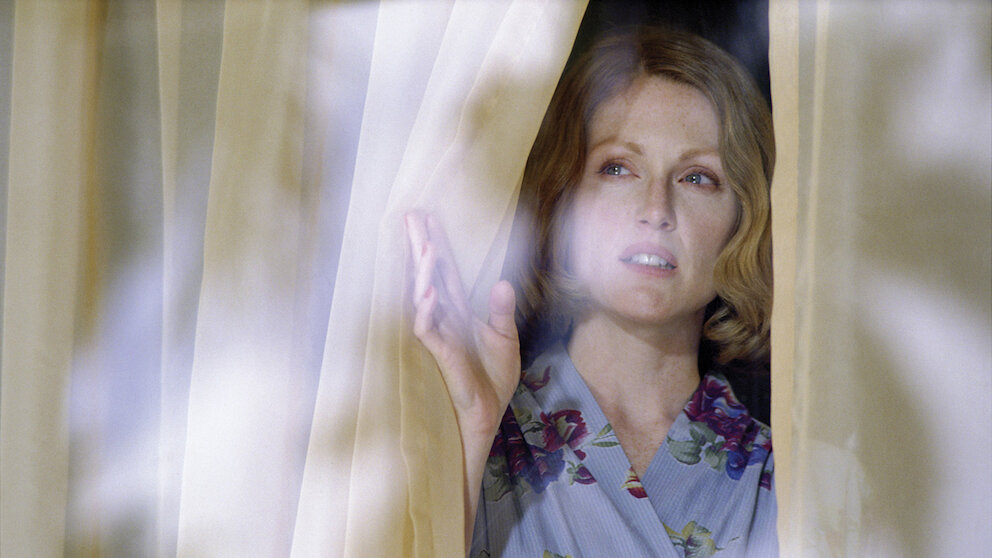

The Hours (2002)
Blu-ray · 88 Films
Shelf Worthy
In Brief
Three extraordinary actresses, three lives separated by decades, and a Philip Glass score that knows exactly where to find the ache. Stephen Daldry’s The Hours remains a devastatingly beautiful experience, and 88 Films’ Blu-ray collects the original DVD supplements alongside a new commentary and David Hare interview. It’s the kind of film that can make 114 minutes feel like an entire lifetime.
The Facts
Synopsis: On three separate days in 1923, 1951, and 2001, Virginia Woolf works on Mrs. Dalloway, a California housewife retreats into its pages, and a New York woman plans a party for a dying friend who calls her Mrs. Dalloway.
Starring: Nicole Kidman, Julianne Moore, Meryl Streep, and Ed Harris.
Directed by: Stephen Daldry.
Rated: BBFC 12 (PG-13 in the United States).
Running length: 114 minutes.
Buy It Here
The Package
Label and release: 88 Films; May 25, 2026.
Format: Single BD-50 Blu-ray featuring the theatrical cut and a limited-edition rigid slipcase with original artwork.
Video: 1080p, 1.85:1.
Audio: English DTS-HD Master Audio 5.1 and LPCM 2.0 stereo.
Subtitles: Optional English.
Disc specification: Region B.
The Film
Some movies ask you to watch a character’s life unfold over decades. The Hours asks you to spend one day with each of three women and somehow makes those 24-hour stretches feel every bit as consequential. Stephen Daldry‘s 2002 adaptation of Michael Cunningham‘s novel has nine Academy Award nominations and Nicole Kidman‘s Best Actress win to its name, but none of that prepares you for how deeply this film can get under your skin. It is a story about depression, expectation, loneliness, and the unbearable weight of an ordinary afternoon when you’re not sure how to get through the next one. Not exactly a light Sunday matinee, then, although it’s a remarkably rewarding one.
In 1923, in the London suburb of Richmond, Virginia Woolf (Kidman, The Others) begins writing Mrs. Dalloway while her husband and the people around her monitor her fragile mental health. In 1951 Los Angeles, Laura Brown (Julianne Moore, Still Alice) is a pregnant housewife who would rather disappear into Woolf’s book than perform another day of domestic happiness. And in 2001 New York, Clarissa Vaughan (Meryl Streep, The Iron Lady) prepares a party for her friend Richard (Ed Harris, The Truman Show), a poet dying of AIDS who has affectionately nicknamed her Mrs. Dalloway. Three women, three time periods, and a novel connecting lives that appear to have almost nothing else in common.
David Hare‘s screenplay refuses to spoon-feed those connections, allowing small details and repeated emotions to move between the stories. A gesture in one decade echoes a decision in another, and the film develops a cumulative ache as the women struggle against the lives they’re expected to want. Kidman’s heavily discussed prosthetic nose may have become the popular shorthand for her performance, but it’s the fear, intelligence, and desperate need for autonomy underneath it that make her Virginia so moving. Moore is almost painfully good at portraying Laura’s suffocation, while Streep gives Clarissa warmth and nervous energy as she pours herself into caring for somebody who might be beyond her reach. Toni Collette, Claire Danes, and Jeff Daniels add welcome depth to the surrounding world, and Harris is heartbreaking as a man whose illness has reshaped his relationship to time itself.
And then there’s Philip Glass. His piano and strings don’t merely accompany the film; they connect the three stories, pushing a shared feeling of longing from one century into the next. The score can be insistent, almost unsettling, yet it’s difficult to imagine the film without it. Daldry, following his feature debut Billy Elliot, takes an enormous formal risk by moving between the three women so frequently, but the editing, performances, and music make the emotional connections feel natural rather than academic. There’s sadness here, certainly, and some particularly difficult material concerning mental illness and death, but reducing The Hours to a tearjerker would miss its compassion for people who are struggling simply to be themselves.
Perhaps it’s fitting that a story so dependent on rhythm, emotion, and the passage of time eventually found its way to the opera stage. In 2022, The Hours became a two-act opera composed by Kevin Puts, with an English-language libretto by Greg Pierce. The Metropolitan Opera premiered the fully staged production that November, with Renée Fleming, Kelli O’Hara, and Joyce DiDonato taking on the three central roles. That’s a pretty remarkable second life for Cunningham’s novel, and while Puts created an entirely new score, I love the idea of these three women’s stories finding another way to express feelings that ordinary conversation can’t always capture. Between the novel, Daldry’s film, and the opera, The Hours has certainly demonstrated that a single day can contain enough emotion to fill an entire evening. Or several.
What’s far less understandable is how a film this celebrated has been treated on physical media. Miraculously, nearly a quarter century after its theatrical release, The Hours is finally making its UK Blu-ray debut through 88 Films, albeit in a Region B edition. There have been earlier Blu-rays in other countries, but American audiences are still waiting for a domestic release of their own. Nine Oscar nominations, three extraordinary leading performances, and one of Philip Glass’s most memorable film scores, and we’re still waiting for this movie to receive the home-video treatment it deserves. I’m counting the minutes, not the hours, until Criterion announces a proper 4K restoration, because if ever a film deserved that kind of attention, it’s this one. In the meantime, I’m delighted that 88 Films has given collectors another opportunity to revisit it in high definition. Some movies only get better with time. The Hours is one of them.

The Transfer
Video
88 Films presents the 114-minute theatrical version in 1080p at 1.85:1 on a dual-layer disc, retaining the film’s theatrical framing. That matters for a movie that continually shifts between the restrained interiors of 1920s England, the carefully composed domestic spaces of 1950s California, and early-2000s New York. The close-ups are especially important: these actors can convey an enormous amount while barely moving, and the presentation keeps those expressions at the center of the experience.
Audio
The English DTS-HD Master Audio 5.1 track gives Glass’s magnificent score room to breathe without overwhelming the intimate dialogue; a lossless LPCM 2.0 option is included as well. The music is such a vital part of the storytelling that having both options is more than a technical footnote. Optional English subtitles complete a clean, thoughtfully assembled presentation.
Transfer Notes
American physical-media collectors have been left with Paramount’s 2003 DVD rather than a domestic Blu-ray, making this UK release a welcome addition to the shelf. Most importantly, the earlier DVD’s supplements are present, joined by two newer additions. This isn’t a complete reinvention of the package, but the film hardly needs one. It simply deserves to remain accessible in a good high-definition edition.

Special Features
- Audio commentary with Heather Wixson (new): A fresh discussion of the film and its place in cinema.
- An Open Source for Words and Images (new, approximately 23 minutes): Screenwriter David Hare reflects on adapting Cunningham’s novel.
- Audio commentary with Stephen Daldry and Michael Cunningham: The director and novelist discuss how the material moved from page to screen.
- Audio commentary with Nicole Kidman, Julianne Moore, and Meryl Streep: Individually recorded reflections edited into one conversation.
- Director’s introduction: Daldry’s archival introduction to the film.
- Four original featurettes: The Lives of Mrs. Dalloway, The Mind and Times of Virginia Woolf, The Music of The Hours, and Three Women.
- Image gallery and theatrical trailer: A handful of additional archival materials.
The Hare interview is the first place I’d go after revisiting the movie, followed by the new commentary. The older pieces are worthwhile for anyone interested in how this unusually structured adaptation came together, and it’s nice to have them gathered instead of left behind on a DVD from another era.
Shelf Worthy?
Shelf Worthy
The Hours remains a remarkable piece of filmmaking, carried by three extraordinary leads and a Philip Glass score that can wring emotion from the smallest exchange. The new supplements complement a solid collection of archival material, and the Blu-ray finally gives collectors another way to retire that well-loved DVD. Mrs. Dalloway said she would buy the flowers herself. I suspect she’d also insist on making room for this disc.
Shelf Worthy: Buy it. This one earns a spot on the shelf.
Stream First: Watch it before you buy.
Completionists Only: For collectors who need every edition.
88 Films provided a copy for review. My opinions are my own.

Reviewed by Joe Botten
Joe Botten is The MN Movie Man, a Twin Cities film critic writing spoiler-free reviews since 2012. He also writes for Loud and Clear Reviews, a Rotten Tomatoes approved site. Find him on Instagram and Letterboxd.
Looking for something?
Search by actor, movie, director, genre or keyword.


Leave a Reply