
Movie Review
Ebenezer
9/10
TLDR
I’m extremely picky about my A Christmas Carol adaptations, and Ti West’s Ebenezer caught me completely off guard. Johnny Depp gives Scrooge an eccentric, wounded edge, the ghostly encounters are genuinely frightening, and the production design, makeup, and effects are tremendous. A few tonal detours and a slightly overlong running time can’t spoil a film that remembers Dickens wrote a ghost story before he wrote a holiday tradition. I cowered, laughed, cried, and left feeling more Christmas cheer than I expected.
Where to watch: In theaters now
The Facts
Synopsis: On one Christmas Eve in Victorian London, the miserly Ebenezer Scrooge is warned by the ghost of his old partner, Jacob Marley, and then visited by three spirits who take him through his past, present, and future on a supernatural journey that will decide his fate.
Director: Ti West (screenplay by Nathaniel Halpern, from A Christmas Carol by Charles Dickens)
Stars: Johnny Depp, Rupert Grint, Andrea Riseborough, Sam Claflin, Daisy Ridley, Arthur Conti, Ellie Bamber, Henry Lloyd-Hughes, Charlie Murphy, Tramell Tillman, and Ian McKellen
Rated: PG-13 for frightening material
Running Length: 116 minutes
The Thoughts
Look, I’m super, suuuuuuper picky about my Dickens, particularly A Christmas Carol. I’ve seen enough versions to know exactly which lines I expect to hear, which moments absolutely need to work, and which adaptations seem to believe that Scrooge’s conversion requires nothing more than a catchy song and a suddenly improved attitude toward Christmas dinner. So when Paramount began selling Ebenezer as a rather silly, fluffy holiday diversion, my expectations weren’t exactly through the roof. Then I watched what director Ti West and screenwriter Nathaniel Halpern had actually made, and I wanted to ask the marketing department whether anybody had shown them the finished film. This thing is dark. It’s creepy. Parts of it are genuinely frightening. And for my money, it’s one of the more interesting big-screen attempts in years to remember why Dickens’s tale has survived so many Christmases.
The story hardly needs an introduction, but just in case somebody has spent the past 183 years avoiding it, Ebenezer Scrooge (Johnny Depp) is a London businessman whose success has been built on a spectacular lack of generosity. He treats his employee Bob Cratchit as an inconvenience, regards Christmas goodwill as a personal affront, and has made a career out of ensuring his money never has the opportunity to improve anybody else’s day. Then his dead business partner, Jacob Marley (Ian McKellen), arrives on Christmas Eve to deliver a warning about the afterlife awaiting men who have lived as Scrooge has. Three spirits follow, showing him the past he has tried to forget, the present he chooses not to see, and a future so miserable that even Scrooge begins considering whether he might have taken this whole miser business a little too far.
Dickens With His Teeth Back
What West understands, better than many filmmakers who have approached this material, is that A Christmas Carol was always intended to frighten its audience. Dickens didn’t write a cozy story about a grumpy man discovering the importance of buying presents. He wrote about poverty, social cruelty, shame, death, and the terrifying consequences of living as though other people’s suffering doesn’t matter. The ghosts aren’t visiting Scrooge to give him a festive pep talk; they’re confronting him with what he has done and what he still has the power to change. That makes West, whose previous films include X, Pearl, and MaXXXine, a surprisingly natural choice. The director knows how to make a place feel cursed before anything supernatural has happened, and he brings that instinct to a version of Victorian London where Christmas cheer is something the characters must fight to find.
Halpern, who created Tales from the Loop and wrote for Legion, gives West room to lean into the horror without abandoning the moral architecture of the story. The two previously collaborated on an episode of Tales from the Loop, and their shared interest in loneliness, memory, and the strange things people carry from one stage of life to another is apparent here. The film has a gothic severity that brings to mind the atmosphere of Robert Eggers’s Nosferatu more readily than the cheerful chaos of The Muppet Christmas Carol. I adore the Muppets, but there’s something tremendously satisfying about a version of this story that doesn’t feel obligated to soften every sharp edge for the sake of holiday comfort.
The history matters, too. Dickens knew the brutal economic realities his story was confronting. When his father was imprisoned for debt at the Marshalsea, the young Charles was sent to work in a blacking factory, an experience that haunted his understanding of money, class, and the humiliations inflicted on families struggling to survive. West’s London feels built around those inequities. The streets are cold, the houses imposing, and the distance between Scrooge’s wealth and everyone else’s misery is impossible to ignore. That’s why his redemption means more than becoming a pleasant fellow at the office Christmas party. He has to recognize that his behavior has damaged people whose lives will not magically improve just because he has a better morning on December 25.

Things That Go Bump on Christmas Eve
West is clearly having a wonderful time with the supernatural elements. Crows gather ominously, street lamps extinguish themselves, graves become places no sensible person would visit after dark, and the spirits arrive with considerably more menace than the average holiday production allows. There are genuine jump scares, moments of grotesque imagery, and sequences that reminded me how effectively a familiar story can frighten you when the director refuses to treat familiarity as protection. I knew where Scrooge’s journey was going, but I wasn’t always sure what West might have waiting around the next corner. It’s a lovely feeling to be surprised by a story you’ve practically memorized.
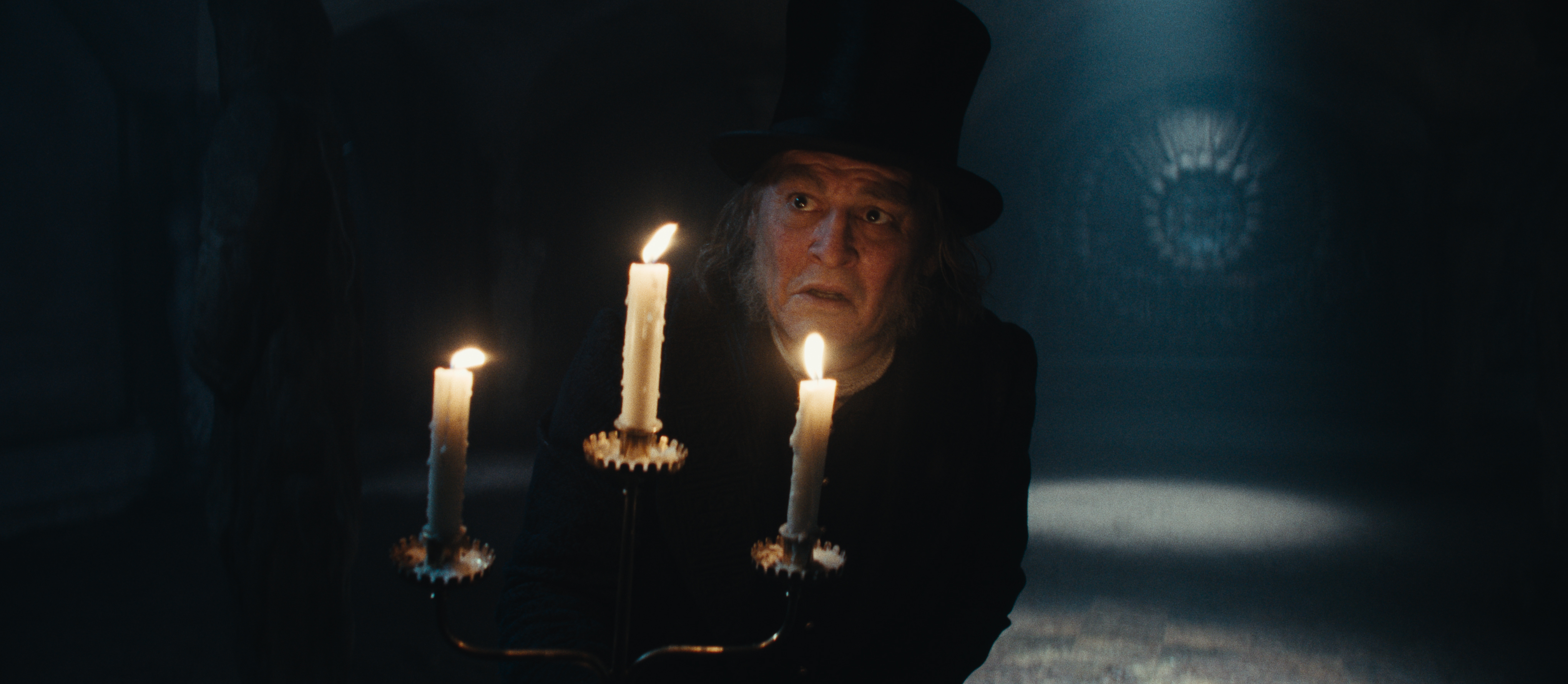
The production values are fantastic, and the special effects and makeup deserve particular praise. Eve Stewart, whose production design work includes Les Misérables, creates a Victorian London that is bleak, imposing, and richly detailed without becoming another picture-postcard Christmas village. Checco Varese’s cinematography gives candlelight and darkness plenty to do, turning rooms and streets into places where you find yourself watching the corners of the frame. The makeup gives the ghostly visitors a physical presence that’s far more unsettling than a few transparent figures floating through the walls, while the effects bring the supernatural punishment to life without making the film feel like one long computer-generated attraction. Tyler Bates, who scored West’s X trilogy as well as John Wick: Chapter 4, supplies music that knows when to chill the blood and when to make room for something gentler.
A Very Different Scrooge
Depp has been wandering through strange cinematic worlds for decades, including a previous trip to a much more musical Victorian nightmare in Sweeney Todd. Here he gives Scrooge his customary eccentricity but doesn’t let the makeup and mannerisms do all the acting. His Ebenezer is weathered, suspicious, proud of his own unpleasantness, and increasingly terrified by what the spirits reveal. I especially liked how slowly his confidence begins to crack. He’s not a lovable old crank who needs a reminder to smile. He’s a man who has spent years protecting himself from sympathy, and his encounter with Marley leaves him genuinely shaken. Depp and McKellen make their early scenes crackle with the unpleasant realization that this haunting is not a practical joke and nobody intends to leave Scrooge alone until he’s learned something.
The supporting cast gives the film a welcome variety of temperaments. Rupert Grint (Knock at the Cabin) brings warmth to Bob Cratchit, while Andrea Riseborough (Possessor) makes the Ghost of Christmas Past both compelling and unsettling. Tramell Tillman (Mission: Impossible – The Final Reckoning) is a memorable Ghost of Christmas Present, and Sam Claflin and Daisy Ridley (Young Woman and the Sea) play Scrooge’s nephew Fred and Fred’s wife, Clara. Between the spirits and the mortals, there are enough distinct personalities to keep this familiar story lively without making it feel like a parade of celebrity cameos. It also amused me to see Depp and Ridley sharing a cast again after Murder on the Orient Express. At least this time they’re dealing with a much more straightforward mystery: how to get a miserable old man to behave like a human being.
Redemption With Consequences
The film isn’t entirely successful at balancing its ambitions. Every so often, Halpern’s script moves from genuinely upsetting supernatural horror to broad comedy with a little too much enthusiasm, and the tonal changes can be jarring. Some of the new material, including an expanded history for Belle as a novelist, offers interesting insight into the people Scrooge has dismissed, but not every addition earns its place. At 116 minutes, the film also runs longer than this particular story needs, and a few passages could have been tightened without sacrificing an ounce of atmosphere. West occasionally seems determined to squeeze in one more scare, one more eccentric flourish, or one more reminder that this isn’t your grandparents’ A Christmas Carol. There are moments when I wanted to reassure him that he’d already made his point.
But there’s an idea at the center of this adaptation that I found especially effective. Scrooge doesn’t begin changing because he’s suddenly overcome by the spirit of giving. He changes because Marley and the other spirits terrify him into recognizing the consequences of the life he’s chosen. His first impulse is partly self-preservation, and that strikes me as a very human place to begin. Genuine compassion is not always something people discover because they’ve been presented with a persuasive argument. Sometimes they have to confront the damage they’ve caused, admit they don’t like the person they’ve become, and decide to do something about it. The film understands that fear may open the door, but redemption still requires Scrooge to walk through it and behave differently when the ghosts are gone. That distinction gives the famous ending some hard-earned emotional weight.
I also couldn’t help thinking about the particular resonance of Depp playing a man seeking a second chance after years of public controversy. The film doesn’t need to underline that association, and it would be reductive to treat a Dickens adaptation as a referendum on its star. But there’s something interesting about seeing an actor whose career has been so publicly discussed return to a major studio production as a character trying to rebuild his relationship with the world. What matters most is the performance, and Depp finds enough humor, bitterness, fear, and vulnerability in Scrooge to remind us why the part has attracted so many memorable actors over the years.
A Carol Worth Keeping
By the end, I had cowered, cried, laughed, and left with considerably more Christmas cheer than I’d brought into the theater. That’s the part I admire most. West can frighten us with ghostly apparitions, show us a London that feels almost physically cold, and make the prospect of the afterlife downright terrifying, yet he still understands that A Christmas Carol is ultimately about the possibility of change. The darkness is not a betrayal of the story’s hope. It’s what allows the hope to matter. Without an understanding of how awful Scrooge has been, his transformation is simply a nice old man giving everyone a surprise. With it, his generosity becomes a genuine act of redemption, and perhaps a reminder that it’s never too late to behave a little better toward the people sharing the world with you.
I have a very crowded shelf of favorite Carols, including Scrooge, Scrooged, George C. Scott’s 1984 adaptation, and Patrick Stewart’s 1999 version. And no, Alastair Sim’s 1951 Scrooge hasn’t surrendered its place at the top of my list. But West has earned room on the shelf, and that’s no small accomplishment for somebody as particular about Dickens as I am. Paramount may have marketed Ebenezer as a harmless holiday diversion, but the movie itself has bigger, sharper teeth. It also has a heart, and by Christmas morning, that heart is exactly where it needs to be.
Ebenezer is in theaters now.

The Final
Ti West’s Ebenezer brings the ghosts, grime, and genuine fear back to Dickens’s famous Christmas story, with Johnny Depp giving Scrooge an eccentric but affecting turn. Some broad comedy and a few drawn-out passages interrupt the mood, but the production design, makeup, effects, and outstanding cast make this a richly entertaining adaptation. I came for a ghost story and left with the Christmas spirit. That’s a holiday miracle worth celebrating.
9/10
Where to watch: In theaters now

Reviewed by Joe Botten
Joe Botten is The MN Movie Man, a Twin Cities film critic writing spoiler-free reviews since 2012. He also writes for Loud and Clear Reviews, a Rotten Tomatoes approved site. Find him on Instagram and Letterboxd.
Looking for something?
Search by actor, movie, director, genre or keyword.


Leave a Reply