
Movie Review
Gentle Monster
8/10
TLDR
Léa Seydoux is tremendous in Marie Kreutzer’s unsettling drama about a woman whose husband’s arrest forces her to confront how little she may know about the person she married. Catherine Deneuve and Jella Haase give the film two very different kinds of strength, while a parallel story about a detective’s family asks some of its toughest questions. Its deliberate pace occasionally tests the patience, but the emotional and moral complications are worth sitting with.
Where to watch: On Netflix now; also released in select theaters
The Facts
Synopsis: Concert pianist Lucy has just moved her family to a country house to ease her husband Philip’s severe burnout. Before they’ve settled in, an early-morning police raid tears their life apart. Caught between the man she loves and the fear of what he may have done, Lucy has to face it alone.
Director: Marie Kreutzer
Stars: Léa Seydoux, Laurence Rupp, Jella Haase, and Catherine Deneuve
Rated: R for sexuality, graphic nudity, and some language
Running Length: 114 minutes
The Thoughts
How well do we really know the person sleeping beside us? It’s a familiar question in thrillers, where the answer usually arrives with a sinister discovery and several increasingly frantic calls to the police. Marie Kreutzer’s Gentle Monster takes a far more disturbing approach. The discovery comes early, but the movie is less interested in surprising us with the truth than in watching how one woman struggles to live with the possibility of it. What happens when the person you’ve trusted with your life, your home, and your child becomes someone you can no longer recognize? And how long can you keep calling your refusal to believe it loyalty before that loyalty begins causing harm of its own?
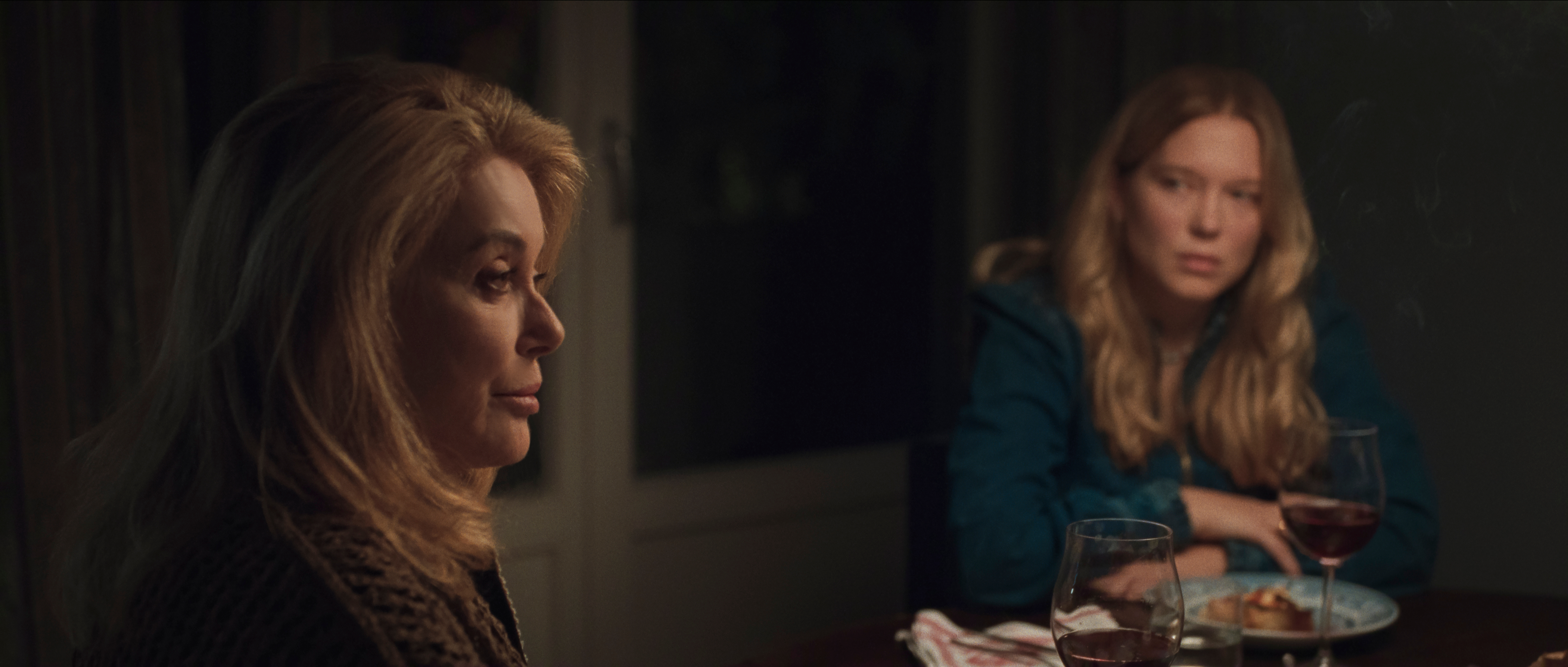
Léa Seydoux plays Lucy, an avant-garde musician who has built a comfortable life with her husband, Philip, and their young son. They’ve moved to a house in the country, hoping for a less frantic existence in which her work and their family might finally have room to breathe. Then Philip is accused of an appalling crime involving children, and the life Lucy thought she understood begins coming apart. Her first response is disbelief, followed by the understandable impulse to defend him. But there are moments when the evidence and her own instincts begin suggesting that the person she wants to protect may not deserve it. Lucy retreats to the home of her mother, Eloise (Catherine Deneuve), a famously unsentimental musician whose own choices as a parent have left their share of scars. The two women have plenty to discuss, and very little practice discussing it kindly.
When Trust Becomes a Trap
Kreutzer, who previously directed Corsage, has described finding the idea for the film in a German newspaper report about a major investigation into child sexual abuse in 2020. What unsettled her was not simply the scale of the crimes, but how often the suspected perpetrators were people trusted by children and the families around them. During development, the subject became painfully close to her professional life when Florian Teichtmeister, who had appeared as Emperor Franz Joseph in Corsage, was charged with possessing child sexual abuse material. He pleaded guilty in 2023. Kreutzer has said she considered abandoning Gentle Monster after the case emerged, then recognized that the discomfort of confronting something so close to home was precisely why the story mattered. That history gives the film a particular urgency, although she wisely resists turning it into a dramatized investigation or a procedural built around lurid revelations.
Instead, the film stays with the people left standing after an accusation changes everything. Lucy has no way to return to the family she believed she had, but she isn’t immediately equipped to accept what may have happened, either. She still remembers the man she loved, the father of her child, the apparently ordinary moments that once seemed proof of his decency. Those memories don’t vanish because a police investigation begins. Kreutzer understands that denial often isn’t a simple refusal to face facts; it can be an attempt to protect an entire version of your life from collapsing. That doesn’t excuse the harm denial may cause, and the film is at its most challenging when it asks us to recognize Lucy’s confusion while remaining alert to the people whose suffering might be overlooked if her husband’s comfort becomes the priority.
The film’s international production gives the story a fascinating sense of cultural and emotional displacement. Made across Austria, Germany, and France, it never settles into the familiar rhythms of an American domestic thriller. Lucy’s uncertainty isn’t punctuated by constant confrontations or a new clue every ten minutes. There are long stretches when she’s simply waiting, trying to decide what she believes and how to behave when no option feels remotely acceptable. Sometimes that deliberate pacing can be frustrating, and I occasionally wished Kreutzer would give Lucy another reason to act instead of another reason to worry. But I also appreciated the refusal to make her situation more dramatically convenient than it ought to be. People caught in a crisis like this don’t get to demand that the next piece of evidence arrive before dinner.

Seydoux Under Pressure
Seydoux is exceptional, giving a performance that relies less on speeches than on the small changes in a face that no longer knows what expression is appropriate. Shock gives way to anger, anger to doubt, and doubt to a desperate desire for reassurance, only for the cycle to begin again when something new unsettles her. She makes Lucy’s contradictory impulses completely understandable without asking us to approve of all of them. One moment Lucy seems ready to protect Philip at any cost; the next you can see her recognizing what that protection might mean for other people, including her son. It’s complicated, uncomfortable work, and Seydoux brings the same intelligence she has shown in The Grand Budapest Hotel, Dune: Part Two, and No Time to Die to a character whose most difficult decisions are almost entirely internal.
The question of Philip’s guilt hangs over the narrative, but the screenplay is smart enough not to make a verdict the only thing that matters. Lucy is being forced to examine her own values. How much can she forgive? What does she owe a husband who may have betrayed everything she believes? And how does she protect her child without letting her wish for a normal family take precedence over his safety? Those aren’t questions that can be answered by one dramatic confession. What makes Seydoux so compelling is the way she allows Lucy’s understanding of herself to change alongside her understanding of Philip. Even when the film appears to be standing still, the performance rarely is.
Judith Kaufmann, who also photographed Corsage, shoots on 16mm and 35mm film, bringing a beautifully tactile quality to the country house and its surrounding landscape. Sunlight falls across rooms that should look peaceful, but the more Lucy begins to question her marriage, the more threatening those familiar spaces become. It’s a lovely contrast between outward security and private dread. The score by Camille, who shared an Academy Award for a song from Emilia Pérez, is similarly restrained and unsettling. Lucy’s piano interpretations of familiar songs become another way of expressing feelings she’s unable to articulate, beginning with Charles & Eddie’s “Would I Lie to You?” It’s a pointed choice without feeling like a joke, especially in a film where the central question is whether somebody has been lying for years.
Mothers and Daughters
Deneuve doesn’t need much screen time to make her presence felt. As Eloise, she brings an authority that comes not from comforting Lucy, but from refusing to join in her wishful thinking. She’s cool, pragmatic, and occasionally maddening, the sort of parent who can tell you an unpleasant truth without offering anything as frivolous as a hug afterward. Yet the performance gradually suggests that some of her bluntness comes from recognizing decisions she once made herself, when her own music career demanded sacrifices and her daughter was expected to adapt. Their scenes are among the film’s most interesting because they’re not simply about the current scandal. They’re about the compromises women are expected to make for their families, and the resentments that can accumulate when those compromises go unacknowledged. Watching Seydoux and Deneuve together, two generations of French cinema create an extraordinary amount of tension without raising their voices very much.
Laurence Rupp is carefully measured as Philip, playing him in a way that makes Lucy’s uncertainty believable. The film doesn’t need him twirling a metaphorical mustache to announce himself as dangerous. It needs us to understand how someone accused of something monstrous can still look and sound like the ordinary person his family knows. But I was equally taken with Jella Haase as Elsa, the detective whose dealings with Lucy carry a professional restraint that occasionally reveals flashes of compassion. Haase understands how difficult it is to offer someone help when the facts of a case aren’t yours to disclose, and she gives Elsa a steadiness the film needs whenever Lucy’s life begins spinning out of control.
The Other Family Secret
Elsa’s story gradually becomes more than a supporting thread. At home, she’s dealing with her father (Sylvester Groth), whose dementia has caused him to mistake his live-in caregiver for his late wife and make unwanted advances toward her. The nurse is frightened and wants protection, leaving Elsa in the uncomfortable position of having to confront harmful behavior committed by someone she loves and understands to be ill. It’s a different situation from Lucy’s, and Kreutzer doesn’t treat the two men or their circumstances as equivalent. What connects the stories is the question of how readily people make exceptions when accountability reaches their own front door. Protecting somebody vulnerable can become tangled with the desire to protect a family member from consequences, and even the people who spend their working lives advocating for victims can find that distinction difficult in practice.
I particularly admired that parallel because it prevents Gentle Monster from becoming a simplistic story about a gullible wife and a terrible husband. Lucy and Elsa are intelligent women who understand the importance of protecting others, yet each discovers a situation in which the right thing to do carries a painful personal cost. Neither can retreat into the comfort of a principle until it has been tested by someone she loves. Kreutzer never suggests that uncertainty makes them innocent of every choice they might make next. Instead, she asks how long we can allow fear, guilt, and familial affection to delay a decision that may be necessary to protect somebody else.
The film can be a demanding watch, partly because its measured pace leaves so much room for us to sit with Lucy’s uncertainty. But Seydoux and Haase give it an emotional force that lingers well beyond the final scene, and Deneuve’s handful of appearances are worth the visit alone. The real monster in Gentle Monster isn’t a creature waiting in the shadows. It’s the possibility that someone we love could be capable of something we cannot bear to imagine, and the uncomfortable recognition that we might still want to look away. That’s considerably more frightening than the average domestic thriller, largely because it doesn’t end when the lights come up.
Gentle Monster is streaming on Netflix.

The Final
Léa Seydoux gives a remarkable performance in Gentle Monster, a deeply unsettling drama about loyalty, denial, and the damage that can occur when terrible behavior comes from someone inside the family. Catherine Deneuve and Jella Haase are superb, and Marie Kreutzer gives the story more moral complexity than its premise might suggest. The pacing is occasionally slow, but the questions it raises don’t leave you in a hurry.
8/10
Where to watch: On Netflix now; also released in select theaters

Reviewed by Joe Botten
Joe Botten is The MN Movie Man, a Twin Cities film critic writing spoiler-free reviews since 2012. He also writes for Loud and Clear Reviews, a Rotten Tomatoes approved site. Find him on Instagram and Letterboxd.
Looking for something?
Search by actor, movie, director, genre or keyword.


Leave a Reply