
Movie Review
American Theater
8/10
TLDR
Nicholas Clark and Dylan Frederick’s American Theater is a fascinating, occasionally hilarious, and increasingly unsettling documentary about a controversial theater director staging his comeback in the Georgia woods. The filmmakers let their subjects do nearly all the talking, which is both the movie’s greatest strength and its most frustrating limitation. Somewhere between Waiting for Guffman and a political campaign rally, there’s a production of the Salem witch trials that has to be seen to be believed.
Where to watch: On the Letterboxd Video Store now; Heights Theater November 30; on demand December 15
The Facts
Synopsis: After leaving the Atlanta theater community amid controversy, director Brian Clowdus assembles a group of conservative performers at an isolated Georgia cabin to create a musical retelling of the Salem witch trials, while pursuing a political career of his own.
Director: Nicholas Clark and Dylan Frederick
Stars: Brian Clowdus, Julie Trammel, Savannah Craven, Tatiana Harman
Rated: Not Rated
Running Length: 83 minutes
The Thoughts
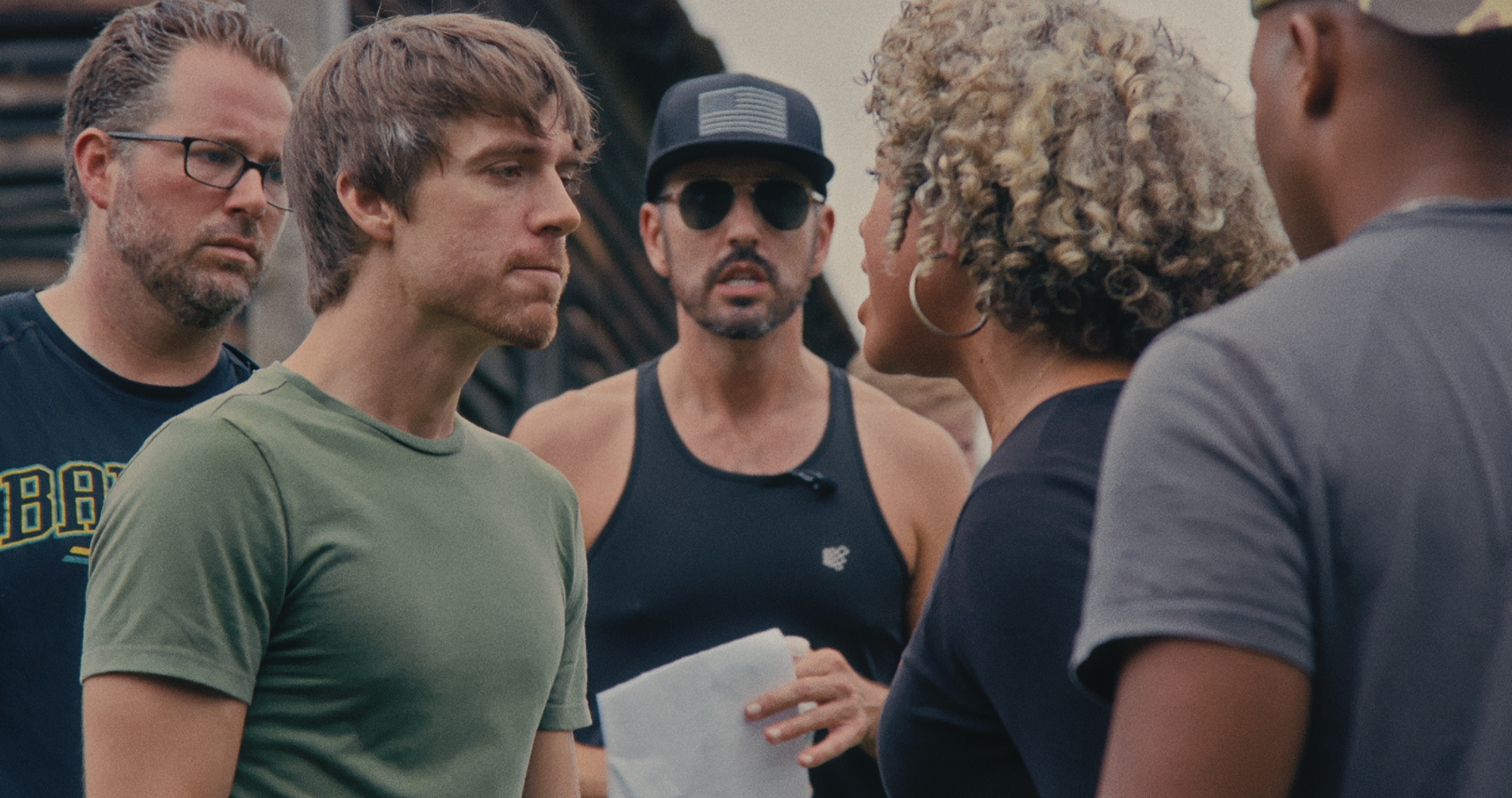
The Salem witch trials have inspired countless plays, movies, and television programs, but I’m not sure anyone has approached the material quite like Brian Clowdus. In American Theater, directors Nicholas Clark and Dylan Frederick follow the controversial theater director as he assembles a group of performers in the Georgia woods to stage a musical about persecution, public accusations, and a community turning against its own. Clowdus believes he knows something about that last part, having experienced a very public fall from grace himself. The resulting documentary, winner of the Documentary Feature Grand Jury Prize at Slamdance, is an absolutely fascinating fly-on-the-wall look at a man determined to make his comeback. Or perhaps bug-on-the-ceiling is more appropriate, considering where most of this takes place.
If Clowdus’s name sounds familiar, it’s probably because of Serenbe Playhouse, the outdoor theater company he founded outside Atlanta. His productions were elaborate, site-specific affairs that included staging Titanic on an actual sinking ship and Miss Saigon with a real helicopter landing. I remember reading about these ambitious shows and desperately wanting to experience one for myself. As someone who loves theater that finds ways to surprise an audience, I was fascinated by a director willing to go to such extraordinary lengths to bring familiar material to life. Of course, there’s a difference between ambitious theatrical imagination and the temperament required to lead a company, and the story of Clowdus’s career took a considerable turn before I ever had the opportunity to buy a ticket.
Clowdus left Serenbe in late 2019, allegations concerning his conduct became public the following summer, and the playhouse closed in 2020. By October 2021, when this documentary was filmed, he’d found a new audience among conservative theatergoers and was preparing a production called The Salem Experience. The location was an abandoned cabin and surrounding woods previously used for Lawless and The Walking Dead. The cast consisted mostly of like-minded performers, the production promised an immersive musical experience, and Clowdus was simultaneously campaigning for a seat in the Florida House of Representatives. Apparently, rebuilding a theatrical career wasn’t quite enough to keep him busy.
The Cameras Keep Rolling
What makes American Theater so interesting is how little Clark and Frederick interfere with the proceedings. There are no talking-head experts explaining what we should think, no narrator providing a convenient history lesson, and very little apparent interest in steering the audience toward a predetermined conclusion. Clark handles the cinematography, while Frederick and Laura Hilliard shape the footage into an 83-minute portrait that moves between rehearsals, production meetings, candid conversations, and political appearances. The directors seem perfectly content to turn on the cameras and see what happens, which is a refreshing approach to a subject who probably doesn’t need much encouragement to keep talking.
I appreciated that restraint, although there were moments when I desperately wanted somebody to ask a follow-up question. Comments are made, contradictions emerge, and conversations occasionally head into territory that deserves a little more examination, but the filmmakers rarely intervene. Depending on your perspective, that will either feel wonderfully objective or frustratingly incomplete. I experienced a little of both. There’s considerable value in allowing people to reveal themselves through their own words and behavior, but I also found myself wondering what had been left out of the story and whether a bit more context might have made some of the stranger moments even more revealing.
Then there’s the production itself. We’re watching a group of people put together an immersive musical about the Salem witch trials, but the documentary offers remarkably little explanation of what the finished show is supposed to be. Who wrote it? How does the music fit into the story? What exactly are audiences going to experience after purchasing a ticket? We’re discovering these things at roughly the same pace as the cast, watching scenes develop, staging decisions change, and theatrical ideas take shape in the middle of the woods. As someone who reviews theater, I found that process endlessly entertaining. There’s nothing quite like watching a production race toward opening night while wondering whether everybody involved has the same understanding of what they’re making.

A Witch Hunt in the Woods
Of course, it’s impossible to separate this production from the culture wars that have found their way into nearly every corner of American life, including our theaters. Clowdus has positioned himself as someone unfairly driven from the community he helped build, and The Salem Experience gives him a historical story that seems almost suspiciously well suited to his personal narrative. He’s staging a show about a community persecuting people it has decided are guilty, while building a new career around his own experience of being accused and ostracized. The parallel is impossible to miss, although some of the performers insist the production isn’t political. That’s quite a claim when the director is literally running for political office between rehearsals.
What makes these moments so compelling is that nobody seems particularly interested in acknowledging the contradiction. Clowdus presents himself as an artist fighting for the freedom to create, while his company embraces a production that appears deeply connected to the circumstances surrounding his reinvention. The performers speak earnestly about their work, their beliefs, and their desire to be part of something meaningful. I found myself wondering how much of the production they viewed as artistic expression and how much they understood as a public statement. Either way, they’re committed, and the camera captures that commitment alongside a few moments that are almost too perfectly absurd to believe.
The company itself is an interesting collection of personalities. Julie Trammel plays Bridget, one of the accusers, while Tatiana Harman portrays Sarah Good. Savannah Craven, another member of the cast, would later attract national attention through her anti-abortion activism, including an incident in which she was struck during a street interview in New York. Trammel subsequently married Ricky Schroder in 2025. Their lives outside this production add another layer of curiosity, but what interested me most was watching them work together. Everyone brings a different personality to the company, and their enthusiasm sometimes seems to outpace the material they’re being asked to perform.
The filmmakers have acknowledged American Movie and Christopher Guest‘s Waiting for Guffman as influences, and I can certainly see the resemblance. There are stretches when American Theater feels like a mockumentary that somebody forgot to tell the participants they were making. The dramatic declarations, the theatrical ambitions, the tiki-torch atmosphere, and the occasional gap between artistic intention and execution are enormously funny. But the humor is complicated by the sincerity of the performers, many of whom clearly believe they’re creating something worthwhile. You can laugh at the spectacle while recognizing how badly some of these people want to be taken seriously, and that combination makes the film considerably more interesting than a simple exercise in ridicule.
It’s also worth mentioning that the documentary counts Tony-nominated playwright Jeremy O. Harris, the creator of Slave Play, among its executive producers. Given how much of his own work has generated conversations about representation, artistic expression, and the politics surrounding theater, his involvement adds an intriguing wrinkle to a documentary that largely refuses to conduct those conversations on the audience’s behalf.
The Price of Admission
Out of curiosity, I looked up what audiences were charged to attend The Salem Experience, and I nearly fell out of my chair. Tickets ranged from $39 to $99, with the most expensive option offering a VIP experience. That’s not an insignificant amount of money for a production staged around a cabin and pond in the Georgia woods, where guests were promised an immersive, 360-degree theatrical experience complete with live music, fire, and a haunted atmosphere. I’ve paid less to see touring Broadway productions with considerably larger casts, professional orchestras, and actual indoor plumbing. Then again, I suppose the chance to experience the Salem witch trials without leaving Georgia was supposed to be part of the appeal.
The film gives us enough of the finished show to form an impression, although the rehearsals and backstage activity are frequently more entertaining than the performance itself. Having spent many years involved with theater onstage, I know there’s often a considerable difference between the polished production audiences experience and the frantic scramble required to get it there. American Theater makes that scramble the main attraction. Watching Clowdus move between theatrical rehearsals and campaign events is particularly revealing, because the same promotional energy seems to drive both activities. Whether he’s selling a production or selling himself, the performance rarely stops.
Clowdus’s political aspirations eventually came to an end when he lost the 2022 Republican primary for Florida House District 6 to Griff Griffitts, approximately 66% to 34%. The documentary doesn’t attempt to turn that election into a larger political investigation, but it does capture a fascinating moment when its subject is trying to establish a new identity in two different professions at once. Watching him move between those worlds, I kept wondering whether theater was his platform for politics, politics was his platform for theater, or the distinction had simply stopped mattering to him.
The Show Must Go On
I may regret saying this later, but I came away from American Theater thinking that Brian Clowdus could easily be the subject of an entire documentary series, sort of like Chrisley Knows Best. He’s a complicated, frequently exasperating character whose ambitions, beliefs, and public persona offer enough contradictions to keep a filmmaker busy for years. There’s no denying that his early theatrical work demonstrated considerable imagination, and I can still understand why those Serenbe productions sounded so exciting. But seeing more of the man behind them has changed how I feel about that work, particularly when artistic ambition appears so closely connected to personal reinvention and the need to control a narrative.
What Clark and Frederick have accomplished is to make those questions interesting without providing ready-made answers. I occasionally wished they’d pushed harder or offered more context, but there’s something admirable about their willingness to let the material speak for itself. The documentary is funny, uncomfortable, occasionally maddening, and consistently fascinating, with moments that would seem far too exaggerated if somebody had written them as fiction. I’m not entirely sure what I’d have made of The Salem Experience had I been sitting in that audience, although I suspect I might have had a few things to say about the ticket price.
American Theater, on the other hand, is worth the admission. It’s available now on the Letterboxd Video Store, screens at the Heights Theater on November 30, and arrives on demand December 15.

The Final
American Theater is a fascinating, funny, and occasionally unsettling portrait of a director staging his own comeback while mounting a production about persecution. Clark and Frederick let their subjects do the talking, and while I occasionally wanted someone to challenge what was being said, the resulting documentary is difficult to look away from. Salem has seen its share of trials, but I don’t think it’s ever had a theatrical production quite like this one.
8/10
Where to watch: On the Letterboxd Video Store now; Heights Theater November 30; on demand December 15

Reviewed by Joe Botten
Joe Botten is The MN Movie Man, a Twin Cities film critic writing spoiler-free reviews since 2012. He also writes for Loud and Clear Reviews, a Rotten Tomatoes approved site. Find him on Instagram and Letterboxd.
Looking for something?
Search by actor, movie, director, genre or keyword.


Leave a Reply