
Movie Review
The Further Mis-Adventures of Cliff Booth
8.5/10
TLDR
David Fincher takes Quentin Tarantino’s favorite stuntman into the seedier corners of 1977 Los Angeles, and Brad Pitt makes slipping back into Cliff Booth’s shoes look effortless. Elizabeth Debicki is sensational, the supporting cast is loaded with pleasures, and the period atmosphere is worth the price of an IMAX ticket alone. A few questionable choices and an ending that comes much too soon keep it from going the distance, but I’d happily spend another evening watching Cliff Booth get himself into trouble.
Where to watch: In IMAX theaters November 25; on Netflix December 23
The Facts
Synopsis: Los Angeles, 1977. Eight years after the events of Once Upon a Time… in Hollywood, former stuntman Cliff Booth makes a living tending bar, running a projector, and taking care of problems Hollywood would prefer to keep out of the papers. A call from talent agent Karen Crosby, on behalf of television star Charlie Peters, draws him into a dangerous mix of ambition, secrets, and considerably less glamorous show business.
Director: David Fincher, from a screenplay by Quentin Tarantino
Stars: Brad Pitt, Elizabeth Debicki, Scott Caan, Carla Gugino, Yahya Abdul-Mateen II, Peter Weller, and Timothy Olyphant
Rated: R for some strong/disturbing violence, bloody images, pervasive language, sexual content, nudity, and drug use
Running Length: 143 minutes
The Thoughts
When I reviewed Once Upon a Time… in Hollywood back in 2019, I gave it an 8 out of 10. I loved disappearing into Quentin Tarantino’s lovingly reconstructed Los Angeles, even if I didn’t always love the detours he took getting us through it. The character I kept coming back to was Cliff Booth, Brad Pitt‘s relaxed, sharp-eyed stuntman with a terrible reputation and an unnerving ability to make violence look like an ordinary part of his afternoon. Pitt won an Oscar for the performance, and deservedly so, but what made Cliff interesting wasn’t simply that he could handle himself in a fight. It was how little he seemed to need anyone else’s approval. He knew who he was, or at least knew how much of himself he was willing to share, and that made him the most intriguing person in the room.
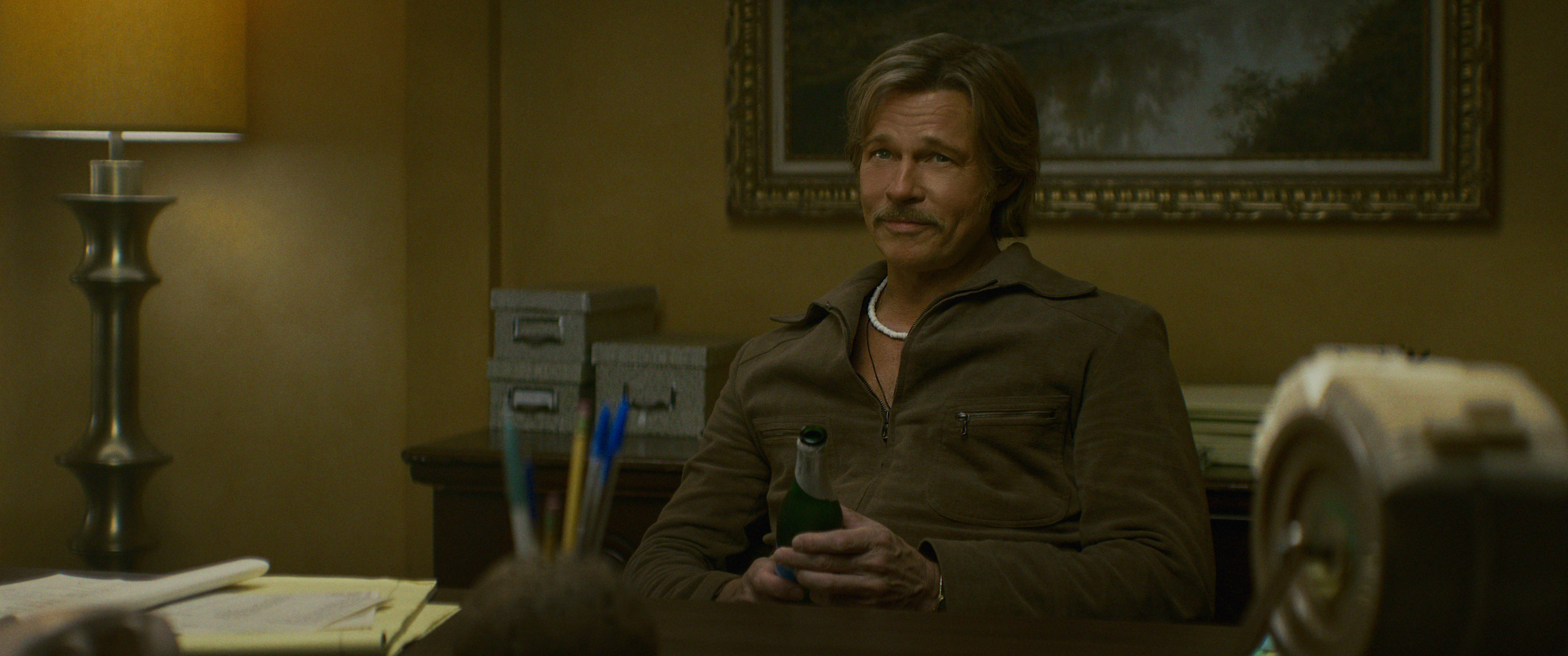
Now it’s 1977, eight years later, and Cliff is still hanging around the edges of Hollywood, only the business has changed and so has his place in it. In The Further Mis-Adventures of Cliff Booth, he’s tending bar, running a projector, and working as the sort of fixer people call when a famous name has become attached to an unfortunate problem. It’s a clever next chapter for a man who once made his living taking the falls intended for movie stars. These days he’s being paid to make sure the stars don’t fall in the first place, at least not where anyone can see them. One phone call from talent agent Karen Crosby (Elizabeth Debicki), acting on behalf of television star Charlie Peters (Scott Caan), is enough to drag Cliff into a dangerous little web of favors, secrets, and people who have a great deal to lose if the wrong story gets out.
I may have enjoyed this film even more than its predecessor, although they’re different enough that comparing them almost feels unfair. Tarantino’s original was a fairy tale about a Hollywood that might have been, complete with a history-changing finale. This one is more interested in what happens when the fantasy has faded, the parties have become business transactions, and the people who once worked in front of the camera are increasingly dependent on the people who know how to operate behind it. The pleasure isn’t simply in seeing Cliff again. It’s in finding out what kind of man he becomes when he’s no longer standing in somebody else’s shadow.
Same Cliff, Different Hollywood
The most fascinating thing about this sequel is the pairing behind the camera. Quentin Tarantino wrote the screenplay but ultimately chose not to direct it, deciding he’d already spent enough time in this particular Hollywood. Enter David Fincher, reuniting with Pitt after Se7en, Fight Club, and The Curious Case of Benjamin Button. On paper, the combination could have been a spectacular mismatch. Tarantino likes to invite you into a room and let everybody talk until the drinks run out. Fincher strikes me as the kind of director who would like to know who’s listening, where the exits are, and what everyone is trying to hide. But their instincts work together surprisingly well, giving the movie Tarantino’s peculiar affection for Hollywood characters and Fincher’s gift for making even a casual conversation feel like somebody’s about to get caught.
Fincher has described receiving an enormous first draft of roughly 230 pages, enough material for what he considered essentially two movies, and cutting about 60 pages before filming. You can feel the scale of what Tarantino originally imagined in the many conversations, side characters, and pieces of show-business history tucked into the finished film. Some are important to the crime story, while others seem to exist because these filmmakers simply enjoy spending time with people who live, breathe, and occasionally exploit the movies. I enjoyed much of that wandering. It’s part of the charm. But the film also has a habit of taking the scenic route through its middle section, which becomes harder to ignore once you realize how little time remains for the ending.
What I particularly appreciate is that Fincher doesn’t try to make a Tarantino movie in someone else’s clothes. The first film had a warm, sun-drenched nostalgia for 1969, even when violence was waiting around the corner. The 1977 Los Angeles of this film is older, murkier, and much more interested in who owes whom a favor. There’s a touch of Robert Altman‘s The Long Goodbye in its willingness to let us hang around with a man who may understand less of the larger conspiracy than he’d care to admit, and some of the cynical Hollywood machinery of Chinatown in the background. These aren’t direct imitations, just part of the cinematic company the movie seems happy to keep. If the original was a love letter to old Hollywood, this is the one written after everyone has learned a few uncomfortable things about the recipient.

Hollywood Looks Good Dirty
Erik Messerschmidt‘s cinematography is a major reason to see this on a large screen. The Los Angeles here isn’t a museum display of vintage cars and period costumes, although the production detail is tremendous. It’s a city that looks as though people actually work, drink, sweat, and make terrible decisions in it. Fincher fills the frame with faces worth studying, rooms full of information, and a sense of place that makes the city feel like another character. It’s an enormous pleasure to lose yourself in the look of the film, particularly when the camera settles long enough for you to appreciate the things happening at the edges of a scene.
And the music! Between the irresistible 1970s needle drops and the darker, more anxious material from Trent Reznor and Atticus Ross, the soundtrack seems to understand the film’s divided personality. One moment you’re enjoying the pleasure of being back in this era, and the next you’re reminded that Cliff’s new line of work can turn ugly in a hurry. Music and image do an enormous amount of storytelling here without anyone having to stop and explain the decade to us. That’s exactly why I’d make the effort to see it in IMAX rather than waiting for my living room. You don’t need a screen that size to follow the plot, but this is the sort of movie whose atmosphere deserves the extra real estate.
Everyone Wants a Piece of Cliff
Pitt is dynamite, slipping back into Cliff’s easy confidence without simply repeating what won him an Oscar the first time. He’s still funny, unflappable, and occasionally alarming, but there’s something particularly appealing about watching an older Cliff assess the nonsense surrounding him. He knows how Hollywood works because he’s spent his life being useful to people who rarely think about what happens to the useful guy afterward. His charm makes him easy to like, but Pitt never lets us forget that he’s also capable of doing things we might find appalling if a less handsome actor were doing them. That’s an important distinction. Cliff isn’t suddenly a saint because he’s the title character, and the movie is more interesting for allowing him to remain morally slippery.
Debicki (Widows) very nearly walks away with the picture as Karen Crosby, a talent agent whose intelligence and composure make her an ideal match for somebody as hard to rattle as Cliff. Their chemistry is terrific, partly because the two actors seem to enjoy testing how much the other character is willing to reveal. Debicki can make an ordinary exchange feel like a negotiation in which she already knows the price of everything, and she gives the film a welcome energy whenever she appears. I wanted more of her, which is saying something in a film that already has a lot of people competing for Cliff’s attention.
Carla Gugino (Gerald’s Game) continues to do the kind of excellent work that should never surprise us and somehow still does, bringing warmth and complexity to Toni, Charlie’s wife. Yahya Abdul-Mateen II (Us) has the presence of someone who could have been a major Hollywood star in practically any decade as Roderick “Hot Rod” Harrison, a football champion who has made the transition to leading man. Peter Weller (RoboCop) is wonderful as Cliff’s father, Gus, adding a personal dimension to a character whose family life previously existed mostly outside the frame. Caan has a great time as Charlie, a television star with a highly developed opinion of himself, and Timothy Olyphant makes a welcome return as James Stacy. It’s a terrific ensemble, but what makes it work is that everyone seems to have a life beyond the particular problem Cliff has been hired to solve.
A Few Blows That Miss
For all its pleasures, the film isn’t without some disappointments. I wasn’t especially fond of the opening’s reliance on a derisive, homophobic storyline when Tarantino and Fincher are capable of finding much more imaginative ways to make people uncomfortable. The material has a mean streak that feels less revealing than it could have been, and it struck me as an unnecessarily easy route into a movie otherwise so interested in the complexities of its characters. It doesn’t ruin what follows, but it does get things off on a sour note. And while I enjoy Tarantino’s conversational detours as much as anyone, there are times in the middle when the story seems to be enjoying its own company a little too much. Fincher usually has an almost ruthless sense of momentum, so the occasional looseness stands out here.
My biggest complaint, though, is the ending. After 143 minutes of building this world, introducing people worth caring about, and inviting us deeper into Cliff’s latest predicament, the film seems to decide rather suddenly that we’ve had enough. I actually found myself wondering whether a few scenes had gone missing. I’m not asking for every thread to be tied into a tidy bow, especially in a story about a man who makes his living dealing with other people’s messes. But there’s a difference between an ending that leaves things intriguingly unresolved and one that leaves you feeling as though someone has closed the book while you’re still reading. Knowing how much material was removed from Tarantino’s original screenplay makes me all the more curious about what might have been left on the cutting-room floor. Maybe that isn’t fair to the film we have, but it’s difficult not to wonder.
Still, I had a tremendous time with The Further Mis-Adventures of Cliff Booth. Pitt remains endlessly watchable, Debicki is a knockout, and Fincher finds a distinct identity within a world Tarantino created without sanding away the eccentricities that made it fun to visit in the first place. The film is at its best when it remembers that Hollywood has always needed people like Cliff, the men who do the dangerous work, keep the secrets, and rarely get their names above the title. Now he finally has his name there, and it suits him. I just wish we’d been allowed to stay a little longer.

The Final
The Further Mis-Adventures of Cliff Booth is a stylish, funny, and frequently thrilling return to a character who deserved more than one movie. Fincher and Tarantino make an unexpectedly terrific team, Pitt is in top form, and Debicki nearly steals the whole show. Some uncomfortable early material, a wandering middle, and a finale that arrives before I’m ready keep it from being an outright knockout. But I already know I’d buy a ticket for Cliff’s next job. Preferably one that lets him finish the story.
8.5/10
Where to watch: In IMAX theaters November 25; on Netflix December 23

Reviewed by Joe Botten
Joe Botten is The MN Movie Man, a Twin Cities film critic writing spoiler-free reviews since 2012. He also writes for Loud and Clear Reviews, a Rotten Tomatoes approved site. Find him on Instagram and Letterboxd.
Looking for something?
Search by actor, movie, director, genre or keyword.


Leave a Reply