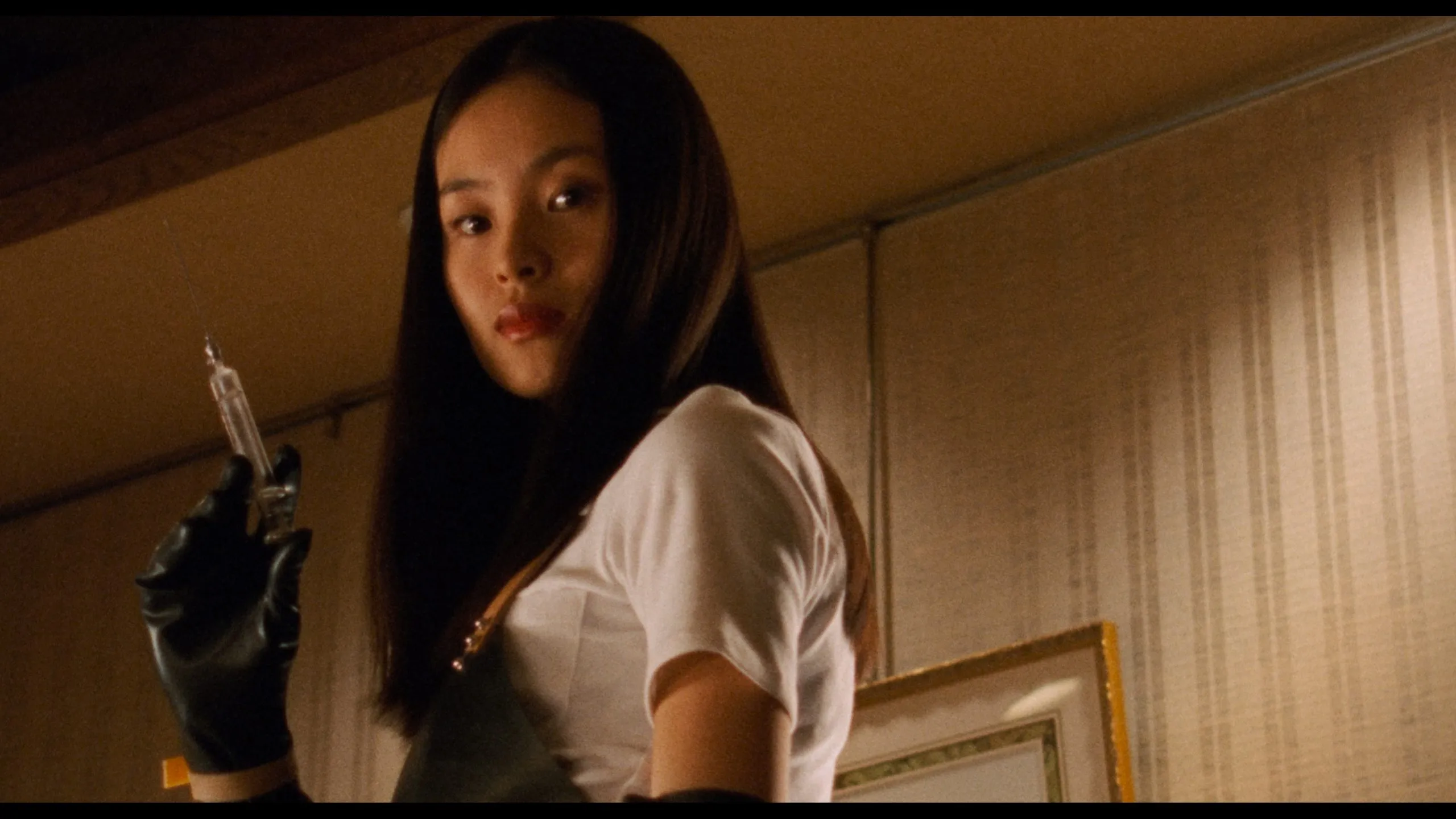

Audition (1999)
4K UHD · Arrow Video
Shelf Worthy
In Brief
Takashi Miike’s deceptively gentle Audition reaches 4K UHD from Arrow Video, newly restored from the original Super 16mm camera negative with Dolby Vision and the original sound options. The extensive extras from the 2019 Blu-ray return alongside two additions. It begins like an awkward romance and ends somewhere I wouldn’t wish on anyone. First-time viewers should know as little as possible.
The Facts
Synopsis: A lonely widower agrees to a sham casting call arranged by a producer friend so he can meet prospective partners, then becomes fascinated by a reserved former dancer whose past he knows little about.
Starring: Ryo Ishibashi, Eihi Shiina, Tetsu Sawaki, Jun Kunimura
Directed by: Takashi Miike
Rated: Not Rated
Running Length: 115 minutes
Buy It Here
The Package
Label: Arrow Video
Format: 4K UHD
Release Date: June 16, 2026
Video: 2160p, Dolby Vision and HDR10, 1.85:1, from a new 4K restoration of the original Super 16mm camera negative approved by cinematographer Hideo Yamamoto.
Audio: Japanese DTS-HD Master Audio 2.0 stereo and 4.0 original mixes, newly restored, plus a 5.1 option
Subtitles: English
Discs: One 4K UHD with the feature and all extras. Limited edition with original-pressing slipcover, reversible sleeve, and collector’s booklet. No Blu-ray included.
The Film
The production company behind Ring wanted another horror success, and its next idea was to adapt a novel that didn’t even feature a ghost. That turned out to be a shrewd choice. Takashi Miike’s Audition reached international festival audiences in 2000 and acquired a reputation for leaving people shaken, a reputation it has spent the years since more than justifying. I’d avoid reading too much about the film before a first viewing. The setup is simple enough to explain, but the pleasure and discomfort come from how thoroughly Miike changes your expectations of what kind of movie you’re watching.
Shigeharu Aoyama (Ryo Ishibashi, Suicide Club) has been a widower for seven years. He raises his teenage son, maintains a comfortable professional life, and seems to have accepted the idea that romance belongs to his past. His son thinks otherwise, gently encouraging him to consider finding somebody new. Aoyama’s friend Yoshikawa (Jun Kunimura, Kill Bill: Vol. 1), a film producer, suggests an unusual solution: hold an audition for a movie that won’t actually be made, giving Aoyama a convenient way to meet a large number of women without the complications of traditional dating. That this is a terrible idea apparently occurs to neither man soon enough.
Among the candidates, Aoyama is drawn to Asami Yamazaki (Eihi Shiina, making her acting debut), a reserved former ballet dancer whose application suggests a life interrupted by injury and disappointment. She is soft-spoken, hesitant, and unusually earnest, traits that seem to answer everything Aoyama hopes to find in a partner. He begins pursuing her, even as Yoshikawa grows uneasy about how little they can verify of her background. Aoyama, of course, has already decided the mystery is part of the attraction. It’s difficult to admit you’ve made a poor romantic decision when you’ve gone to such elaborate lengths to arrange it.
Daisuke Tengan adapted Ryu Murakami’s 1997 novel, and Miike shot the film in Tokyo in roughly three weeks with longtime collaborators, including cinematographer Hideo Yamamoto and composer Koji Endo. For much of its running time, the movie seems determined to be a quiet study of loneliness, courtship, and the gap between who someone is and who we imagine them to be. Aoyama isn’t an obvious monster, but his method of meeting women exposes a selfishness he barely recognizes. He wants a fresh start, yet the audition allows him to evaluate prospective partners as though their lives exist chiefly for his convenience. That imbalance matters long before the movie decides to become frightening.
Ishibashi gives Aoyama a believable mixture of sadness, complacency, and hope, never asking us to admire the deception that brought him to Asami. Shiina, meanwhile, has an extraordinarily controlled presence. The small pauses in her speech, the careful movements, and the watchfulness in her eyes are difficult to read. Depending on the moment, she seems vulnerable, guarded, or merely uncomfortable around a man she barely knows. Miike understands that an audience eager to identify a threat can create its own anxiety out of something as simple as a telephone that won’t ring.
The slower opening isn’t wasted time. It lets us settle into Aoyama’s perspective and the rhythms of an ordinary romantic drama before the film starts disturbing that confidence. Miike doesn’t simply spring a surprise for shock value; he gradually reveals how much the characters and audience have been willing to assume. By the time the final stretch arrives, the experience is far more upsetting than it would have been if the picture had announced its intentions from the first scene. The tonal shift has become famous, but describing it in detail would do a first-time viewer no favors.
I admire the patience of a film this notorious. It’s willing to spend a long time in mundane conversations and moments of silence because it knows they will acquire a different meaning later. Some viewers will struggle with the pace, and others will find the conclusion too much to bear. Both are understandable reactions. What makes Audition exceptional is that its horror emerges from the same emotional territory as its romance: loneliness, vulnerability, resentment, and the dangerous temptation to turn another person into whatever we need them to be. It may be the politest horror film I’ve ever seen, at least until it isn’t.

The Transfer
Video
Arrow’s new restoration comes from the original Super 16mm camera negative, scanned at Imagica in Japan, graded in Wales, and approved by cinematographer Hideo Yamamoto. Presented at 1.85:1 in 2160p with Dolby Vision and HDR10, it retains the thicker grain and tactile character of the small-gauge photography. The color palette moves through restrained sepia tones and cooler blues and greens, with deeper reds gaining particular force when the story calls for them. The film shouldn’t look glossy, and the restoration respects that. Arrow’s 2019 Blu-ray came from a 2K restoration of a 35mm interpositive, making this a meaningful step closer to the photographed material.
Audio
Three Japanese DTS-HD Master Audio options are included: newly restored original 2.0 stereo and 4.0 mixes, plus a 5.1 presentation. The four-channel mix is an appealing choice for the original surround design, while the stereo provides a straightforward alternative. This is a movie in which small sounds can be more unnerving than the largest effects, and clean dialogue and controlled ambience matter enormously. English subtitles are included.
Transfer Notes
Arrow presents the same 115-minute version on a single UHD. The 2019 edition’s extensive supplements carry over, while the new restoration gives returning viewers the strongest reason to revisit it. There is no standard Blu-ray copy in this particular package.

Special Features
- Introduction by Takashi Miike (1:16): A brief greeting tucked into the Play menu.
- Audio commentary by Takashi Miike and Daisuke Tengan: Director and screenwriter discuss their collaboration.
- Audio commentary by Tom Mes: The filmmaker’s biographer places the movie in a wider context.
- Callback: Ryo Ishibashi on Audition (NEW, 8:00): A recent conversation with the lead actor.
- Ties That Bind (30:07): Miike’s interview from 2019.
- Damaged Romance (35:22): Tony Rayns examines the film’s ideas and impact.
- Archival cast interviews: Ryo Ishibashi (16:15), Eihi Shiina (20:10), Renji Ishibashi (20:57), and Ren Osugi (16:27), presented in HD.
- Deeper Deeper Into Audition (NEW, 11:18): An audio essay by Alexandra Heller-Nicholas.
- Japanese and international trailers: Both are included; the Japanese trailer reveals far too much for a first viewing.
- Image gallery: Approximately 31 images.
- Booklet and reversible sleeve: New essays by Anton Bitel, Jennie Kermode, and Jamie Graham; artwork by Dark Inker and Graham Humphreys.
Six interviews, two commentaries, and an essay make for an extensive set of supplements, but I’d save them all until after the movie. Audition is one occasion when doing the homework first can spoil the exam.
Shelf Worthy?
Shelf Worthy
The new camera-negative restoration and original sound options make this a substantial upgrade over older presentations, and Arrow has retained an excellent collection of extras. Shelf Worthy for Japanese horror fans and anyone who knows they’ll revisit Miike’s most notorious romance. For newcomers, the best advice is simple: go in cold, save the trailers for afterward, and don’t assume a polite opening means the evening will stay that way.
Shelf Worthy: Buy it. This one earns a spot on the shelf.
Stream First: Watch it before you buy.
Completionists Only: For collectors who need every edition.
Arrow Video provided a copy for review. My opinions are my own.

Reviewed by Joe Botten
Joe Botten is The MN Movie Man, a Twin Cities film critic writing spoiler-free reviews since 2012. He also writes for Loud and Clear Reviews, a Rotten Tomatoes approved site. Find him on Instagram and Letterboxd.
Looking for something?
Search by actor, movie, director, genre or keyword.


Leave a Reply