
Movie Review
Elsinore
9/10
TLDR
Andrew Scott is extraordinary as Ian Charleson, the Scottish actor who stepped into Hamlet at London’s National Theatre while dying of AIDS. Simon Stone’s Elsinore is much funnier, angrier, and more alive than its premise suggests, with Olivia Colman, Billie Piper, and a superb ensemble surrounding Scott. A few grand montages and an overenthusiastic score occasionally push for tears the performances have already earned, but this is essential viewing for anyone who loves the theater.
Where to watch: In theaters November 20
The Facts
Synopsis: London, 1989. When Daniel Day-Lewis leaves the National Theatre’s production of Hamlet, actor Ian Charleson takes over the role despite living with AIDS and knowing the physical demands may shorten his life. He goes on to give 24 performances.
Director: Simon Stone, from a screenplay by Stephen Beresford
Stars: Andrew Scott, Olivia Colman, Billie Piper, Johnny Flynn, Luke Thompson, Joe Locke, Juliet Stevenson, and Peter Mullan
Rated: R for language, some sexual content, and brief graphic nudity
Running Length: 111 minutes
The Thoughts
There’s a story in the press notes for Elsinore that tells you almost everything you need to know about Ian Charleson. His doctor, Margaret Johnson, would tell him he was too sick to perform that night, and he’d respond by slipping out the back of the clinic, catching a taxi, and going to the theater anyway. I can imagine her frustration, but I can also imagine how little chance she had of changing his mind. Charleson was an actor, and in 1989, when he had precious little time left, he was offered the role actors spend their whole lives dreaming about. Some people might have gone home to rest. He went to work. Simon Stone’s Elsinore, starring an absolutely electrifying Andrew Scott, understands why that decision was both utterly exasperating and deeply beautiful. This could easily have been a film devoted entirely to sickness and loss. Instead, it’s funny, stubborn, occasionally outrageous, and bursting with life.
The circumstances surrounding Charleson’s final stage triumph are extraordinary. When Daniel Day-Lewis walked away from the National Theatre’s production of Hamlet, director Richard Eyre needed another Prince of Denmark. Charleson, the Scottish actor best known to movie audiences for Chariots of Fire, wanted the role badly enough to take it while living with AIDS, even after being warned of the physical cost. He performed Hamlet 24 times. To anyone who has spent time around actors, that combination of ambition, pride, terror, and sheer refusal to miss an opening night will be immediately recognizable. The difference is that Charleson wasn’t merely pushing through a cold or a bad back. He was spending what remained of his life doing the thing that made him feel most alive, while trying to keep the full extent of his illness from the world around him.
The Prince and the Actor
I’ve been impressed with Scott for years, and after giving both All of Us Strangers and 1917 perfect scores, I thought I had a pretty good idea of what he was capable of. Elsinore finds still another gear. He’s effectively playing two demanding roles at once: Charleson in the dressing room, where wit, vanity, flirtation, and an actor’s famously fragile ego are all in working order, and Charleson onstage, where every performance of Hamlet becomes an argument with his own mortality. Scott already knows the part from the inside, having played Hamlet for Robert Icke in 2017, first at the Almeida and then in the West End. Three performers from that production, Juliet Stevenson, Luke Thompson, and David Rintoul, reunite with him here, and you can sense the theatrical shorthand in their interactions. These people know the peculiar intimacy that develops among actors who have trusted one another under stage lights.
Scott doesn’t approach Charleson as a saint, thank goodness. He’s vain enough to care how he looks, proud enough to resist being pitied, and funny enough to make you forget how serious the circumstances are until something interrupts the laughter. He can be selfish, unreasonable, and absolutely determined to have the last word. That makes the performance much more moving than a procession of noble speeches would have been, because we aren’t asked to admire Charleson from a respectful distance. We get to spend time with him, enjoy his company, and occasionally want to shake some sense into him. The hair and blue contact lenses contribute to the physical resemblance, but the real transformation happens in Scott’s energy. According to the production notes, Stone never called cut while Scott was still working through a take. I understand why. Who would want to be the person who told this actor it was time to stop?
The theater sequences are especially thrilling, not because the film insists that Hamlet is important, but because it shows us why Charleson needed to be part of it. Scott performs the famous speeches with an understanding of the words that seems to change as Charleson’s body begins failing him. Lines about death, memory, and what comes after aren’t simply great literature being delivered with appropriate gravity. They’re questions Charleson is asking himself in real time. Stone and screenwriter Stephen Beresford have enough confidence in Scott to let those moments unfold, and the difference between an actor playing Hamlet and an actor needing Hamlet becomes the movie’s emotional center. As somebody who loves the theater, I found it almost impossible to look away.

The Closet and the Spotlight
Elsinore is equally interested in the world Charleson lived in outside the National. In 1989, a diagnosis of AIDS carried a terrible social stigma, and Charleson kept both his illness and his sexuality private. The film’s most interesting confrontation may be between him and Derek Jarman (David Dawson), the openly HIV-positive artist and filmmaker who had cast Charleson in Jubilee years earlier. Jarman wants him to speak publicly and use his visibility to help others. Charleson wants the right to be an actor without becoming a representative of everybody else living with the disease. It’s an uncomfortable disagreement precisely because both men have a point. Visibility matters, particularly when fear and prejudice are doing so much damage, but so does a person’s right to decide how much of his private life he owes the public. The screenplay doesn’t pretend the answer is simple, and I appreciated that enormously.
A later hospital sequence, in which Charleson finally tells his parents that he’s gay and seriously ill, is devastating in a very different way. Peter Mullan barely needs to speak as his father, Jack. He allows the shock, love, and helplessness to register in a way that respects the people involved rather than using them to wring another easy tear from us. This is where Beresford’s experience writing Pride serves the film so well. He understands that stories set during the AIDS crisis cannot be reduced to suffering alone. People fell in love, teased their friends, went to work, fought with their families, and laughed at completely inappropriate things while they were sick. Charleson’s life was not a waiting room for his death, and Elsinore wisely refuses to treat it that way.
The Company He Kept
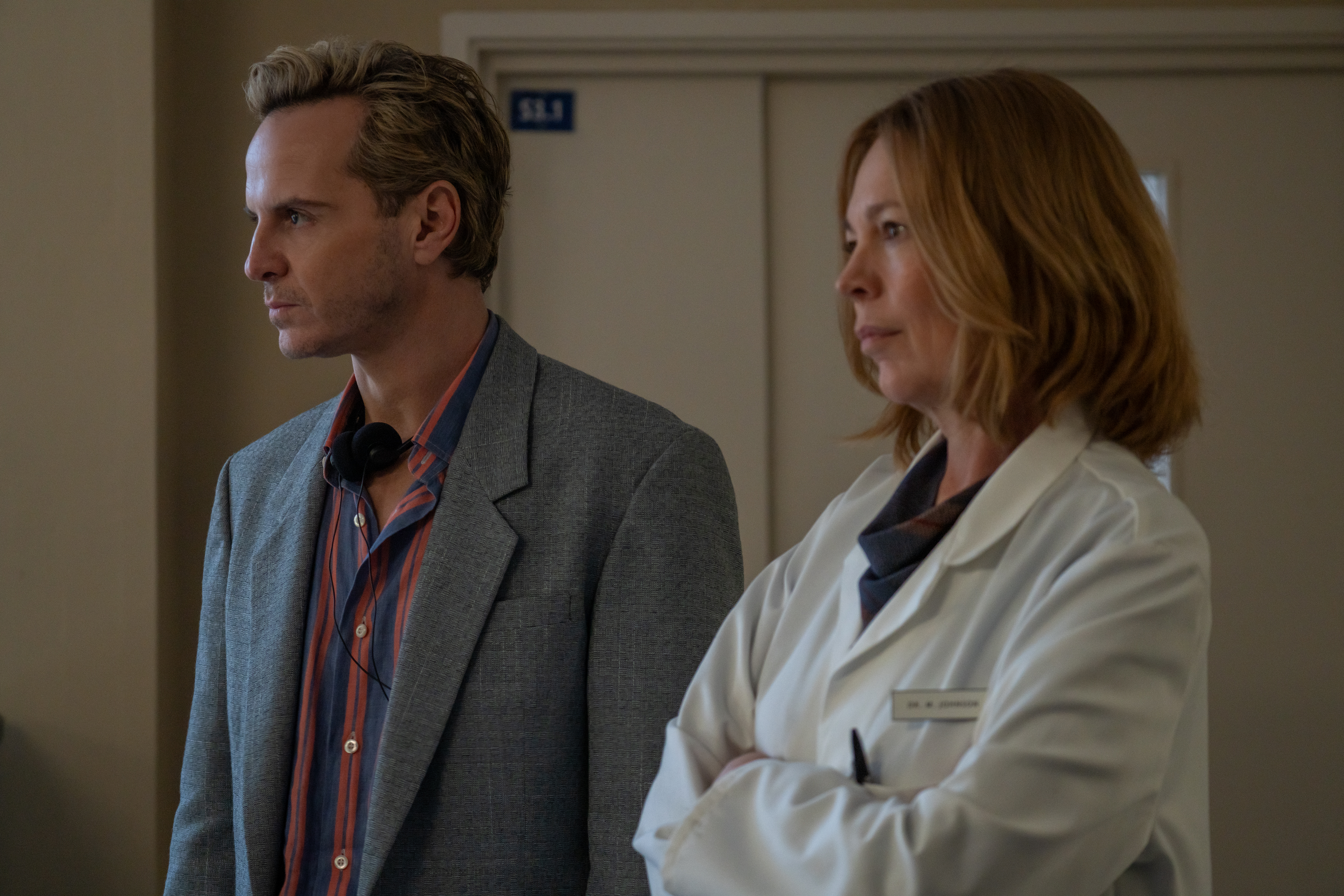
Billie Piper is terrific as Patsy Pollock, Charleson’s friend and a casting director who cheers him on when nearly everybody else thinks agreeing to Hamlet is madness. Her affection is unmistakable, but she also knows how to puncture his ego, and their scenes have the easy warmth of people who have been through an awful lot together. Olivia Colman is equally good as Dr. Johnson, who watches her patient ignore medical advice with the exhaustion of someone who already knows the next argument is coming. Scott and Colman know how to spar, and their exchanges are among the film’s funniest, but underneath every joke is a doctor trying to keep someone alive and a patient asking what being alive is worth if he can no longer do what he loves. The real Johnson helped pioneer HIV care in Britain, which makes the conflict between professional duty and personal affection even more affecting.
Johnny Flynn brings genuine conflict to Richard Eyre, who has to decide whether giving his friend the role is an act of faith or an unbearable risk. Matthew Beard is lovely as Sean Mathias, who wants Charleson safe more than he wants him applauded, while Stevenson, who knew the real Charleson from their Royal Shakespeare Company days, brings her own theatrical history to the role of Sylvia Syms, the production’s Gertrude. Joe Locke, as a young patient who looks up to Charleson, and Luke Thompson, as a friend whose health is deteriorating, broaden the film’s emotional reach without turning the supporting characters into a parade of tragedies. The backstage community feels like a chosen family in the truest sense, a group whose members know one another’s flaws and love one another anyway.
When Less Would Mean More
My one substantial reservation is that Stone occasionally doesn’t seem to trust the film’s strongest material to do its own work. There are stirring montages and moments when the dialogue practically announces the meaning of a scene, as though anyone watching Scott hasn’t already understood it. Stefan Gregory’s score is lovely, but at times it’s so determined to lift us toward an emotional crescendo that I wanted to ask it to sit down and let the actors finish. The production notes describe an intentionally big, uplifting musical approach, and I can understand that choice for a film determined not to be defeated by grief. Still, when Scott is doing this much with a glance or a breath, an orchestral reminder isn’t always necessary.
Those misjudgments are small compared with what the movie gets right. The rehearsal-room scenes have the excitement of watching a talented company discover a performance together, and the production sequences capture the electricity that passes between stage and audience when something extraordinary happens. Stone, Beresford, and Scott reportedly maintained a group chat called the Charleson Chaps while developing the screenplay and performance, and the care they took shows in the details. This isn’t merely a movie that admires actors. It understands their routines, insecurities, little jokes, friendships, and the strange mix of discipline and superstition that keeps a production alive. Most importantly, it recognizes that Charleson’s decision to play Hamlet was neither a medical recommendation nor a tidy inspirational slogan. It was a choice made by a complicated man who knew exactly what the role meant to him.
Twenty-Four Nights
I left Elsinore thinking less about the fact that Ian Charleson died than about how determined he was to spend his remaining time living on his own terms. The title invokes a place where Hamlet wrestles with mortality, but this version of Elsinore is also a theater, a rehearsal room, and the company of people who made one actor feel that his work still mattered. Scott gives Charleson back his humor, his ambition, his irritation, and his magnificent stubbornness. He lets us see an artist doing something difficult not because he wishes to become an inspiration, but because he can’t bear the thought of not doing it.
It’s the kind of film I wish more theater lovers could experience together, if only to share that wonderful sensation of hearing an audience hold its breath at the same time. Bring tissues, certainly, but bring somebody who loves the stage and understands why a performer might risk everything to hear the curtain rise one more night. If you’d like my first take from the festival, I wrote about it out of TIFF for Loud and Clear Reviews. Elsinore opens in theaters November 20, and I can’t recommend it highly enough.

The Final
Funny, defiantly alive, and deeply moving, Elsinore gives Ian Charleson the tribute he deserves without turning him into a plaster saint. Andrew Scott is magnificent, the supporting ensemble is exceptional, and its best scenes understand why theater can be worth living for. A few overly emphatic musical flourishes aside, this is one of the year’s most affecting performances and an absolute must for theater lovers.
9/10
Where to watch: In theaters November 20

Reviewed by Joe Botten
Joe Botten is The MN Movie Man, a Twin Cities film critic writing spoiler-free reviews since 2012. He also writes for Loud and Clear Reviews, a Rotten Tomatoes approved site. Find him on Instagram and Letterboxd.
Looking for something?
Search by actor, movie, director, genre or keyword.


Leave a Reply