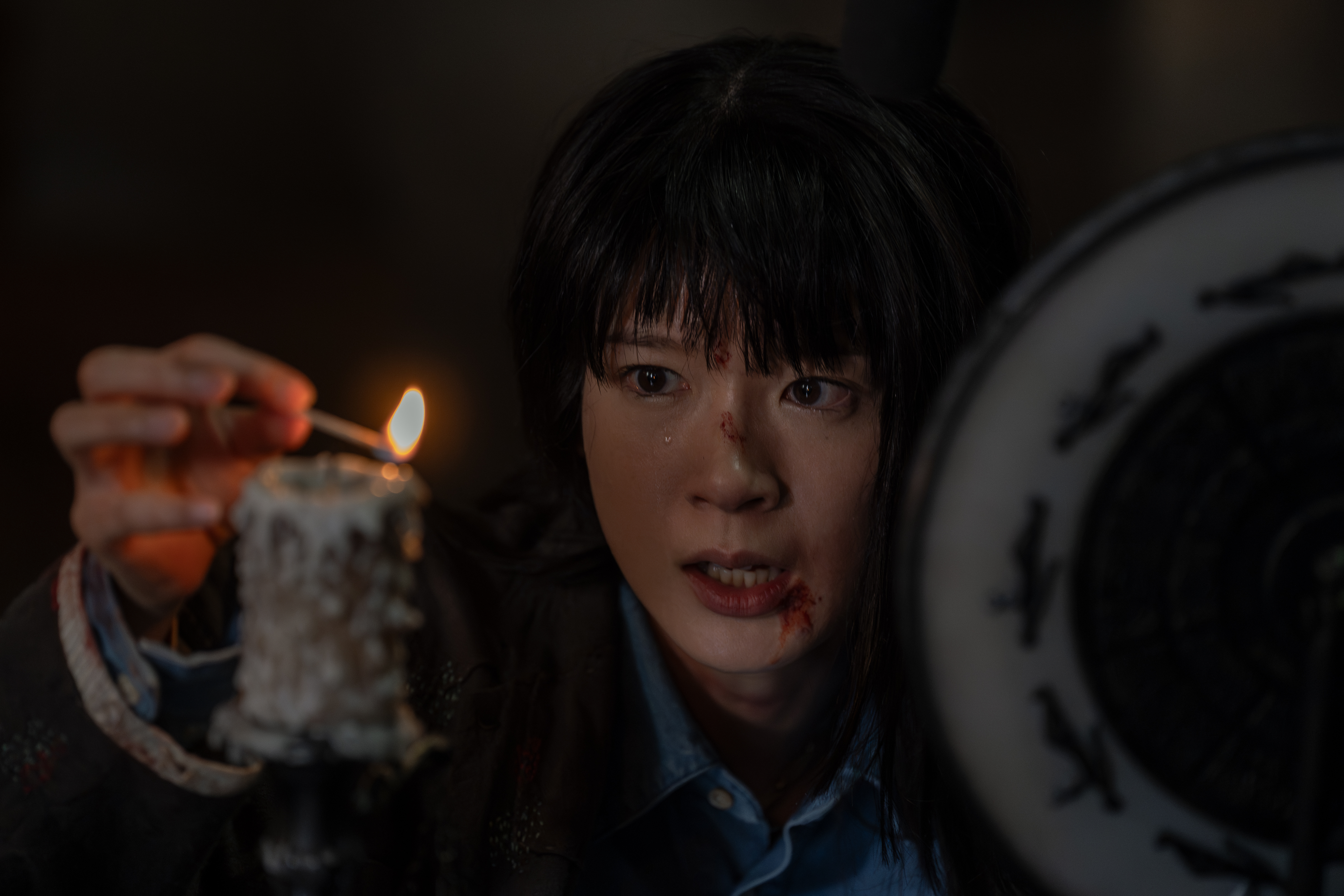
Synopsis: Airi is a wandering medium who spends her life guiding restless spirits out of the world of the living. Summoned to an isolated country house, she meets a grotesque apparition with powers well beyond anything she has handled. Digging into the house’s past turns up a secret, and for the first time her worst adversary is not supernatural but living.
Stars: Moeka Hoshi, Kurumi Inagaki, Kento Kaku, Mutsuo Yoshioka, Bokuzō Masana, Tae Kimura
Director: Dave Boyle (writer and director)
Rated: Not Rated
Running Length: 104 min
Movie Review in Brief: Never After Dark creates an intriguing world of professional ghost work, with distinctive rituals and practical effects. Moeka Hoshi gives it a strong center, but its shifting narrative never builds the sustained tension I wanted.
Never After Dark Knows How to Haunt a House
I love the moment in a ghost story when the expert arrives, surveys whatever has been tormenting everybody, and treats it like a problem with a procedure. That’s the appealing starting point of Never After Dark, where communicating with restless spirits is somebody’s work rather than a shocking revelation. Dave Boyle gives that work unusual tools and an inventive visual identity, making the film feel as though it has thought about what happens between the dramatic entrances and exits of a supernatural specialist.
I wanted to love it and came away fond of what it attempted. The atmosphere can be scary, and the ideas certainly are, but something never quite ignites. It has the imagination to haunt you, but not the tension to finish the job. That gap matters because the film keeps introducing possibilities that ought to make its confined setting more oppressive, yet the pressure doesn’t build as strongly as I hoped.
Helping the Dead Is an Unusual Day Job
Airi (Moeka Hoshi, Shōgun) travels around helping spirits leave the world of the living. A summons to an isolated country house puts her in contact with an apparition whose powers don’t fit neatly within her experience. Her investigation promises an explanation, but the situation becomes harder to manage as the house’s past begins intruding on the present.
Boyle’s interest is in what happens when professional confidence runs up against something it can’t readily classify. Airi knows how to approach the dead; knowing the rules doesn’t necessarily prepare her for the people involved. That’s a promising way to combine a ghost story with the danger of being trapped somewhere unfamiliar, and Hoshi makes a useful center for it. The film needs somebody we can follow through its peculiar rituals without stopping to question every object she picks up.
Kurumi Inagaki, Tae Kimura, Mutsuo Yoshioka, and Kento Kaku fill out a small ensemble, keeping the story’s human and supernatural presences in close proximity. The contained cast and location should make every new complication feel harder to escape. I appreciated the setup more consistently than the suspense it generated.
That Mirror Deserves Its Own Warning Label
The production’s strongest talking point is also something you can actually see on screen. Designer Yuji Hayashida created Airi’s spinning mirror device, including a zoetrope effect in its frame, as a functioning practical prop. Lighting director Hidenori Nagata’s team helped bring that ritual to life, giving Airi’s work an identity beyond the familiar assortment of candles and ominous muttering.
Boyle makes an important distinction in the press notes: Airi’s methods belong to a fictional tradition created for the film. They shouldn’t be mistaken for an authentic spiritual practice simply because the story is Japanese. That freedom lets the filmmakers develop their own rules and imagery, which is where much of the movie’s interest resides.
The effects favor work achieved in camera, with practical lighting transitions, body doubles, and mirror techniques supplying much of the uncanny activity. Patrick Ouziel’s cinematography has real objects and spaces to engage with, while the former hotel used as the house contributes its own peculiar architecture. I liked being able to see the environment clearly enough to register its strangeness. Horror doesn’t always need to turn the lights down until the audience is squinting at its own reflection.
More Possibilities Do Not Mean More Pressure
Boyle and producer Kaku developed the project after their collaboration on House of Ninjas, deliberately seeking a smaller production. The ambition hasn’t shrunk with the scale, and that’s both the attraction and the problem. Within this house, the film wants to establish a profession, introduce a supernatural system, unsettle our understanding of events, and shift the kind of danger we’re watching.
Those moves kept me interested, but they also spread the tension thin. I’d begin settling into the uncertainty of a scene, only to find that the story was asking me to reconsider the arrangement before the fear had tightened its grip. Surprise and suspense aren’t interchangeable; discovering another wrinkle doesn’t automatically make the room feel smaller.
Composer Jonathan Snipes contributes to the film’s distinctive sound, including the original song “Silhouette,” written for a fictional band. Natsuko Inoue’s sound design and Chieko Suzaki’s editing help construct the movement between ordinary space and the world Airi accesses. The care is apparent. What’s missing for me is the sustained dramatic concentration that would make all those inventive choices feel unavoidable rather than intriguing.
A Clever Haunting Needs to Leave a Mark
Airi’s work gives the haunting a fresh way in, Hoshi makes her someone we can follow, and the practical effects supply images worth remembering. I wanted that spinning mirror to open onto a story with the same grip on me. Instead, the changing narrative keeps giving the tension somewhere to escape.
I’d still rather watch a filmmaker try something peculiar than sit through another haunting assembled from the same tired instructions. Never After Dark earns that goodwill through its willingness to invent, and there are viewers who may connect more strongly with its changing shape. I settled on finding this to be an inventive ghost story I admired more than I feared. I enjoyed visiting its strange world; I just wanted it to follow me home.
Looking for something? Search for it here! Try an actor, movie, director, genre, or keyword!

Leave a Reply