Whalefall Review: Into the Belly of Grief

Movie Review
9/10
Whalefall is a whale of a tale that’s less ludicrous than it sounds. Austin Abrams goes through hell inside a convincing, practical sperm whale, and Josh Brolin’s flashbacks turn a nail-biter into a moving story about fathers, sons and grief.
Where to watch: In theaters October 16 (20th Century Studios)
Synopsis: Following the death of his father, Jay Gardiner goes diving off the Central Coast of California in search of his remains but is swallowed by a massive sperm whale. Trapped inside its belly with only one hour of oxygen left, Jay comes to realize that the hard-earned lessons his father taught him may be the key to his escape.
Director: Brian Duffield
Stars: Austin Abrams, Josh Brolin, Elisabeth Shue, John Ortiz, Jane Levy, Emily Rudd
Rated: PG-13, for peril, violent content, bloody images, some strong language, and thematic content
Running Length: 106 minutes
Just when you thought Pinocchio had it rough, along comes Whalefall. The premise immediately conjures that little wooden boy rattling around inside Monstro in Disney’s Pinocchio, and that comparison has been stuck with me ever since Daniel Kraus published his novel in 2023. Once you’re in the water with Brian Duffield’s adaptation, though, the joke starts to fade. All you can do is will its young diver back to shore because you know what’s waiting for him. Comparisons to The Martian and Project Hail Mary are inevitable, too. Each strands one man with only his wits and whatever happens to be within reach. Whalefall takes that survival premise one horrifying step further: it swallows its hero whole.
This whale of a tale is somehow not as ludicrous as it sounds on paper. Jay Gardiner (Austin Abrams, Resident Evil) has spent a year refusing to deal with his father’s death from mesothelioma. He’d already dodged the long illness that led up to it by fleeing the California coast for a college in landlocked Iowa. Now he’s home for the one-year anniversary with a mission he hasn’t told anyone about: finding his father’s remains on the ocean floor. That’s where Mitt, declining rapidly, took his own life by weighing himself down and jumping overboard.
His mother, Zara (Elisabeth Shue, Cocktail), has found a new normal. So have his sisters, Eva (Jane Levy, Evil Dead) and Nan (Emily Rudd, Fear Street Part Two: 1978), who’ve opened the letters Mitt left them in his final moments. Jay, meanwhile, is stuck in a weird limbo, avoiding the grief that comes with closure and acceptance. His own goodbye note still sits on top of his old scuba gear in his dad’s weathered cooler.
The morning of his dive is full of little warning signs he should probably heed. A family friend spots him filling his oxygen tank and mentions Coast Guard activity, something to do with orcas. Down at the marina, the seals are barking extra loud and long today. At the beach, an approaching Coast Guard vehicle hurries him into the water, where the sea feels a little too still, eerie almost.
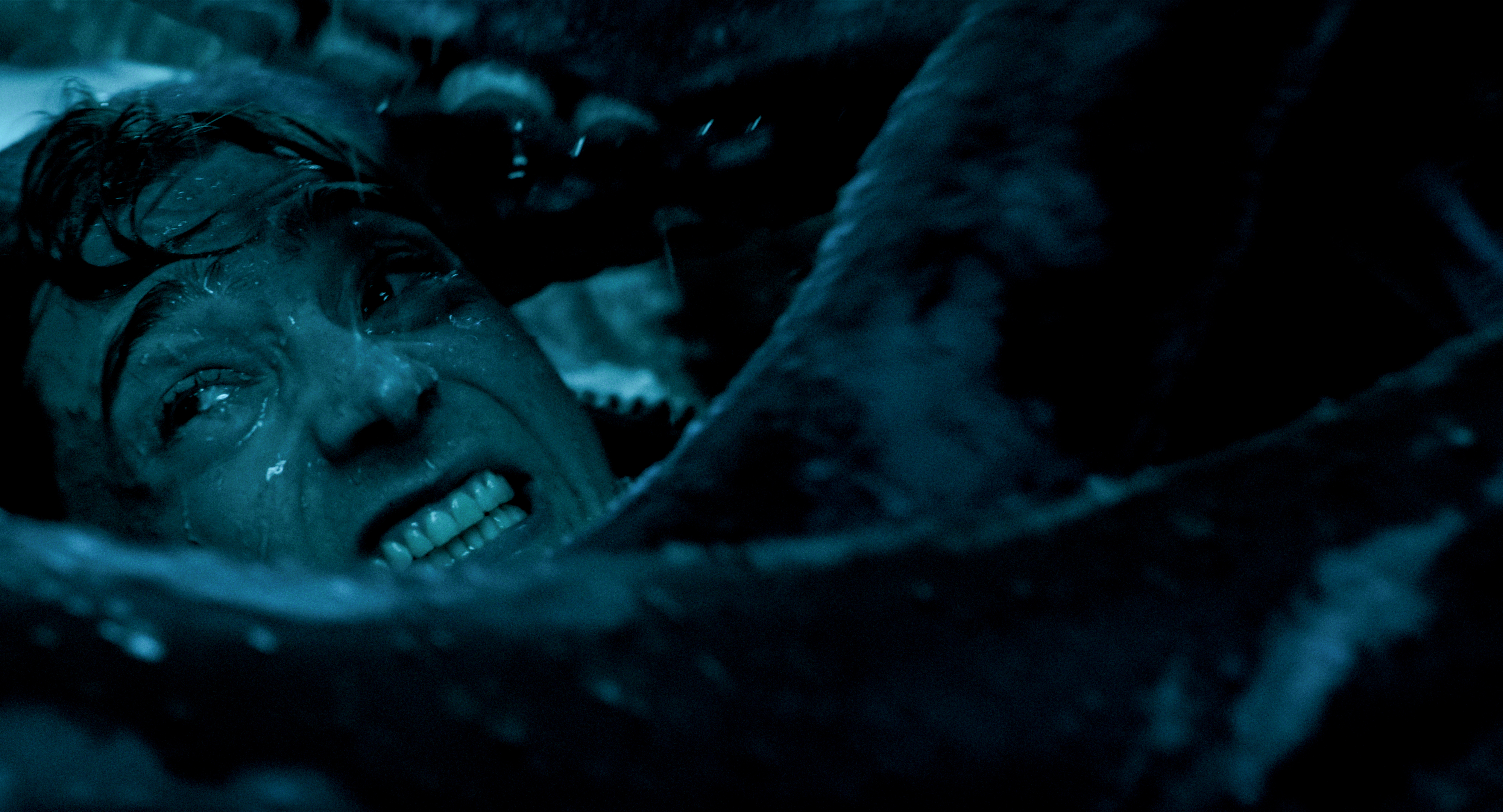
For a few minutes, the dive has the blissful calm of an early morning in the water, somber mission and all. Then Jay drifts right into the path of a giant sperm whale chasing a squid, and the whale swallows them both in one convincing gulp. Suddenly he’s fighting his way through a multi-chambered stomach where every chamber comes with its own deadly drawbacks. Duffield pits him against the whale, his own panicking mind and, don’t forget, that squid, which went down first and is still very much alive.

Duffield has displayed a fondness for the bottom of the ocean for a while now. He co-wrote Underwater, a deep-sea thriller with a Lovecraftian monster lurking below, and the creature feature Love and Monsters. Then he moved behind the camera for Spontaneous and the nearly wordless No One Will Save You. This film pairs the scale of those monster scripts with the tight focus of his directing, except this time the creature is real. Kraus, his co-writer, spent about three months researching whales so the story could favor biology over fantasy.
That realism carries into the production, too, because while so many blockbusters are shot against green screens, Duffield actually built the inside of the whale. His crew made a 360-degree stomach set that could roll, with operators working cables and pulleys so its walls could constrict, chew and tilt. Wētā Workshop designed and built those practical effects from endoscopy and autopsy footage, while ILM handled the digital side. Duffield has said their storyboards went out the window once they got inside, and that sense of figuring it out on the fly shows. It’s a gloriously tactile, old-school piece of genre filmmaking, and it makes every squeeze of that stomach feel real.
Abrams is having a banner year, coming off a terrific turn in Resident Evil as an everyman who reacts the way most of us would. He mutters to himself, lets out high-pitched screams and strings together some creative combinations of swear words. Whalefall is the second punch, an uppercut that should have studios and directors knocking loudly on his door by the end of its opening weekend. He’d never been scuba diving before this film, and he spent about two months inside that stomach set getting sloshed around. It’s largely a solo film and he carries it with ease.
Some sequences are so pulse-pounding you can hear your own heartbeat, and he commits to every one of them. Abrams goes through hell in this movie, and he’s easy to root for every step of the way. Someday, maybe, a role this raw and punishing will share the awards conversation with Tom Cruise in Digger and Andrew Scott in Elsinore. I’m also glad the screenplay rarely has him narrate his next move out loud, since nobody talks like that in real life anyway.
Done on the cheap, or without its strong flashbacks to Jay’s father, this could have been a disaster of an adaptation. Those flashbacks bring in Mitt Gardiner (Josh Brolin, Dune), and they break up the tension right when we need it. Brolin, who saved the costume budget a fortune by going shirtless in about 95 percent of his scenes, gives Abrams plenty to play off of. It’s an impressive physique for a man in his late 50s, and next to Abrams’s softer build, it underlines Mitt’s dominance over his son.
Mitt can see he’s racing the clock, so he tries to speed up his connection with his son, only to watch Jay walk away instead. Their scene on the boat, the breaking point for a relationship that was already shaky, is a standout. It’s a heartbreaking performance from Brolin, who’s never better than when he plays a tough guy with a tender heart.
We saw the film in a Dolby theater, where cinematographer Aaron Morton‘s work on land and Jamie Alac‘s underwater footage look sharp and bright. That clarity makes it easy to spot flaws in a digital creature, but this whale is absolutely convincing. Joseph Trapanese (Oblivion), scoring his third Duffield feature, brings in orchestra and choir for a stirring score. There’s an intense sequence near the end, which I won’t spoil, where the music and visual effects come together beautifully. It’s gorgeous to let it all envelop you, even knowing there’s danger all around.
Not everything lands, though. A few passages reach into mysterious, almost otherworldly territory, which suits the deep ocean, but the film never fully explores it. Instead, those moments feel like a convenient shortcut from point A to point B. The action inside the stomach can also get wild enough that you lose your bearings, and not by design. At times it just isn’t clear what’s happening.
Duffield has called his film the opposite of Jaws, and the comparison makes sense. Steven Spielberg turned a shark into a monster, and followers like The Meg gave their sea creatures a taste for blood. This sperm whale, though, is no villain. It’s an indifferent force of nature that eats squid, and Jay just happens to fit down its throat, so the terror comes from the situation. The film also keeps a sense of awe for something this big and strange, which is what Duffield says he wanted.
That’s also what makes this more than a thrill ride. As Jay fights to survive, his bitter memories of Mitt give way to the advice and encouragement laced into all that pain and doubt. Mitt did the best he could with the tools he had, came up short and was too proud to say so. That turns Whalefall from a nail-biting underwater thriller into something more, a moving look at fathers, sons, grief and loss. When a whale dies, it sinks to the ocean floor and feeds the life down there for years, which is where the title comes from. Jay goes looking for what’s left of his father and finds out how much Mitt left behind.

Brian Duffield’s tactile survival thriller swallows Austin Abrams whole and spits out a banner performance. A few muddy stretches inside the stomach can’t sink it, and Josh Brolin’s flashbacks give it a real, aching heart.
9/10
Where to watch: In theaters October 16 (20th Century Studios)

Reviewed by Joe Botten
Joe Botten is The MN Movie Man, a Twin Cities film critic writing spoiler-free reviews since 2012. He also writes for Loud and Clear Reviews, a Rotten Tomatoes approved site. Find him on Instagram and Letterboxd.
Looking for something?
Search by actor, movie, director, genre or keyword.
The MN Movie Man
Spoiler-free film critic on a mission to ensure your cinematic experience is unforgettable. Let's dive into the magic of movies together!
Subscribe now to keep reading and get access to the full archive.


Leave a Reply