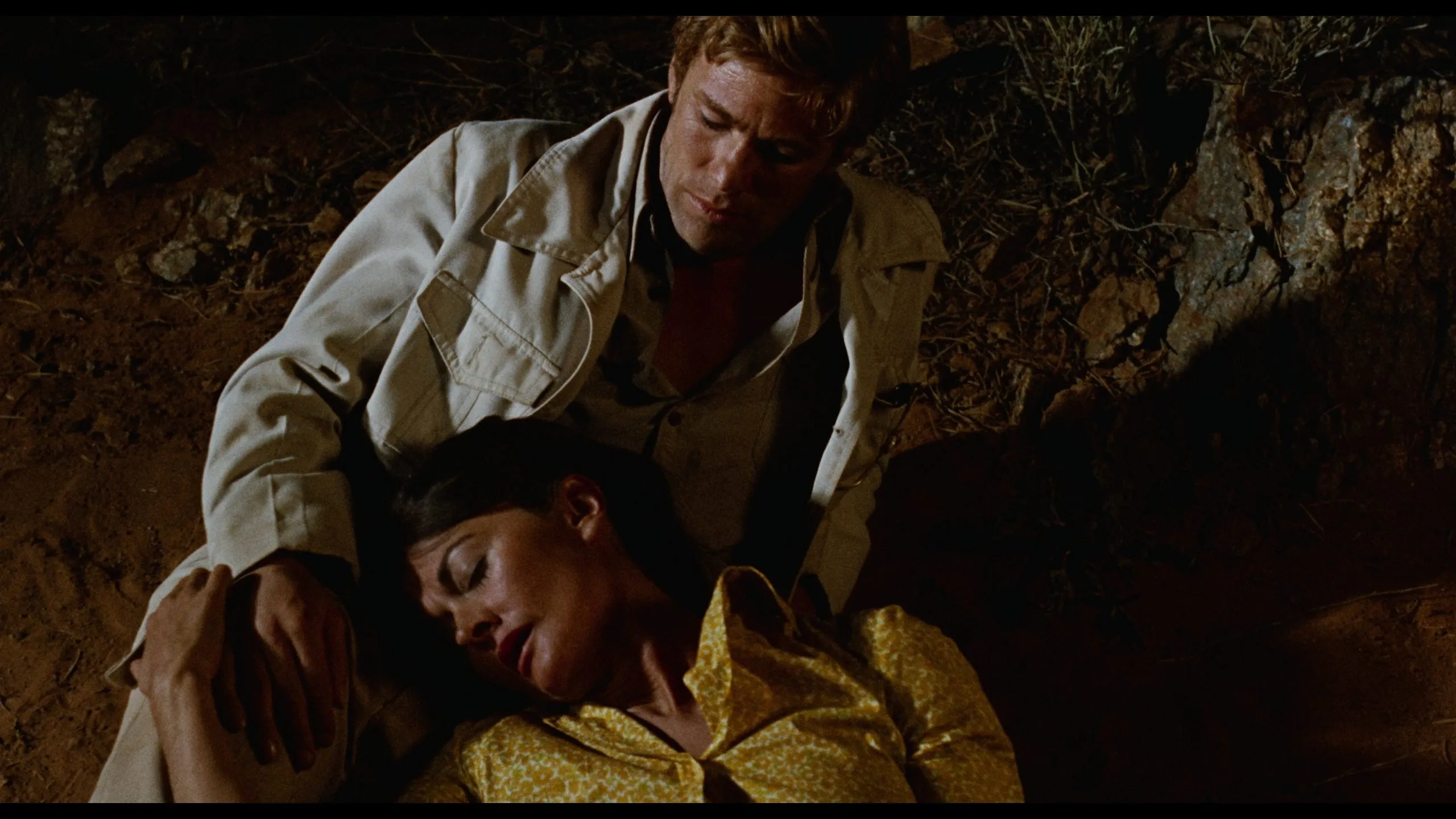

Wake in Fright (1971)
4K UHD · Arrow Video
Shelf Worthy
In Brief
A schoolteacher’s overnight stop in the Australian outback becomes a nightmare of beer, gambling, and hospitality he can’t escape. Ted Kotcheff’s remarkable Wake in Fright arrives on Arrow’s 4K UHD in a restoration from the original camera negative, with a substantial collection of interviews and documentaries. The film’s real kangaroo-hunting footage is difficult to watch, but the movie around it is unforgettable.
The Facts
Synopsis: A schoolteacher passing through a remote mining town loses his money in a gambling game and finds himself trapped among locals whose relentless friendliness grows increasingly threatening.
Starring: Gary Bond, Donald Pleasence, Chips Rafferty, Sylvia Kay
Directed by: Ted Kotcheff
Rated: Not Rated
Running Length: 109 minutes
Buy It Here
The Package
Label: Arrow Video
Format: 4K UHD
Release Date: June 30, 2026
Video: 2160p, Dolby Vision and HDR10, 1.85:1. A 4K restoration of the original camera negative scanned by Australia’s National Film and Sound Archive and graded by ROAR Digital, the same restoration used for Umbrella’s 2025 Australian edition.
Audio: English DTS-HD Master Audio 1.0 original mono
Subtitles: English SDH
Discs: One 4K UHD containing the full feature and extras. Limited edition with a slipcover on original pressings, reversible sleeve, and collector’s booklet. No Blu-ray copy included.
The Film
For years, Wake in Fright was the sort of movie you heard about more often than you could actually see. It competed for the Palme d’Or at Cannes in 1971, received limited attention back home, and eventually disappeared as its original negative went missing. Editor Anthony Buckley helped track down the materials, and the restored film returned to Cannes in 2009 with Martin Scorsese among its champions. That’s an impressive journey for a picture about a man who can’t manage to get out of a small town.
John Grant (Gary Bond, Zulu) teaches at a remote outback school, a posting he regards as an unfortunate interruption on the way to a better life. With the holidays beginning, he’s eager to reach Sydney and the woman waiting for him there. First comes a stop in the mining town of Bundanyabba, which the locals affectionately call the Yabba. He plans to spend a night and catch the next train. The town, unfortunately, has other ideas.
The first few encounters seem harmless enough. A police officer, Jock Crawford (Chips Rafferty, in his final film), extends a welcome that includes the practically mandatory drink. Soon John is surrounded by men who regard refusing a beer as something close to a personal insult. Then he discovers two-up, a wildly popular coin-toss gambling game, and convinces himself that a quick win could solve all his problems. By the time he understands the cost of his confidence, the money that would have carried him to Sydney is gone. His holiday has become a sentence without a release date.
As John searches for a way out, he meets Doc Tydon (Donald Pleasence, Halloween), an educated, extravagantly drunk physician who has made his peace with the Yabba in the worst possible way. John also falls into the company of local hard drinkers who seem determined to show their new friend a good time, whether he wants one or not. Sylvia Kay’s Janette offers another glimpse of a life spent in the town’s orbit. These encounters don’t resemble a conventional horror plot. They feel like invitations that become impossible to decline, with each new glass taking a little more control away from John.
Canadian director Ted Kotcheff, who would later make Uncommon Valor and First Blood, adapted Kenneth Cook’s novel with screenwriter Evan Jones and used Broken Hill to create a setting that seems capable of cooking its inhabitants alive. The heat isn’t merely atmospheric. It changes the way people behave, shortening tempers and turning every room into an oven. Kotcheff is especially good at the unnerving discrepancy between the townspeople’s cheerful manners and John’s mounting desperation. Pleasence is terrific as Doc, playing him as an intelligent man who can still identify a catastrophe even while participating enthusiastically in it. What begins as an awkward stopover becomes an increasingly ugly examination of belonging, masculinity, and how quickly a civilized self-image can collapse.
The kangaroo-hunting sequence is the film’s most serious obstacle, and it deserves a direct warning. Kotcheff incorporated footage of actual professional hunters killing animals. The material is distressing, and some viewers will understandably decide that seeing it is more than they’re willing to accept. The footage also makes the film’s accusations against the men involved harder to dismiss as cinematic exaggeration. Its purpose is clear; its impact is no less unpleasant for that.
What has stayed with me about Wake in Fright is how little overt villainy it needs. The locals don’t spend their days announcing bad intentions, and John isn’t an especially admirable guest. He’s arrogant, judgmental, and capable of making one bad decision after another. Yet the further he sinks, the more frightening the town becomes. By the end, a friendly offer of another beer sounds less like generosity than a threat. Few films have made a hangover feel this much like a horror story, and the Yabba is a place I’m very happy to visit only through a screen.

The Transfer
Video
Arrow presents the film in 2160p at 1.85:1, with Dolby Vision and HDR10, using the restoration produced from the original camera negative by the National Film and Sound Archive of Australia and ROAR Digital. The muddy green-yellow tint that hung over some screenshots I’ve seen of earlier Blu-rays gives way to warmer, more natural reds, browns, and sunbaked yellows. Faces look appropriately weathered, the pub interiors reveal more of their clutter, and the grain retains the gritty character of the photography. The documentary-style hunting footage remains variable by nature, and occasional flare and wear are part of the material. At last, the Yabba looks hot rather than vaguely seasick.
Audio
The original English mono is presented in DTS-HD Master Audio 1.0. Its modest hiss and occasional fluctuations suit the film’s rough texture, while the crowded pubs and John Scott’s score provide plenty of atmosphere. Dialogue remains intelligible, although the English SDH subtitles are useful when the thick accents and louder drinking sessions collide.
Transfer Notes
This is the same 4K restoration seen on Umbrella’s 2025 Australian release. Collectors who own that disc already have the central picture upgrade, while viewers with older Image or Eureka Blu-rays have a much stronger reason to move up. Arrow presents the complete 109-minute version and keeps all extras on the single UHD.

Special Features
- Audio commentary by Ted Kotcheff and Anthony Buckley: Recorded in 2008 with the director and the editor who helped rescue the film.
- Audio commentary by Peter Galvin: The author of The Making of Wake in Fright supplies another perspective.
- Return to the ’Yabba (49:46): Andrew Mercado revisits Broken Hill and the film’s legacy.
- Take in Fright (20:42): Cinematographer Brian West discusses the production.
- Sounds of the Outback (NEW, 14:52): Sound editors Keith Palmer and Eddy Joseph revisit their work.
- The Cinema’s Great Squeaky Bald Git (14:51): Kim Newman on Donald Pleasence, with the best bonus-feature title in the collection.
- The Filmmaker and the Film Buff (20:07): Philippe Mora and Paul Harris reflect on the film.
- Archival interviews: Kotcheff in Yer Mad, Ya Bastard! (12:57), Jack Thompson in Not Quite Hollywood (6:50), a 2009 TIFF Q&A with Kotcheff (45:51), and an extended Kotcheff audio interview (2:10:27).
- John Scott audio interview (15:30): The composer speaks with Daniel Schweiger.
- Alternate scenes from Outback (10:40): Material from the softened U.S. version, presented in standard definition.
- Archival television material: A 2009 rediscovery report, a Chips Rafferty obituary, and the 1971 segment Who Needs Art?
- Trailers and additional reel: U.S. trailer, TV spot, restoration trailer, and Foreign Visions of Local Stories (38:13), featuring Australian films by overseas directors.
- Image gallery (5:00): Accompanied by John Scott’s score.
- Booklet and reversible sleeve: Archive material, Jeff Marshall artwork, and new essays by Jay Slater, Paul Le, and David Michael Brown.
It’s an extraordinary amount of context for a movie that was nearly lost, and the new sound-editing interview is a welcome addition. If you watch every extra, you may spend longer in the Yabba than John Grant ever intended.
Shelf Worthy?
Shelf Worthy
The real animal deaths are a substantial warning, not a footnote, but viewers prepared for that material will find one of the most unnerving films of the 1970s. Owners of older, poorly graded discs have an easy upgrade, and Australian 4K owners can let the supplements make their decision. This is Shelf Worthy for anyone interested in the darker corners of international cinema. Just remember the town’s hospitality policy: once someone offers you a drink, saying no is apparently not an option.
Shelf Worthy: Buy it. This one earns a spot on the shelf.
Stream First: Watch it before you buy.
Completionists Only: For collectors who need every edition.
Arrow Video provided a copy for review. My opinions are my own.

Reviewed by Joe Botten
Joe Botten is The MN Movie Man, a Twin Cities film critic writing spoiler-free reviews since 2012. He also writes for Loud and Clear Reviews, a Rotten Tomatoes approved site. Find him on Instagram and Letterboxd.
Looking for something?
Search by actor, movie, director, genre or keyword.


Leave a Reply