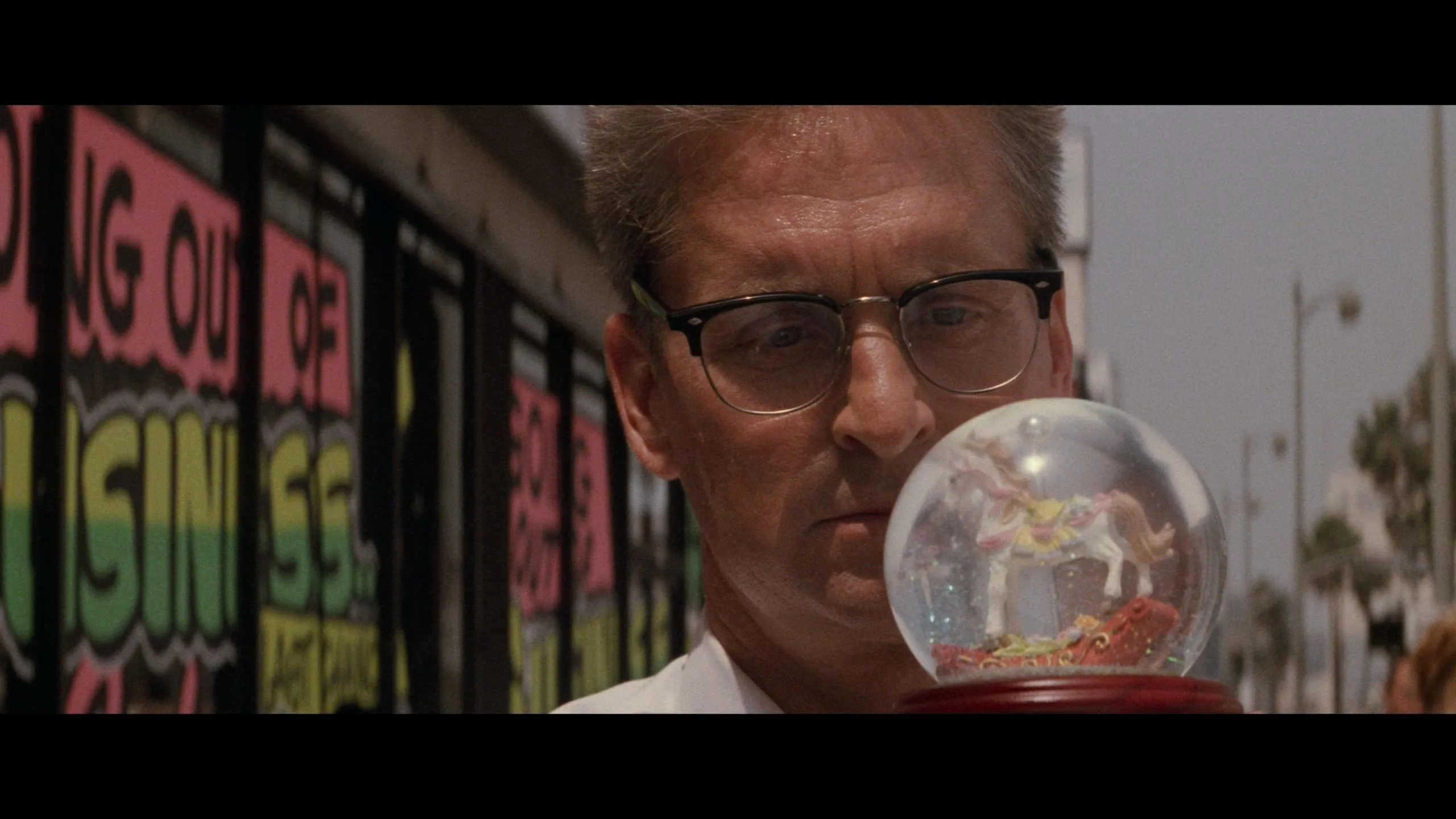

Falling Down (1993)
4K UHD · Arrow Video
Stream First
In Brief
Michael Douglas abandons his car in Los Angeles traffic and proceeds to make everybody else’s day much worse. Joel Schumacher’s prickly 1993 thriller gets a new cinematographer-approved 4K restoration, a restored stereo soundtrack, and three new featurettes. The movie remains unsettling for reasons that have little to do with its violence.
The Facts
Synopsis: On a sweltering day in Los Angeles, an unemployed defense worker abandons his car and sets off across the city to see his daughter, leaving a growing trail of trouble behind him. A police sergeant on the verge of retirement begins connecting the incidents.
Starring: Michael Douglas, Robert Duvall, Barbara Hershey, Rachel Ticotin
Directed by: Joel Schumacher
Rated: R
Running Length: 113 minutes
Buy It Here
The Package
Label: Arrow Video
Format: 4K UHD
Release Date: July 21, 2026
Video: 2160p, Dolby Vision and HDR10, 2.39:1; new 4K restoration from the original 35mm negative, approved by cinematographer Andrzej Bartkowiak; theatrical cut
Audio: English DTS-HD Master Audio 4.0 and restored English lossless 2.0 stereo
Subtitles: English SDH
Discs: One 4K UHD with the feature and extras. Limited edition with slipcover, reversible sleeve, and collector’s booklet. No Blu-ray included.
The Film
A month after Falling Down opened, Michael Douglas’s buzz-cut commuter landed on the cover of Newsweek as a symbol of the angry white man. The film had already knocked Groundhog Day out of the top box-office spot, proving that audiences were willing to spend an evening with somebody having a much worse day than Bill Murray. More than thirty years later, the movie still provokes a complicated reaction. It’s funny, unpleasant, exciting, and sometimes a little too pleased with itself. The biggest question isn’t why William Foster loses his temper. It’s why the film occasionally makes us enjoy watching him do it.
Foster (Douglas, And So It Goes) begins his day stuck in Los Angeles traffic, sweating in a car with a broken air conditioner as an endless procession of horns and irritated motorists closes in around him. He finally gets out, leaves the car where it sits, and announces that he’s going home. Except home is no longer really his. His ex-wife Beth (Barbara Hershey, Last Summer) lives near Venice Beach with their young daughter, whose birthday party he’s determined to attend despite not being invited. The journey seems simple enough on a map, but Foster is carrying considerably more resentment than his briefcase can hold. Recently unemployed and increasingly alienated, he has decided that the rest of the world is somehow responsible for the life he no longer recognizes.
His walk across the city becomes a series of confrontations that begin with ordinary frustrations and spiral into something far more dangerous. A Korean grocery-store owner refuses to give him change, a fast-food restaurant stops serving breakfast just before he reaches the counter, and gang members make the mistake of demanding his briefcase. Foster treats every disagreement as proof that society has stopped following rules he believes ought to exist. The objects he acquires along the way make each subsequent encounter more threatening. Eventually, his complaints stop sounding like those of a disgruntled customer and start sounding like warnings nobody should ignore. It’s a clever progression because director Joel Schumacher lets the humor slowly sour instead of announcing the moment when Foster has crossed the line.
Across town, Sergeant Martin Prendergast (Robert Duvall, The Paper) is trying to get through his final day before retirement. His colleagues treat him as a harmless old-fashioned cop, and he’s preparing for a move that seems designed more to satisfy his nervous wife than himself. When a string of bizarre incident reports begins reaching the precinct, Prendergast notices a pattern nobody else takes seriously. Detective Sandra Torres (Rachel Ticotin, Total Recall) is willing to follow his hunch, and their investigation gradually brings them closer to the increasingly dangerous man crossing the city on foot. Prendergast has his own disappointments, but unlike Foster, he has learned that the world doesn’t owe him an apology every time things go badly.
Schumacher, working between The Lost Boys and Batman Forever, turns Los Angeles into a particularly nasty pressure cooker. Screenwriter Ebbe Roe Smith builds the story around a recognizable collection of urban irritations, then keeps escalating the consequences until our initial recognition becomes uncomfortable. Douglas is excellent at that transition. His Foster looks like an ordinary office worker, with the short-sleeved shirt, tie, and black-framed glasses of a man who believes proper appearance ought to count for something. Douglas makes him funny enough that we understand why audiences might cheer some of his early outbursts, then reveals the entitlement, anger, and genuine danger behind them. The clothes never change, but our understanding of the man wearing them certainly does.
Duvall is just as good in a less showy role. Prendergast’s patience isn’t a sign of weakness, and his willingness to listen makes him a far more capable officer than the people who dismiss him. Ticotin gives Torres the energy to challenge the department’s assumptions, while Hershey brings a necessary reality check to Foster’s self-pity. Beth isn’t a cruel ex-wife denying him happiness. She’s a frightened mother with good reasons to keep him away from their child. That distinction matters enormously. Without her perspective, this could become a fantasy about an aggrieved man who finally decides not to take it anymore. With it, the movie keeps reminding us that his version of events is not the only one.
The tension comes from how often Schumacher seems tempted to have it both ways. Some stops along Foster’s route play like sharp social satire, while others come dangerously close to letting us enjoy his intimidation of people who have done little to deserve it. The Korean-owned grocery-store sequence, which drew protests at the time, is especially uncomfortable. A later encounter with a neo-Nazi shopkeeper offers a much clearer distinction between Foster’s resentments and an ideology he rejects, but it doesn’t erase the film’s earlier ambiguities. That push and pull is part of what has kept Falling Down in the conversation. The movie understands that anger can be seductive, but it occasionally has trouble resisting the seduction itself.
The city is almost another character, full of simmering traffic, dusty streets, crowded shops, and people trying to survive their own personal emergencies. Andrzej Bartkowiak’s cinematography gives the whole day a feverish warmth, and James Newton Howard’s score keeps the tension moving without turning the action into something heroic. A tale about a man convinced he’s been cheated by society could have aged into a period curiosity. Instead, in an era of constant public rage and grievance, it feels disturbingly current. The unsettling part is how familiar some of Foster’s complaints sound before you remember what he does with them.
I don’t think Falling Down works as an endorsement of its protagonist, even if certain scenes invite an easy cheer. It works as a warning about the distance between feeling wronged and believing that entitles you to hurt somebody. Douglas makes the trip fascinating, but Duvall is the man I’d rather follow home.

The Transfer
Video
Arrow scanned the original 35mm negative in 4K at Warner Bros. Motion Picture Imaging, with cinematographer Andrzej Bartkowiak approving the restoration. Presented in 2160p at 2.39:1 with Dolby Vision and HDR10, the image shows considerably more detail and better tonal balance than Warner’s earlier Blu-ray. Fine grain remains visible, and the added clarity brings out textures in clothing, storefronts, and the sweat accumulating on Foster’s face. The grade leans warm, with amber and a slight green cast giving the day its suffocating atmosphere. Even the city seems to have been left on a dashboard in July. That’s exactly the right look for a movie about a man who can’t cool off.
Audio
Arrow includes a restored stereo mix and a DTS-HD Master Audio 4.0 presentation of the original Dolby Stereo design. The 4.0 track adds a little space to city ambience, passing traffic, and James Newton Howard’s score without turning a dialogue-driven thriller into a sound-system demonstration. Both tracks keep conversations clear, and English SDH subtitles are included.
Transfer Notes
The theatrical cut follows Warner’s 2009 Blu-ray Book and subsequent standard Blu-ray edition. Arrow’s limited edition contains the film on 4K UHD only; a Blu-ray version is available separately. Reversible sleeve artwork, a slipcover, and a booklet with writing by Alexandra Heller-Nicholas and Simon Ward complete the package.

Special Features
- Archival audio commentary with Joel Schumacher, Michael Douglas, Ebbe Roe Smith, and other members of the production: A lively group discussion carried over from Warner’s release.
- Man on the Edge: Screenwriter Ebbe Roe Smith Unravels Falling Down (NEW) (18:43): The writer explains the origins of D-Fens and the screenplay.
- At War with the World: Composer James Newton Howard on Falling Down (NEW) (9:04): A brisk discussion of the score’s creation.
- Going Home: Falling Down’s Los Angeles, Then and Now (NEW) (12:49): Gillian Wallace Horvat revisits the locations along Foster’s journey.
- Deconstructing D-Fens: A Conversation with Michael Douglas (10:12): The actor looks back in an interview from the 2009 edition.
- Theatrical trailers and image gallery: Two trailers and roughly 160 stills and posters.
- Collector’s booklet: New writing by Alexandra Heller-Nicholas and Simon Ward.
The fresh conversation with Smith is the place to start, and the location piece is a fun addition for anyone who knows Los Angeles. The extras aren’t enormous, but they do a good job explaining how one bad day became such an enduring source of arguments. Not bad for a man who only wanted to get home.
Shelf Worthy?
Stream First
Arrow’s restoration is excellent, and Douglas and Duvall give the film far more weight than its premise might suggest. But two hours with Foster can be a trying experience, especially if you aren’t interested in a thriller that keeps asking whether you’re supposed to laugh, recoil, or both. Longtime fans and Warner Blu-ray owners have a solid reason to upgrade. Everyone else should take the walk once before buying. Preferably not after a bad commute.
Shelf Worthy: Buy it. This one earns a spot on the shelf.
Stream First: Watch it before you buy.
Completionists Only: For collectors who need every edition.
Arrow Video provided a copy for review. My opinions are my own.

Reviewed by Joe Botten
Joe Botten is The MN Movie Man, a Twin Cities film critic writing spoiler-free reviews since 2012. He also writes for Loud and Clear Reviews, a Rotten Tomatoes approved site. Find him on Instagram and Letterboxd.
Looking for something?
Search by actor, movie, director, genre or keyword.


Leave a Reply