
Soylent Green (1973)
4K UHD · Arrow Video
Stream First
In Brief
Richard Fleischer’s sweaty vision of an overcrowded future gets a new camera-negative restoration in Dolby Vision, complete with its original mono soundtrack and a healthy selection of archival interviews. The detective story sometimes lumbers, but the movie’s atmosphere and Edward G. Robinson’s farewell make it worth revisiting.
The Facts
Synopsis: In the overcrowded New York of 2022, a police detective investigates the murder of a food-industry executive and begins to suspect that the corporation feeding the city is hiding something terrible.
Starring: Charlton Heston, Leigh Taylor-Young, Chuck Connors, Edward G. Robinson
Directed by: Richard Fleischer
Rated: PG
Running Length: 97 minutes
Buy It Here
The Package
Label: Arrow Video
Format: 4K UHD
Release Date: July 28, 2026
Video: 2160p, Dolby Vision and HDR10, 2.39:1; new 4K restoration from the original 35mm camera negative, theatrical cut
Audio: English LPCM 1.0 original mono
Subtitles: English SDH
Discs: One 4K UHD with the feature and extras. The limited edition includes a slipcover, reversible sleeve, and collector’s booklet. No Blu-ray is included.
The Film
Edward G. Robinson appeared in 101 movies, and Soylent Green was the last. He died on January 26, 1973, less than three months before the film reached theaters, and his final sequence here was the last scene he ever performed. That’s a rather devastating bit of movie history to bring into a science-fiction thriller best remembered for a single line of dialogue. I’m not going to repeat that line, because somehow there are still people who haven’t seen the movie. They deserve the chance to discover its terrible secret the old-fashioned way.
The year is 2022 (ah, remember those days??), and New York has become an overheated nightmare with 40 million people competing for food, water, and a place to sleep. Apartment stairwells are packed with bodies, the streets are perpetually crowded, and the air looks as though somebody left the city in a dirty aquarium. Real food has become a luxury reserved for the wealthy. Everyone else survives on processed wafers supplied by the Soylent Corporation, which has made itself indispensable to a population with no better options. Police detective Robert Thorn (Charlton Heston, Ben-Hur) shares a cramped apartment with Sol Roth (Robinson, Double Indemnity), an elderly scholar whose memory of the old world is nearly as valuable as his work as Thorn’s researcher, or “book.”
When wealthy Soylent board member William Simonson (Joseph Cotten, The Third Man) is murdered in his luxury apartment, Thorn gets the case. The crime scene is almost indecently comfortable: fresh food, running water, proper furniture, and a young woman named Shirl (Leigh Taylor-Young, I Love You, Alice B. Toklas!) who comes with the apartment as its live-in “furniture.” It’s a particularly ugly piece of world-building, a sign of how completely money has turned people into possessions. Thorn isn’t above pocketing a few of the dead man’s luxuries for himself. He returns home with food that Sol can barely believe still exists, and the older man’s delight at tasting something genuine tells us more about this society than another speech about overpopulation ever could.
Thorn quickly suspects that Simonson’s death was no ordinary burglary. His investigation leads toward the executive’s imposing bodyguard, Tab Fielding (Chuck Connors, The Rifleman), and a network of people who appear to know much more than they’re willing to say. His superiors would prefer the case closed, especially once the trail begins brushing against the company that keeps the city fed. With Sol digging through books and old records, Thorn moves between filthy tenements and immaculate corporate spaces, discovering just how far apart the rich and poor have drifted. It’s a familiar detective framework, but the setting makes every stop feel unpleasantly plausible.
Director Richard Fleischer, whose career also included Fantastic Voyage and Red Sonja, doesn’t waste time explaining how civilization collapsed. He simply shows what life looks like afterward. The police use enormous machines to scoop protesters out of the streets, people sleep wherever they can find floor space, and a decent meal has become an almost mythic experience. This was the third major science-fiction dystopia in Heston’s run, following Planet of the Apes and The Omega Man, and he gives Thorn the weary cynicism of a man who has never known anything else. He’s not a model public servant. He’s a survivor with a badge and a willingness to take advantage of the occasional opportunity.
Robinson gives the film its heart. Sol remembers trees, open spaces, and meals that weren’t issued by a corporation, and his grief over everything the world has lost feels genuine. Heston supplies the movie-star muscle, but Robinson gives us a reason to care what happens to this miserable future. Their friendship feels completely natural, full of petty complaints and genuine affection. Knowing that Robinson was seriously ill during production adds a great deal of weight to his final scenes, although his performance hardly needs the biographical assistance. He understood precisely how much a small gesture could accomplish.
Adapted from Harry Harrison’s novel Make Room! Make Room!, the film shifts its source material toward an industrial conspiracy and a final revelation that has become part of popular culture. The procedural plotting can be sluggish, particularly when Thorn is following leads we already suspect won’t end well. Yet the world surrounding him is so carefully imagined that I find myself watching the background as often as the detective. The calendar has already moved past the year in which the film takes place, but its anxieties about inequality, pollution, and corporations controlling basic necessities haven’t lost much force. A future that looked outrageous in 1973 now comes with a few uncomfortable similarities to the present.
For all the attention given to its final twist, Soylent Green is sadder than its punchline suggests. It’s about people who have lost so much that some of them can barely remember what they’re missing. Robinson remembers, and that’s what makes the movie linger after the mystery is over.

The Transfer
Video
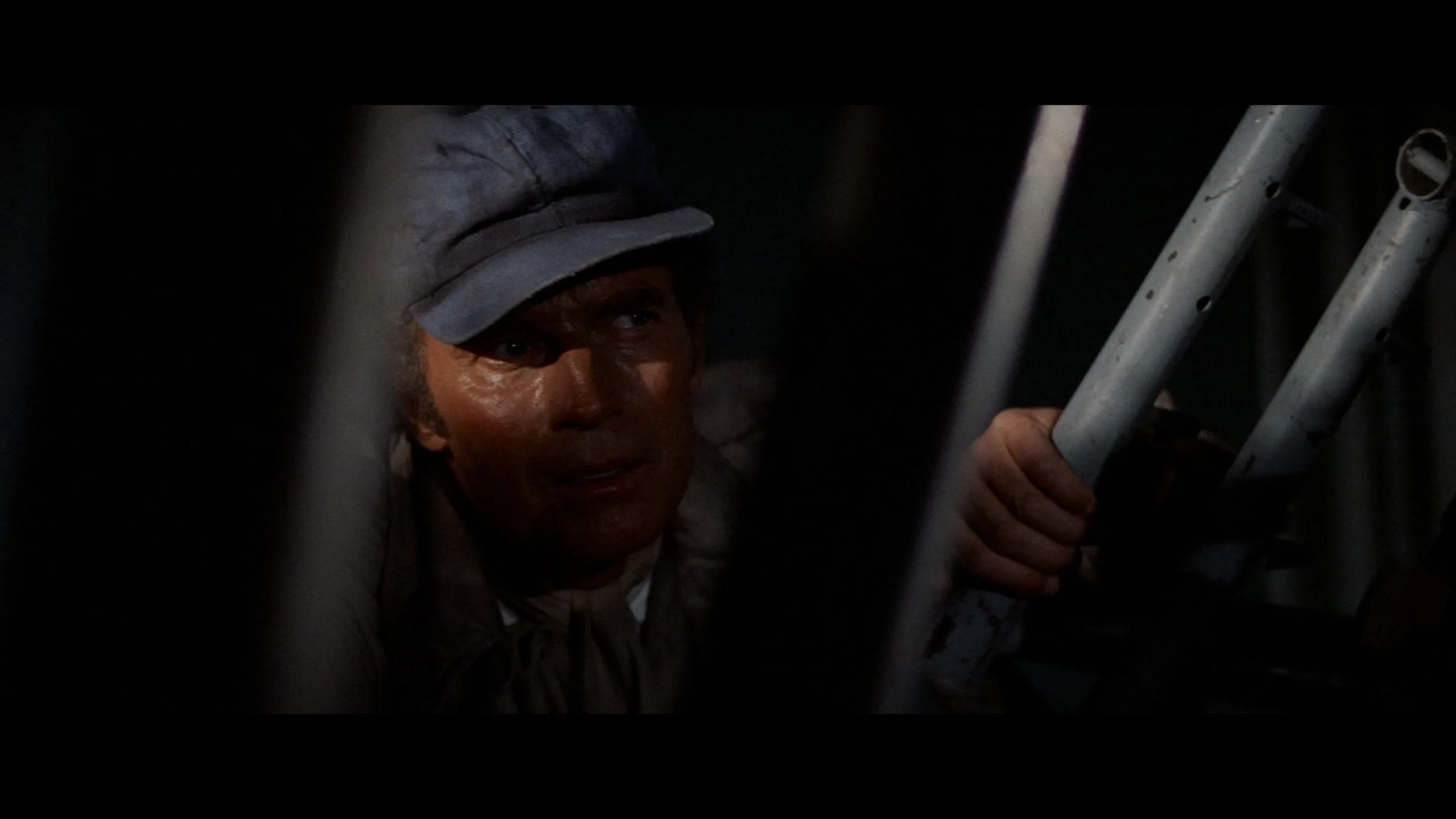
Arrow’s 4K restoration was scanned from the original 35mm camera negative at Warner Bros. Motion Picture Imaging and graded at Silver Salt. Presented in 2160p at 2.39:1 with Dolby Vision and HDR10, it preserves the movie’s deliberately grimy look while giving the image considerably more texture. That thick green haze hanging over the exteriors is part of the photography, not something the disc needs to clean away. Interiors offer stronger detail in clothing, faces, and the clutter of Thorn’s apartment, while the wealthy characters’ saturated colors stand out against the rest of the city’s exhausted browns and grays. The picture has greater depth, but 2022 New York remains a place you’d want to shower after visiting. Perfect.
Audio
The original English mono arrives as uncompressed LPCM 1.0, with dialogue, Fred Myrow’s score, and the city’s constant commotion sharing a single channel. It sounds full and clear, and nothing about this cramped world cries out for a surround remix. English SDH subtitles are included.
Transfer Notes
This is the film’s first 4K release after Warner’s 2003 DVD and 2011 Blu-ray. Arrow’s limited edition pairs the theatrical version with a reversible sleeve featuring Nathanael Marsh artwork, a slipcover, and a booklet with essays by Frank Collins and Alexandra Heller-Nicholas. The feature is on a single 4K disc, with no Blu-ray copy in the package. It makes a natural double feature with Arrow’s Westworld, another unsettling vision of tomorrow from 1973.

Special Features
- Audio commentary with Richard Fleischer and Leigh Taylor-Young: The original 2003 Warner track.
- Audio commentary with Michael Brooke and Johnny Mains (NEW): A newer discussion recorded in 2025.
- Charlton Heston at the BFI: A 1985 stage interview, presented as audio over the feature.
- Richard Fleischer at the BFI (1:16:25): The director discusses his career in a 1994 appearance.
- A Look at the World of Soylent Green (10:03): The vintage MGM promotional featurette.
- MGM’s Tribute to Edward G. Robinson’s 101st Film (4:51): A short tribute hosted by Heston, especially moving in retrospect.
- Theatrical trailer (3:29) and image galleries: Promotional artwork and more than 400 stills.
- Collector’s booklet: New writing by Frank Collins and Alexandra Heller-Nicholas.
The two commentaries and lengthy BFI conversations give the set plenty of substance, while the Robinson tribute is the extra I’d point people toward first. For a movie about rationing, Arrow certainly isn’t stingy with the portions.
Shelf Worthy?
Stream First
The mystery takes its time, and anyone who knows the twist may find the journey more interesting for its setting than its surprises. That’s enough to keep it at Stream First, even though the restoration and extras make a strong case for collectors. Heston fans and lovers of dystopian science fiction can upgrade with confidence. Everyone else should take that first look without spoiling the ending. Robinson deserved a farewell this affecting, and it’s good to have it looking this fine.
Shelf Worthy: Buy it. This one earns a spot on the shelf.
Stream First: Watch it before you buy.
Completionists Only: For collectors who need every edition.
Arrow Video provided a copy for review. My opinions are my own.

Reviewed by Joe Botten
Joe Botten is The MN Movie Man, a Twin Cities film critic writing spoiler-free reviews since 2012. He also writes for Loud and Clear Reviews, a Rotten Tomatoes approved site. Find him on Instagram and Letterboxd.
Looking for something?
Search by actor, movie, director, genre or keyword.


Leave a Reply