
Movie Review
Nuisance Bear
7.5/10
TLDR
Patient, beautifully photographed, and more provocative than it first appears, Nuisance Bear follows polar bears through Churchill, Manitoba, and Arviat, Nunavut, before turning the question of who’s really the nuisance back on us. Its observational approach occasionally tests your patience, but the extraordinary imagery, immersive sound, and Cristobal Tapia de Veer’s terrific score make it worth the effort.
Where to watch: In select theaters, distributed by MUBI
The Facts
Synopsis: As polar bears move through Churchill, Manitoba, tourists, wildlife officers, and residents attempt to manage their presence. Farther north, an Inuit community faces its own realities of living alongside the animals, revealing how complicated the question of coexistence has become.
Directors: Gabriela Osio Vanden and Jack Weisman
Featuring: Mike Tunalaaq Gibbons (narrator)
Rated: Not Rated
Running Length: 89 minutes
The Thoughts
I can certainly understand why Nuisance Bear was such a favorite at Sundance this past January, where it won the Grand Jury Prize for U.S. Documentary. Whether that enthusiasm carries it all the way to the Oscars remains to be seen, but I suspect the film itself couldn’t care less. Much like the polar bear at its center, it moves at its own speed, seemingly unconcerned with such pesky distractions as conventional pacing, tidy explanations, or making sure everyone in the audience is keeping up. Directors Gabriela Osio Vanden and Jack Weisman are content to observe, letting the images accumulate until a larger picture begins to emerge. It’s an approach that demands patience, and I can’t say I was always willing to give it as much as it wanted. Still, there’s something wonderfully appropriate about a documentary examining our expectations of wildlife while refusing to behave quite the way we expect it to.
From a Short to the Long Haul
Osio Vanden and Weisman have been following these animals, and the people who live alongside them, for years. Their feature grew out of the 2021 shortNuisance Bear, which made the Oscar shortlist for documentary short. For this expanded version, the filmmakers reportedly accumulated approximately 700 hours of footage, eventually whittled down to 89 minutes by editor Andres Landau. That’s a staggering amount of time spent watching and waiting, particularly when your leading man is a polar bear who has never heard the words “hit your mark.”
The film’s success has continued beyond Sundance, including a Best Science/Nature Documentary win at the Critics Choice Documentary Awards. But what makes it stand apart from the wildlife documentaries I grew up watching isn’t simply the quality of the photography. It’s the decision to leave the people in the frame. Rather than presenting the Arctic as a pristine wilderness populated exclusively by magnificent animals, the filmmakers show us tourists, wildlife officers, hunters, residents, and the various industries that have developed around the bears. Sometimes the most revealing part of a wildlife encounter isn’t the animal we’re watching, but the behavior of everyone who has gathered to watch it.

Welcome to Churchill. Please Keep Moving.
We begin in Churchill, Manitoba, which proudly calls itself the Polar Bear Capital of the World. Every autumn, hundreds of bears gather along the western shores of Hudson Bay, waiting for the sea ice to form so they can return to hunting. It’s an extraordinary natural event, and one that has turned this remote community into a destination for travelers hoping to glimpse one of the planet’s most impressive predators.
Of course, there’s a considerable difference between visiting Churchill to photograph a polar bear and living in Churchill when one decides to wander down the street. These are enormous, powerful animals, and the threat they pose to residents is very real. Bears that venture too close to town may find themselves trapped in a holding facility affectionately nicknamed “polar bear jail,” eventually being relocated by helicopter to somewhere considered less troublesome.
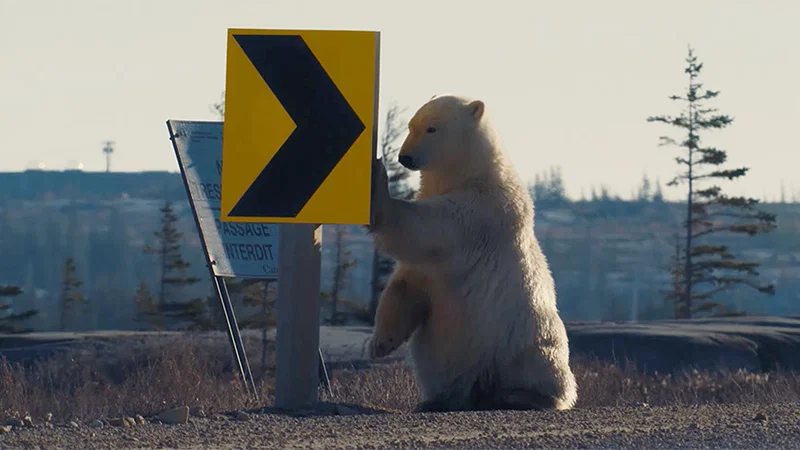
Watching this elaborate process unfold, I couldn’t help noticing the irony. We’ve built a thriving tourist industry around getting as close as possible to polar bears, then developed an equally elaborate system for ensuring they don’t get too close to us. Trucks, helicopters, officials, guides, and tourists all play their parts in what sometimes resembles an unusually expensive game of wildlife traffic control. Everyone wants that unforgettable encounter with nature, apparently, provided nature sticks to the designated viewing areas and doesn’t interfere with the tour schedule.
To their credit, Osio Vanden and Weisman never suggest that protecting human lives is unnecessary or that the officers handling these encounters have easy jobs. The contradiction is more complicated than that. We’re watching animals follow migration patterns that existed long before Churchill became a tourist attraction, while people attempt to manage the inevitable conflicts that arise when those paths intersect with modern communities. Neither side can simply pretend the other isn’t there.
A Very Different Welcome in Arviat
The second half follows a relocated bear farther north, near Arviat, a predominantly Inuit community in Nunavut. It’s here that the documentary becomes considerably more interesting, because the change in location brings an entirely different relationship with the animals.
In Churchill, polar bears are a tourist attraction, a source of economic opportunity, and a potential danger to residents. In Arviat, that danger remains, but the animals also have a place within traditions and subsistence practices that extend back generations. Hunting, survival, and respect for the natural world are intertwined in ways that can’t be reduced to a simple argument about whether people should leave the bears alone. The film also raises an uncomfortable question about relocation itself. When one community moves a potentially dangerous animal elsewhere, what does that decision mean for the people living at its destination?
Much of this perspective comes through the narration of the late Inuit elder Mike Tunalaaq Gibbons, who died before the feature was completed. His contributions are among the film’s most valuable elements, offering an understanding of the bears that comes from a lifetime spent within the community rather than observing it from the outside. There’s an enormous difference between studying how people live alongside these animals and hearing directly from someone whose family and neighbors have been doing so for generations.
I only wish we spent more time with Gibbons and the people of Arviat. The documentary opens the door to a fascinating discussion about the differences between wildlife conservation, tourism, and Indigenous traditions, but doesn’t always explore those distinctions as fully as I’d hoped. That isn’t to suggest the film owes us an exhaustive lesson in Inuit culture. Rather, the people we meet are so compelling that I found myself wanting to understand more about their experiences. The contrast with Churchill changes how we view everything that came before it.

So, Who’s the Nuisance?
There’s a rather delicious irony in the title, and the longer the documentary goes on, the more uncomfortable it becomes. Polar bears possess remarkably sensitive senses, yet we surround them with roaring engines, helicopters, cameras, tourists, and every conceivable form of human commotion. We interrupt their movements, attempt to redirect their behavior, and relocate them when they venture into spaces we’ve decided belong to us. Then we label the animals a nuisance because they don’t cooperate.
From the bear’s perspective, I imagine the complaint department would be receiving some very different paperwork.
Of course, it’s not quite that simple. The effects of climate change are altering sea ice patterns and making it increasingly difficult for polar bears to hunt as they once did, bringing additional pressures for the animals and the communities that share their territory. People cannot simply abandon their homes, any more than a hungry polar bear can be expected to understand municipal boundaries. What the film asks us to consider is how we’ve helped create a situation in which everyone must adapt, yet frequently behave as though the responsibility belongs entirely to the bears.
The filmmaking itself is extraordinary. Cristobal Tapia de Veer, whose credits include The White Lotus and Smile, contributes a wonderfully strange, percussive score that occasionally makes the documentary feel more like a suspense thriller than a nature film. Watching a polar bear evade barriers, vehicles, and tracking crews becomes unexpectedly exciting, particularly when the music introduces a sense of danger that the images themselves might otherwise leave entirely to our imagination.
I appreciated the absence of those sweeping orchestral cues that typically accompany footage of majestic animals trudging across enormous landscapes. Tapia de Veer’s music has a personality all its own, and it works beautifully alongside the film’s impressive sound design. The crunch of ice, the roar of machinery, the wind sweeping across open terrain, and the enormous stretches of apparent stillness are all part of the experience. This is one documentary that deserves to be heard through a good sound system.
The cinematography is equally remarkable, moving between breathtaking northern landscapes and the occasionally absurd spectacle of humans attempting to organize the natural world around their convenience. It’s beautiful, sometimes haunting, and often more revealing than any narration could be.
Patience Is Part of the Price
For all that admiration, I can’t pretend Nuisance Bear kept me completely engaged from beginning to end. Osio Vanden and Weisman are so committed to allowing their subjects and images to speak for themselves that there were times I wished someone would step in and provide a little more context. Not a lecture, mind you, but an occasional helping hand connecting some of the ideas.
The decision to avoid conventional interviews, explanatory graphics, and a more structured narrative is both the film’s greatest strength and its most noticeable limitation. There’s something refreshing about being trusted to observe and draw our own conclusions. Still, when a subject as complicated as the relationship between Inuit communities and polar bear hunting is introduced, I wanted to spend more time understanding that perspective. Gibbons gives us a compelling introduction, but there’s clearly much more to the story.
I did appreciate that the filmmakers don’t shy away from the hunt or its aftermath. We see how the animal is used and how those practices fit within a relationship with the natural world that differs considerably from the one tourists experience in Churchill. The sequences are presented without sensationalism, allowing viewers to consider the cultural and practical realities rather than being instructed how to react.
And while I occasionally grew restless, there’s no denying the beauty of the images. The bears moving along the coastline, the vast northern landscapes, and the eventual return of the ice all contribute to a sense of time and place that would be diminished by a more hurried approach. These aren’t animals operating on our schedule, and perhaps that’s precisely the point.
I wouldn’t necessarily recommend this to someone expecting a fact-packed wildlife documentary filled with statistics and explanations. It’s a more contemplative experience, one that requires you to spend time watching, listening, and thinking about what you’re being shown. I didn’t always love that approach, but I came to appreciate why the filmmakers chose it.
The Final
Nuisance Bear occasionally asks more patience than I was prepared to give, and I still wish it had explored the experiences of the people in Arviat more extensively. But those reservations don’t diminish the impressive filmmaking on display. The cinematography is gorgeous, the sound design is exceptional, and Cristobal Tapia de Veer’s score gives the whole experience an unusual sense of urgency.
More importantly, Osio Vanden and Weisman have made a documentary that challenges the assumptions we bring to stories about wildlife and conservation. The journey from Churchill to Arviat reveals how differently two communities experience the same animals, while reminding us that our attempts to manage nature can have consequences well beyond the places we’re trying to protect.
By the time the credits rolled, I was thinking less about how humans might better control polar bears and more about how confidently we’ve decided that the places they inhabit belong to us.
Considering these animals were here long before the trucks, tourists, and helicopters arrived, perhaps it’s time we reconsidered who the real nuisance is.
7.5/10
Where to watch: In select theaters, distributed by MUBI

Reviewed by Joe Botten
Joe Botten is The MN Movie Man, a Twin Cities film critic writing spoiler-free reviews since 2012. He also writes for Loud and Clear Reviews, a Rotten Tomatoes approved site. Find him on Instagram and Letterboxd.
Looking for something?
Search by actor, movie, director, genre or keyword.


Leave a Reply