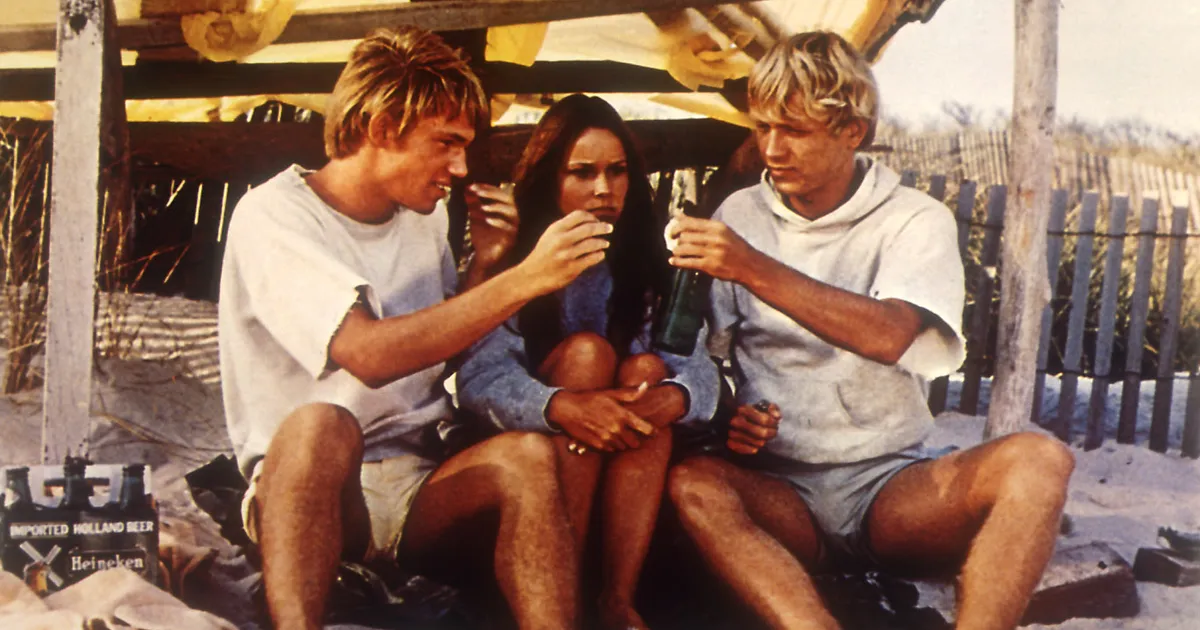

Synopsis: During summer vacation on Fire Island, three young people become very close. When an awkward girl tries to infiltrate the trio’s newly found relationship, they construct an elaborate plot that has violent results.
Stars: Barbara Hershey, Richard Thomas, Bruce Davison, Catherine Burns
Director: Frank Perry
Rated: R
Running Length: 97 minutes
Movie Review in Brief:A film that spent decades as a rumor returns in its original theatrical cut, restored beautifully and loaded with new extras built by superfan Larry Karaszewski. The movie is a brilliant, punishing sit that not everyone will want twice, so it lands as a Stream First.
Buy the film here

Last Summer Blu-ray Review: The Film That Refused to Stay Lost
For most of my life, Last Summer was a rumor. No DVD, no Blu-ray, a VHS edition long out of print. The reputation kept growing while the film stayed out of reach. The original 35mm prints went missing. What circulated were compromised recuts, including a television version somehow whittled from an R down to a PG. This Blu-ray review of Last Summer covers the end of all that and more, because Warner Archive has brought Frank Perry’s 1969 drama back in its theatrical form.

Four Teenagers and One Very Cruel Summer
Fire Island, 1969. Sandy (Barbara Hershey, Strange Darling) finds an injured seagull on the beach and randomly drafts two boys passing by to help her save it. Dan (Bruce Davison, Insidious: The Last Key) and Peter (Richard Thomas, Pennywise: The Story of IT) immediately fall in with her. The parents are elsewhere and the days are long. The three of them settle into a summer of beer, weed, and flirtation. It’s the low-grade competition of teenagers testing what they can get away with.
Then Rhoda (Catherine Burns) turns up. She’s awkward, lonely, and desperate to be let in, and the trio’s treatment of her starts as teasing before it turns sour and, eventually, evil. Eleanor Perry‘s screenplay, adapted from Evan Hunter’s 1968 novel, refuses to hand you a villain. Cruelty starts as a joke, becomes entertainment, and nobody in the group notices the moment it stops being a game. Frank Perry just watches it happen in gorgeous daylight, which is what makes it unbearable.
Burns received an Oscar nomination for this and should have won (Goldie Hawn took the prize for Cactus Flower). There’s a monologue about two thirds through that I won’t describe, except to say Perry holds on her in close-up and refuses to cut away. Burns doesn’t give in and play Rhoda’s humiliation. She sits inside it and lets you watch, which makes her performance uncomfortable and unforgettable. Hershey is magnetic and seriously frightening, working out her power over the boys in real time. Davison finds the crude volatility under Dan’s confidence. Thomas gives Peter enough decency to make his ultimate failures land.
I’d heard about this film for years before I finally saw it, and I understand now why it never became a repertory staple. It’s a hard sit. The ending is cruel in the way late-1960s American cinema had just won the right to be, and it offers nothing resembling comfort. There’s also a weird subplot involving a computer dating service that plays today like straight catfishing, which was the last thing I expected out of a 1969 production.
Admire it, absolutely. Revisit it, maybe not.

What Was Found in the Sand
The restoration story is the reason this disc exists. From what I read about the efforts, Warner Bros. Motion Picture Imaging worked from a recent 4K scan of the best surviving elements: the original negative for the first four reels. The remaining fifteen to twenty minutes came from various clippings of two interpositives and an internegative. You can spot the shifts in sources if you go hunting, and you’ll see evidence mostly in color density, obvious grain, and smudging of fine detail. In total, fifteen minutes of this movie were rebuilt from spare parts, and it winds up looking better than some films released today.
What matters is that the 1080p presentation looks like 1969 rather than digitally scrubbed. That recognizable natural grain that makes every surface (skin included) look like fine sandpaper is present, and with so much of the film set on the beach, the sun’s cloudy glare tans the skin and reddens the cheeks beautifully. Many elements of this film were considered lost for decades, but watching this disc, you’d never know it. At times, the starkness is almost overwhelming, paired with the plot’s vulnerability.
Audio is a DTS-HD 2.0 Master Audio track built from the mono source and split across two channels for modern playback. It’s clean and clear, especially for a film in which nearly all the dialogue was looped after the fact. John Simon’s score stands out, along with a few groovy songs (if anything hasn’t aged well, it’s the “far-out” dancing of our lead trio). Optional English SDH subtitles cover the feature only, not the extras.

The Larry Karaszewski Special Edition
That’s what George Feltenstein calls this release, and the name fits. Karaszewski, who wrote Ed Wood and The People vs. Larry Flynt with Scott Alexander, spent years pushing for Last Summer and helped reassemble it. As the self-dubbed “ultimate fan” of the film, he’s all over the disc. His feature commentary pairs him with film historian Justin Bozung (noted as the “ultimate expert”). They fill all 97 minutes with exhaustive production history, cast notes, and the film’s afterlife in butchered television prints. Even if you find that you are on the fence about watching the film a second time, try it with this commentary and you’ll find yourself fascinated with this duo and their investment in this film.
Two must-watch Q&A sessions capture the restoration’s return to theaters. The first (29:40) comes from the American Cinematheque’s Aero Theatre in Santa Monica in March 2026 Karaszewski interviews Hershey and Davison, and the interview becomes a moving tribute to Burns, who tragically died in 2019. The second (34:26) came from New York’s Paris Theater in May 2026 and features Richard Thomas, who hadn’t seen the film since its release. Both are warm, specific, and worth your time.
The rest: a rare deleted scene (3:43) with Thomas and Ralph Waite as Peter’s alcoholic father, one of the film’s few adult moments. An Allied Artists promo reel (2:56) subtitled “Response to the Challenge of the 70’s.” A “Trailers From Hell” segment (2:34) with Karaszewski and the theatrical trailer (2:19), which is taken from a rough digital source.
Then there are the physical touches, which are the real shock: a golden colored slipcover and a booklet inside with a Karaszewski essay, neither of which I’ve seen before from a Warner Archive release.

Some Summers Never Let You Off the Island
The film is tough to love and tougher to want again. I’m glad I saw it, I’m glad it exists in this form, and even though Burns gives one of the best performances most people have never seen, I have no plans to put it back on. That’s more my problem than the disc’s, and if the movie hits you differently, this is as good as catalog restoration gets. For some, it will be an essential addition to their collection simply because it’s available. However, certain parts of the film disturbed me so much that even knowing it’s on my shelf makes me wince.
Stream First. Watch it, sit with it, and see whether it stays with you the way it stayed with Karaszewski. If it does, this is the edition to own, slipcover and all. A film that spent decades as a rumor in the wind finally has a physical body again. Whether it earns a permanent spot on your shelf is between you and the gods of Fire Island.

Looking for something? Search for it here! Try an actor, movie, director, genre, or keyword!


