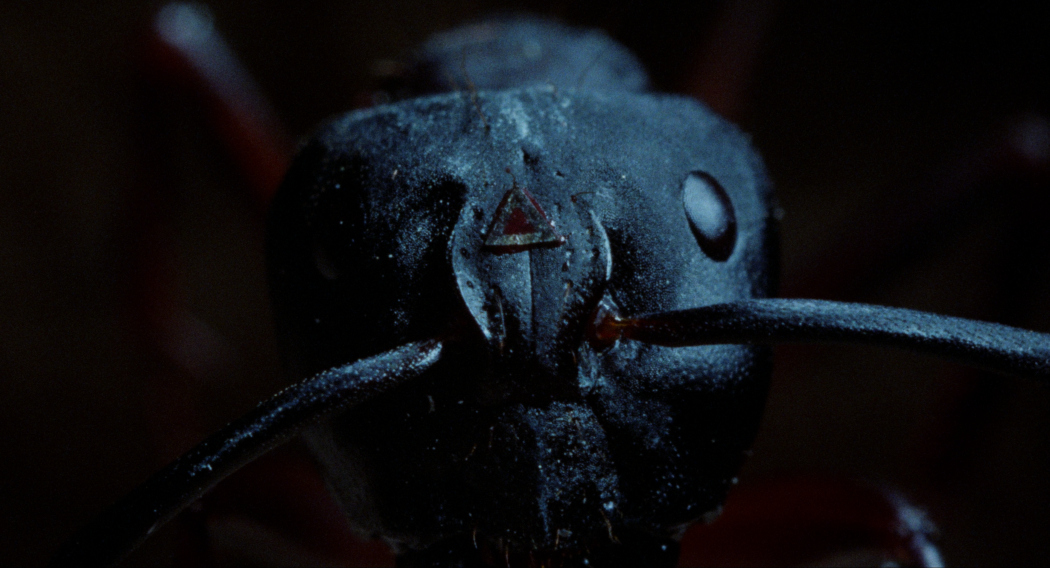

Phase IV (1974)
4K UHD + Blu-ray · 88 Films
Shelf Worthy
In Brief
Saul Bass made one feature, and naturally it was a dazzlingly strange science-fiction film in which ants are far smarter than the humans trying to study them. Phase IV looks magnificent in 88 Films’ 4K edition, which includes a restoration from the original negative, Dolby Vision, new discussions, and Bass’s legendary excised ending. It’s the rare killer-bug movie that gives the insects the intellectual advantage and the audience something to think about long after the credits.
The Facts
Synopsis: Following a strange cosmic event, colonies of desert ants begin cooperating in increasingly intelligent and unsettling ways. Two scientists establish a research station to investigate, only to discover their subjects have plans of their own.
Starring: Michael Murphy, Nigel Davenport, and Lynne Frederick.
Directed by: Saul Bass.
Rated: BBFC 12.
Running length: 83 minutes (theatrical version).
Buy It Here
The Package
Label and release: 88 Films; April 20, 2026.
Format: Two discs, 4K UHD and Blu-ray, with limited-edition Thomas Walker O-ring artwork featuring a micro-motion effect on silver board and a booklet by Barry Forshaw and James Whittington.
Video: 2160p, Dolby Vision/HDR10, 1.85:1, restored from the original negative; Blu-ray in 1080p.
Audio: English original mono presented in lossless 2.0.
Subtitles: English SDH.
Disc specifications: UHD region free; Blu-ray Region B.
The Film
Saul Bass spent decades making audiences pay attention before the movie even started. His remarkable title sequences for filmmakers such as Alfred Hitchcock and Otto Preminger helped establish the art of opening credits as a storytelling tool, while his work on Psycho extended into the infamous shower sequence. Given that history, perhaps it’s appropriate that his only feature as director, Phase IV, is a science-fiction film where the images are frequently more interesting than the people speaking. Released in 1974, it isn’t the rampaging giant-insect movie its marketing suggested. It’s a cold, hypnotic, occasionally baffling experiment about an ant colony that begins organizing itself in ways humanity has absolutely no business underestimating.
Following a mysterious cosmic event, desert ants start cooperating with an intelligence and purpose that unsettles two scientists. Biologist Ernest Hubbs (Nigel Davenport, Chariots of Fire) and colleague James Lesko (Michael Murphy, Manhattan) establish a sealed, computerized research station in what the film presents as the Arizona desert, although the production was actually shot in Kenya. They hope to learn why the ants are behaving differently, but it soon becomes apparent that the insects are observing their human visitors every bit as carefully. A young woman named Kendra (Lynne Frederick, Nicholas and Alexandra) joins the scientists, and the situation gradually becomes less a laboratory investigation than a contest to determine which species understands the other better. The humans bring technology, protective equipment, and a great deal of professional confidence. The ants bring teamwork, patience, and apparently much better project management.
The real stars are the insects themselves, photographed in astonishing close-up by Ken Middleham, whose work also appeared in The Hellstrom Chronicle. Bass and cinematographer Dick Bush turn sand, antennae, and tiny bodies into images that are alternately beautiful and alarming, finding elaborate patterns in the colony’s movements that suggest an intelligence just beyond our understanding. The macro photography remains impressive more than half a century later, partly because Bass never treats the ants as simple monsters. They’re a society, and watching them work is almost as mesmerizing as watching the increasingly nervous people trying to control them. Brian Gascoigne and David Vorhaus provide an eerie electronic score that pushes the film toward something closer to science-fiction abstraction than conventional creature-feature excitement.
The structure owes something to 2001: A Space Odyssey, with a nearly wordless opening, emotionally distant characters, and the suggestion that humanity may not be the most important thing in the universe after all. That distance can be a challenge. Hubbs and Lesko are more fascinating as opposing scientific attitudes than as people I particularly cared about, and the movie occasionally seems less interested in human behavior than in allowing us to watch ants carry out another unnervingly elaborate mission. But that chilly perspective is also what makes Phase IV special. It asks us to consider the possibility that the natural world might evolve past the point of needing us, and that our first instinct would still be to convince ourselves we were in charge. The ecological unease feels remarkably contemporary, even when the computers and scientific equipment don’t.
Paramount apparently had a difficult time deciding what to do with the film after discouraging test screenings. The studio removed Bass’s ambitious, nearly wordless final montage, added narration, and marketed the result more conventionally. The missing ending became something of a legend, with fragments resurfacing in unusual places before the complete sequence was shown publicly in 2012. Seeing that material now is a reminder that Phase IV was never supposed to behave like an ordinary insect-horror picture. Bass was making something much stranger, more visual, and frankly more daring. The movie wasn’t a success in its day, but its refusal to play by the usual rules has given it a fascination that only increases with time.

The Transfer
Video
88 Films presents the theatrical cut in a 2160p restoration from the original negative, framed at 1.85:1 with Dolby Vision and HDR10. Middleham’s macro photography is an ideal showcase, allowing audiences to examine the insects, sand grains, and delicate textures that make Bass’s world feel simultaneously familiar and alien. The harsh desert light and stark white laboratory interiors also make the expanded tonal range a welcome addition. Vinegar Syndrome’s 2024 US UHD used an original-negative restoration with HDR10, while this edition adds a Dolby Vision option.
Audio
The film’s original mono soundtrack is supplied in lossless English 2.0, with optional English SDH subtitles. That’s a perfectly sensible choice for a movie with stretches of near silence, punctuated by precise effects and a hypnotic electronic score. There’s no need to make the ants thunder through the surround channels when their smallest movements are already capable of making your skin crawl.
Transfer Notes
The featured movie is Paramount’s approximately 83-minute theatrical version, not a reconstruction of Bass’s originally intended cut. His excised finale appears separately among the supplements, allowing viewers to compare what audiences originally saw with the sequence the studio removed. Vinegar Syndrome’s edition includes a longer 89-minute Preview Version reconstructed using Bass’s editing notes and remains valuable for anyone studying the film’s competing forms. The 88 Films edition instead emphasizes the theatrical film, the deleted finale, and newly produced critical features.

Special Features
- New commentary with Nathaniel Thompson and Troy Howarth: A fresh examination of Bass’s one directorial feature.
- Ant Allegory (new): Author Deborah Allison considers the film’s ecological and thematic possibilities.
- Another World (new): Artist Graham Humphreys discusses Saul Bass and the movie’s visual language.
- Original Saul Bass ending: The extraordinary, roughly four-minute montage removed from the theatrical cut.
- Theatrical trailer: Includes glimpses of footage missing from the finished feature.
- Limited-edition booklet and artwork: Writing by Barry Forshaw and James Whittington, plus the Thomas Walker-designed O-ring.
It’s a relatively compact extras menu compared with some boutique releases, but the lost ending is a treasure. Bass’s work rarely needed much dialogue to make a point, and these few minutes demonstrate just how much he could accomplish through images alone.
Shelf Worthy?
Shelf Worthy
Phase IV isn’t the movie to put on when you want enormous radioactive insects knocking over skyscrapers. It’s stranger, more cerebral, and in some ways considerably creepier than that. The 88 Films 4K is a terrific introduction for patient science-fiction fans and anyone fascinated by the visual imagination of Saul Bass, although owners of Vinegar Syndrome’s edition will want to retain the alternate cut. Humanity may have the biggest brains in this film, but the ants are the ones who know how to use theirs.
Shelf Worthy: Buy it. This one earns a spot on the shelf.
Stream First: Watch it before you buy.
Completionists Only: For collectors who need every edition.
88 Films provided a copy for review. My opinions are my own.

Reviewed by Joe Botten
Joe Botten is The MN Movie Man, a Twin Cities film critic writing spoiler-free reviews since 2012. He also writes for Loud and Clear Reviews, a Rotten Tomatoes approved site. Find him on Instagram and Letterboxd.
Looking for something?
Search by actor, movie, director, genre or keyword.


Leave a Reply