Adapting William S. Burroughs’ 1985 novella Queer to the screen was always going to be a daunting task. With its introspective prose that brought its tensions to a smothering simmer, the novella thrives on what remains unsaid as much as what is expressed. With Queer, director Luca Guadagnino attempts to transform Burroughs’ extremely literary (read: hard to film) semi-autobiographical work into a cinematic form, blending his signature visual flair with the shadowy emotions of discontent and desire. While the film unsurprisingly dazzles with its aesthetic achievements (this is a Guadagnino film, after all), it struggles to bridge the gap between Burroughs’ internal musings and the demands of narrative storytelling.
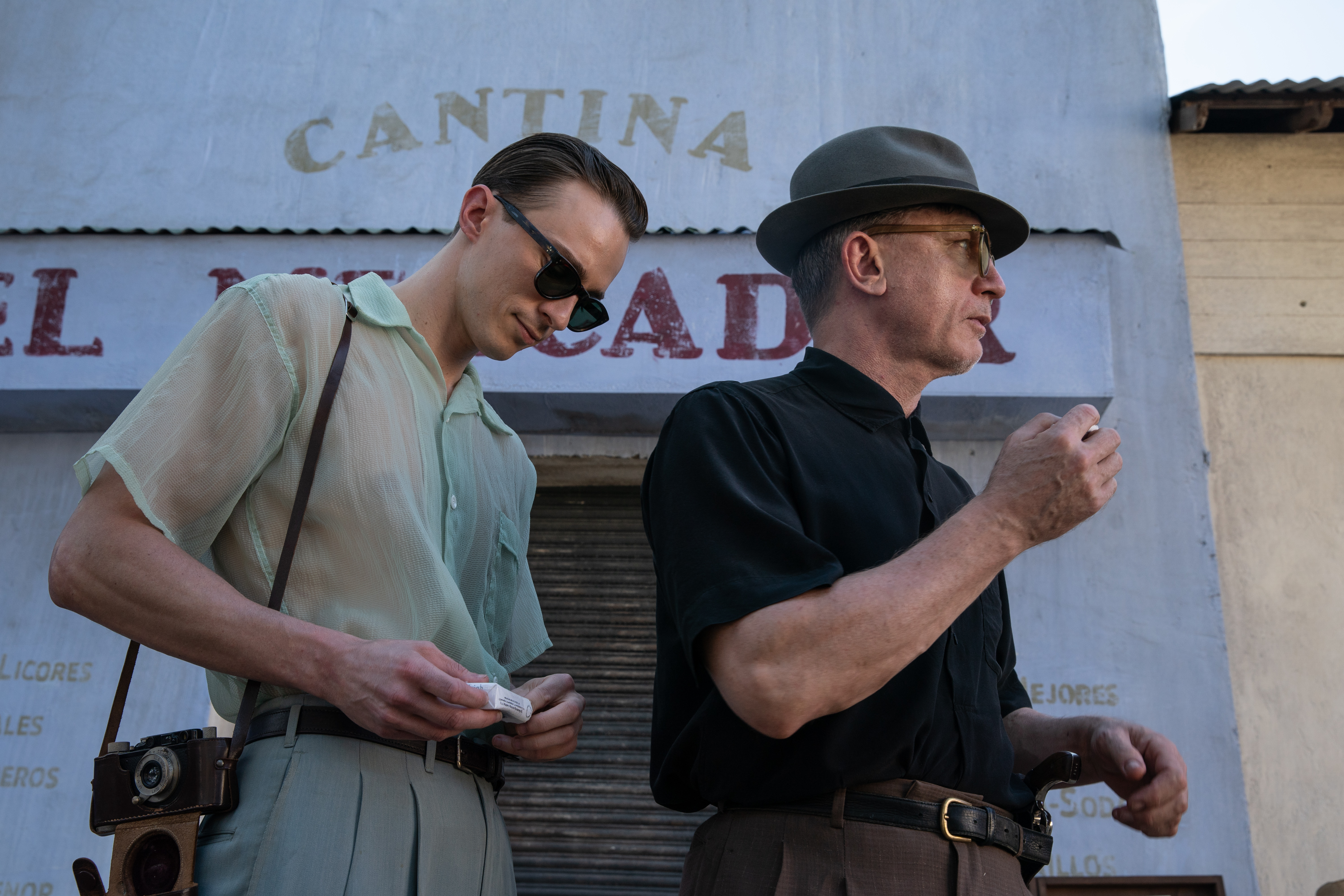
Standing in as a pseudo-reflection of Burroughs is the character of William Lee (Daniel Craig, Knives Out), a self-exiled American navigating the gritty, sweat-drenched streets of 1950s Mexico City. Here is a man haunted by his past soon consumed by his fixation on the newly arrived Eugene Allerton (Drew Starkey, Love, Simon), a younger, emotionally aloof GI he meets in a bar. Their uneasy connection grows into an obsessive, one-sided pursuit, eventually leading the pair on a hallucinatory journey to South America in search of yagé, a mythical drug rumored to offer telepathic abilities. Though steeped in woozy imagery, their quest is less about transcendence and more about Lee’s final unraveling as he grapples with isolation, longing, and his own toxic tendencies, traits he can’t run from forever.
Forever a sleek, dashing James Bond, Craig sheds the suaveness of his super spy persona to inhabit Lee’s easily flustered vulnerabilities. His portrayal is composed, even disquieting, capturing the awkward intensity of a man clinging to a love that isn’t reciprocated. Conveying Lee’s desperation for connection with a rising ferocity, his emotional implosion becomes absorbing and unsettling, if a overall a bit staid because his counterpart is so bland. As Allerton, Starkey nails the blankness that keeps Lee—and the audience—at a distance. While effective for a stretch, the script (adapted by Guadagnino’s Challengers collaborator Justin Kuritzkes) gives the actor little to do beyond serving as the object of Lee’s obsession, leaving his character frustratingly underdeveloped. I don’t get the impression Starkey was capable of taking it further, though, and wonder what a different actor might have been able to do with the role as written.
As is often the case with Guadagnino’s work, the supporting cast is stacked with enviable talent offering moments of intrigue, but they suffer from uneven utilization here. Phantom Thread‘s Lesley Manville’s turn as Dr. Cotter, a peculiar figure encountered late in the story, injects critical eccentric energy into the third act, but it’s caught in a genuinely head-spinning sequence that the audience doesn’t have much time to ease into. Meanwhile, early appearances by Quiz Lady’s Jason Schwartzman (in a schlubby fat suit covered by an array of embarrassing “Husky Fit” shirts and the like), Drew Droege (Fool’s Paradise), and filmmakers Ariel Schulman (Paranormal Activity 4) and David Lowery (The Green Knight) feel more like fleeting cameos than integral contributions. Why feature such familiar faces if you aren’t going to do anything interesting with them?
Despite these shortcomings, Guadagnino’s world-building as a filmmaker with a trained eye remains impeccable. His recreation of mid-century Mexico City is immersive, with smoky cantinas, shadowed alleyways, and stifling-hot jungles forming a vivid backdrop for Lee’s descent into a frenzy of his own making. Known for his sensual and atmospheric style in films like Call Me by Your Name, Guadagnino’s production design (by newcomer Stefano Baisi) captures both the grit and allure of the era, while J.W. Anderson’s sweat-drenched costumes nicely reflect each character’s eccentric spirit and show off Starkey’s best assets. The jungle sequences, in particular, pulse with life through Sayombhu Mukdeeprom‘s camerawork, contrasting the suffocating sterility of Lee’s emotionally stunted reality (or the reality he has escaped to in Mexico). However, while Guadagnino’s methodical mastery is on full display, it sometimes overshadows the story, leaving the intended moments meant to matter undercut by the emphasis on style.
One of the film’s most intriguing elements is its score, composed by Trent Reznor and Atticus Ross. The duo’s music provides a haunting, restrained backdrop, amplifying the film’s disquieting tone. However, much like the narrative itself, the score feels emotionally distant, lacking the laid bare intensity that could have drawn viewers deeper into Lee’s psyche. Earlier in 2024, Reznor and Ross turned their score for Guadagnino’s Challengers into what could almost be called the film’s fourth leading character. While they’ll undoubtedly get an Oscar nomination for that, this one is a curious non-starter. The detachment within the score permeates the entire film, making it challenging to engage fully with the characters’ internal struggles.
Kuritzkes screenplay exposes the inherent difficulties of adapting Burroughs’ contemplative prose. The novella’s stream-of-consciousness style and fragmented structure resist straightforward translation, and the film often feels caught between preserving the source material’s ambiguity and crafting a cohesive narrative. Themes of unreciprocated desire, addiction, and the power imbalances in relationships are present but underexplored, leaving the story feeling incomplete. Modern audiences don’t need all their stories told in a linear fashion or their hands held when a narrative diverts into, say, a jungle, but they should feel confident they’ll be able to find their way to safety…that doesn’t happen in Queer.
In its final moments, Queer opts to finally align with Burroughs’ style but, by then, can only leave the viewer with a major feeling of indifference. For all its visual splendor and Craig’s willing performance, the film struggles to connect emotionally, keeping its characters almost defiantly at arm’s length. Guadagnino’s direction, while technically impressive as is typical, falters in capturing the base intensity of Lee’s longing, rendering the story more beautiful in concept than moving in reality.


Leave a Reply