


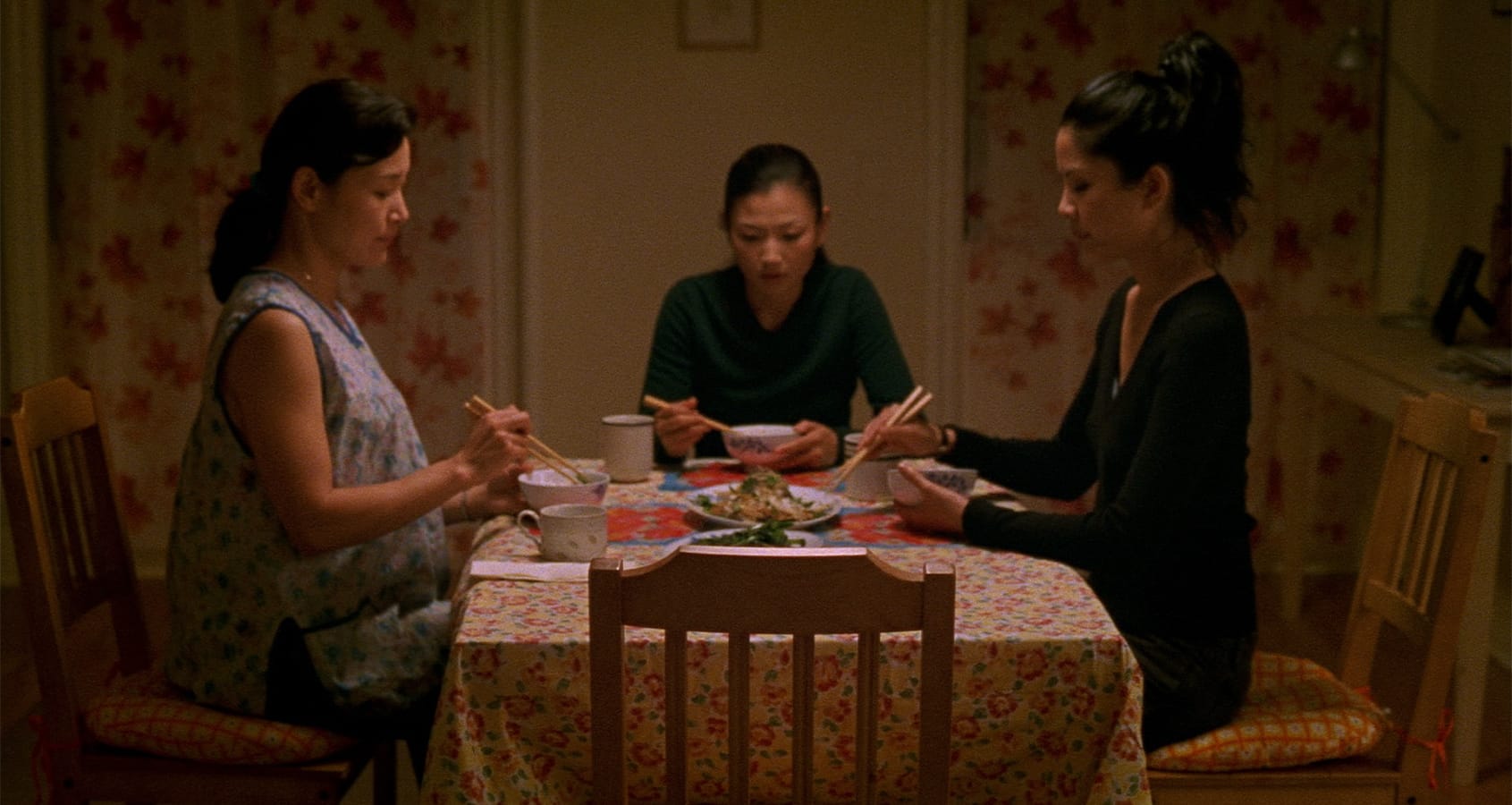
Synopsis: A gay Chinese-American and her traditionalist mother are reluctant to go public with secret loves that clash against cultural expectations.
Stars: Joan Chen, Michelle Krusiec, Lynn Chen, Jin Wang, Guang Lan Koh, Ato Essandoh, Jessica Hecht
Director: Alice Wu
Rated: R
Running Length: 97 minutes
Movie Review in Brief: Saving Face makes its long-awaited Blu-ray debut in a lovingly preserved edition from Criterion, honoring Alice Wu’s singular voice in queer cinema with sharp presentation and thoughtful extras.
Alice Wu never intended to make a movie when she started writing what would become Saving Face. Working as a program manager at Microsoft’s CD-ROM entertainment department, Wu began crafting a novel inspired by her own experience coming out to her mother—a conversation that resulted in two years of silence and the eventual dedication of this film to the woman who learned it’s never too late to fall in love for the first time.
That personal genesis shows in every frame of Wu’s 2004 directorial debut, a film that arrived during the mid-2000s indie boom and has quietly endured as one of the few lesbian films with an unequivocally happy ending. Criterion’s addition of Saving Face to their collection represents another important voice in queer cinema finding its rightful place among the boutique label’s essential films.
Dr. Wilhelmina “Wil” Pang (Michelle Krusiec, The Invitation) navigates dual lives as a successful Manhattan surgeon and a closeted daughter in New York’s Chinese-American community. When her widowed mother Hwei-Lan (Joan Chen, The Wedding Banquet) is expelled from the family home for an out-of-wedlock pregnancy, she moves in with Wil, complicating an already delicate balance.
Meanwhile, Wil finds herself drawn to Vivian (Lynn Chen, Launchpad), a dancer whose pursuit of modern dance over traditional ballet mirrors Wil’s own struggle between personal authenticity and familial expectations. As both women grapple with love that challenges cultural norms—Wil with her sexuality, Hwei-Lan with her unexpected pregnancy—their parallel journeys toward self-acceptance unfold against the backdrop of traditional expectations and changing generational values.
Wu met over a thousand actors to find performers who could handle the film’s bilingual dialogue with real comedic timing. The effort shows in performances that feel authehtic instead of tried on for size. Krusiec brings a simmering intensity to Wil, capturing the exhausting work of code-switching between professional confidence and filial duty. Her chemistry with Lynn Chen develops naturally, avoiding the rushed passion that often characterizes LGBTQ+ cinema in favor of genuine connection.
Joan Chen delivers the film’s most complex performance as Hwei-Lan, a woman whose stern exterior gradually reveals vulnerabilities that mirror her daughter’s hidden truths. Chen’s own interview reveals how Wu initially hesitated to cast her, thinking she was too glamorous for the role, but Chen’s determination to dress down and embrace a fading beauty adds remarkable weight and backstory to her character.
Wu’s direction shows supreme assurance for a debut feature, understanding that intimate stories require patient observation rather than flashy technique. The film maintains the deliberate pace and dialogue-driven focus that characterized the best of ’90s indie NYC cinema, wearing its $2.5 million budget as a badge of authenticity rather than limitation. Wu knows exactly where she’s headed narratively, even if the journey occasionally feels more contemplative than energetic.
Criterion preserves the film’s natural grain, grounding Saving Face in its specific time and place. Shot by cinematographer Harlan Bosmajian on 35mm film in Queens, Brooklyn, and Manhattan locations, the cinematography captures both the vibrant colors of Chinese celebrations and the muted tones of Wil’s carefully compartmentalized life. The contrast between these worlds—one bursting with communal energy, the other marked by professional restraint—becomes a visual metaphor for Wil’s internal conflict. This Blu-ray presentation feels crisp and authentic, allowing Wu’s careful attention to visual storytelling to shine through without digital interference.
Criterion includes Wu’s feature and deleted scenes commentaries from the 2005 DVD, plus a behind-the-scenes featurette and Sundance diary. The real treasures are the new interviews with Wu and Joan Chen, both providing excellent context for their careers leading up to Saving Face and reflecting on why getting this particular story right mattered so much. Wu’s discussion of the film’s continued relevance—viewers telling her it helped them come out—underscores its lasting impact beyond festival accolades.
The included booklet features production stills and an astute essay by Phoebe Chen that places the film within broader contexts of Asian American cinema and LGBTQ+ representation. The new cover art by Ping Zhu proves eye-catching, though it doesn’t quite capture the film’s gentle spirit as effectively as it might.
Made over twenty years ago, Saving Face still feels fresh thanks to Wu’s choice to avoid tech-heavy storytelling. The themes remain painfully relevant—families from specific cultural backgrounds struggling to accept LGBTQ+ children, and those children wrestling with resentment toward parents who sacrificed much for them. Immigration stories naturally involve cultural negotiation, and many obstacles facing LGBTQ+ individuals within traditional communities persist today, making Wu’s film feel remarkably contemporary.
Within the landscape of queer cinema, Saving Face occupies a special place as a film unafraid to embrace joy alongside struggle. While it lacks the buoyant energy of something like Kissing Jessica Stein (a film I hope will also wind up with Criterion at some point), Wu’s more measured approach allows space for multiple storylines—lesbian identity, late-life romance, patriarchal systems—without losing focus on the central mother-daughter relationship that anchors everything. The film’s commitment to authentic cultural specificity rather than universal palatability gives it lasting power that transcends its modest scale.
For fans of the film or its stars, this Criterion release represents essential ownership, particularly for Wu’s commentary and the illuminating new interviews. Newcomers should consider this a worthy blind buy, understanding that its reflective pace and cultural specificity may not appeal to all viewers. Saving Face doesn’t possess the kinetic energy of films set in a city always on the go, but its patient observation of characters learning to love themselves—and each other—without shame creates something far more valuable: a portrait of dignity earned through courage, one honest conversation at a time.
You can buy the film directly from Criterion here.
Looking for something? Search for it here! Try an actor, movie, director, genre, or keyword!
The MN Movie Man
Spoiler-free film critic on a mission to ensure your cinematic experience is unforgettable. Let's dive into the magic of movies together!
<script async src="https://widget.justwatch.com/justwatch_widget.js"></script>


