There’s no faster shortcut to relevance these days than standing next to someone who already has it. In Lurker, writer-director Alex Russell‘s deeply eerie and compulsively watchable psychological thriller, that shortcut becomes a blood sport. Russell’s directorial debut dissects the pathology of social climbing with the surgical precision of Nightcrawler and the queasy intimacy of Ingrid Goes West, creating a thriller that burrows under your skin and refuses to leave.
We meet Matthew (Théodore Pellerin, Boy Erased) behind the counter at a boutique on La Brea, his expression somewhere between blank and calculating. He clocks Oliver (Archie Madekwe, Saltburn) across the store—an emerging pop artist with the kind of soft fame that makes strangers stop for selfies. Matthew cues up a Nile Rodgers track, baiting the hook. Oliver bites.
What seems like a meet-cute built on shared taste is actually a well-researched ambush. From this moment on, everything Matthew does is part of a bigger plan. Russell stages this seduction with the elegance of a long con. Matthew, lonely, directionless, and 22, isn’t content to idolize Oliver from afar. He wants in. And once Oliver invites him to a show and then into his home, Matthew quickly makes himself indispensable—first as a runner, then as a videographer, then as a near-constant presence.
We witness a masterclass in manipulation as Matthew systematically infiltrates Oliver’s inner circle. Russell, whose writing credits include acclaimed episodes of The Bear and Dave, understands the delicate ecosystem of celebrity entourages. There’s Swett (Zack Fox), Oliver’s protective best friend; Noah (Daniel Zolghadri), the wary videographer; and Shai (Havana Rose Liu, No Exit), the pseudo-manager with the sharpest instincts about Matthew’s true intentions. When Shai warns Matthew that access without purpose is a dead end, it’s the closest the film comes to a mission statement. It all seems so easy. Until someone else gets invited to the party.
When Jamie (Sunny Suljic, The Killing of a Sacred Deer), a former coworker, joins the entourage, he quickly becomes the new favorite. He has charm, humor, maybe even talent. And unlike Matthew, he’s not faking anything. So Matthew, no longer content to hover in Oliver’s orbit, does what lurkers do best: he watches, he waits, and he schemes. The closer he gets to the sun, the more brittle he becomes. Fame, or the nearness of it, turns out to be a volatile drug.
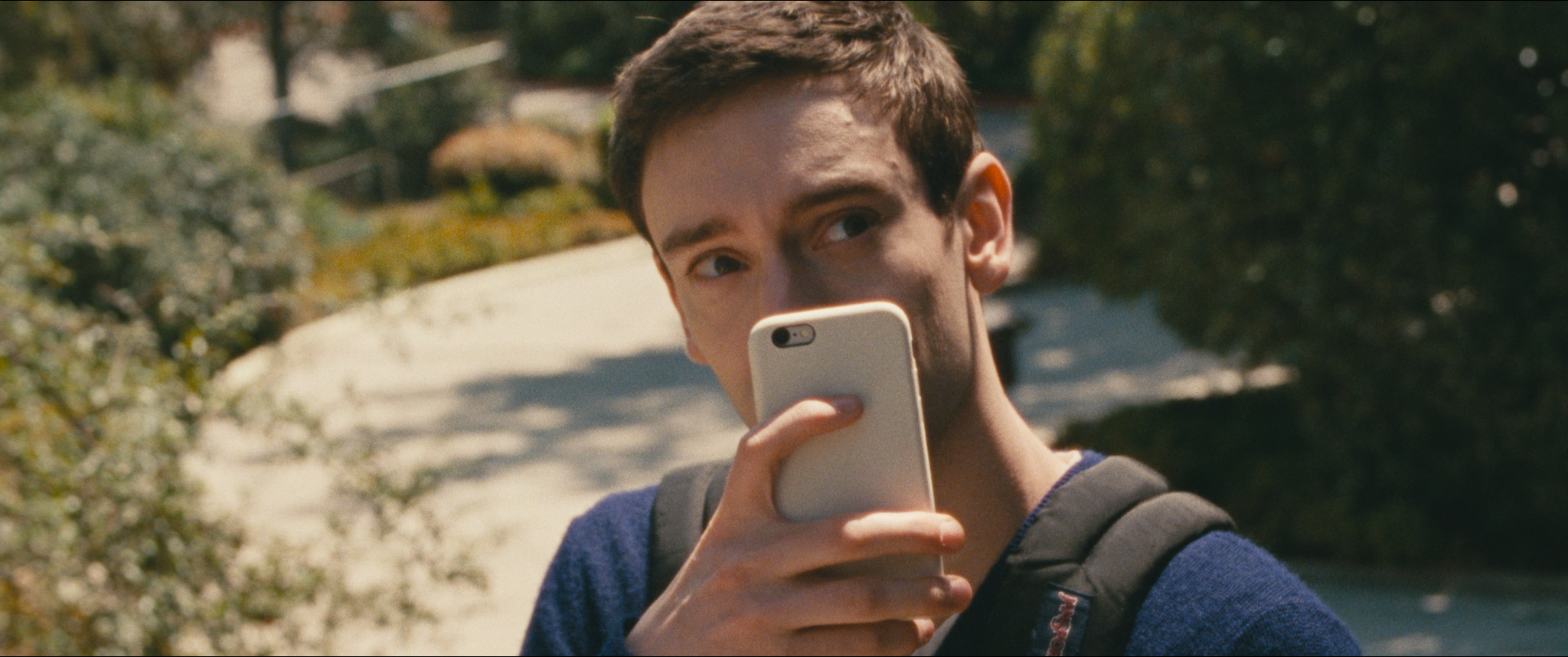
Pellerin plays Matthew like a social void given flesh—a blank-eyed operator who’s deeply aware of how charisma works, even if he doesn’t possess any himself. The actor’s gaunt features and practiced smile suggest someone who’s studied human connection rather than experienced it. It’s a tricky performance, especially since the camera rarely lets us forget we’re seeing him perform for Oliver, for the crew, for us. His emptiness feels complete and authentically dangerous.
Madekwe, in turn, plays Oliver not as a victim, but as someone who knows he’s cultivating orbiters. He wants “real people” around him, he says, but what he really wants is curated authenticity. Their dynamic becomes a codependent loop—fascinating, sad, and charged with just enough homoerotic tension to further complicate everything. There’s a fascinating ambiguity here: does Oliver truly not see through Matthew’s act, or does he recognize a kindred spirit in manufactured connection?
Craft-wise, Lurker looks like money without flaunting it. Pat Scola’s cinematography leans into grain and shadow, casting LA as a city where dreams don’t die so much as dissolve. The editing—courtesy of David Kashevaroff—snaps between formats, evoking the fragmented way we all experience each other now: through lenses, screens, and filtered clips. Kenneth Blume‘s score (aka Kenny Beats) pulses with glitchy tension, layering Oliver’s slick pop sound with the unease humming beneath it.
The setup recalls Velvet Buzzsaw‘s cold-blooded ambition, but with a sheen of influencer-era disaffection. Matthew isn’t chasing recognition for something he made. He’s chasing recognition through someone else. He’s the kind of fan that parasocial dynamics have turned into a new breed of antagonist—one who blends in until he can’t. In one of the film’s most quietly disturbing moments, a stranger asks Matthew how to become like him, assuming proximity equals skill. Matthew can’t answer. Because there is no answer. He’s not a creator. He’s a mirror, cracked and handheld.
Lurker thrives on psychological unease rather than violence. The film’s most chilling moments aren’t acts of aggression but instances of emotional manipulation, as Matthew exploits Oliver’s need for validation with surgical precision. Russell explores how social media has created a generation fluent in performance but starved for genuine connection. Matthew represents the logical endpoint of parasocial relationships—someone who’s studied their obsession so thoroughly they can turn intimacy into a sharp tool of destruction.
The cultural commentary feels particularly sharp when influence and access have become their own forms of currency. Russell doesn’t just critique celebrity culture; he examines how the mechanics of fame corrupt everyone it touches. Oliver isn’t innocent in this dynamic—his need for an audience makes him complicit in his own exploitation. It’s a nuanced take that avoids simple victim/predator dynamics in favor of something more unsettling: mutual enablement.
Where Lurker occasionally stumbles is in its final act, when Russell’s measured approach gives way to more conventional thriller mechanics. The climax leans too heavily on metaphor, with a final track—”What’s the difference between love and obsession?”—that spells out what the film’s already made clear. A late-game power shift lands awkwardly, disrupting the film’s otherwise impeccable control. The escalation feels slightly forced after such carefully calibrated psychological tension has been built up.
Still, even with those missteps, the final stretch leaves you breathless from the quiet horror of watching someone lose themselves by trying to become someone else. Lurker succeeds because it understands that the most effective horror comes from recognizable human behavior pushed just past the point of comfort. We’ve all encountered people like Matthew—those who seem slightly too eager to please, whose interests align suspiciously well with our own. Russell’s achievement is making us complicit in Oliver’s seduction while horrifying us with its implications.
Russell has made a debut that feels of the moment without being disposable. It’s a cautionary tale wrapped in cool lighting and cooler vibes, but the core is pure ache. Lurker lingers, creeps, and like its title promises, doesn’t leave your head easily.