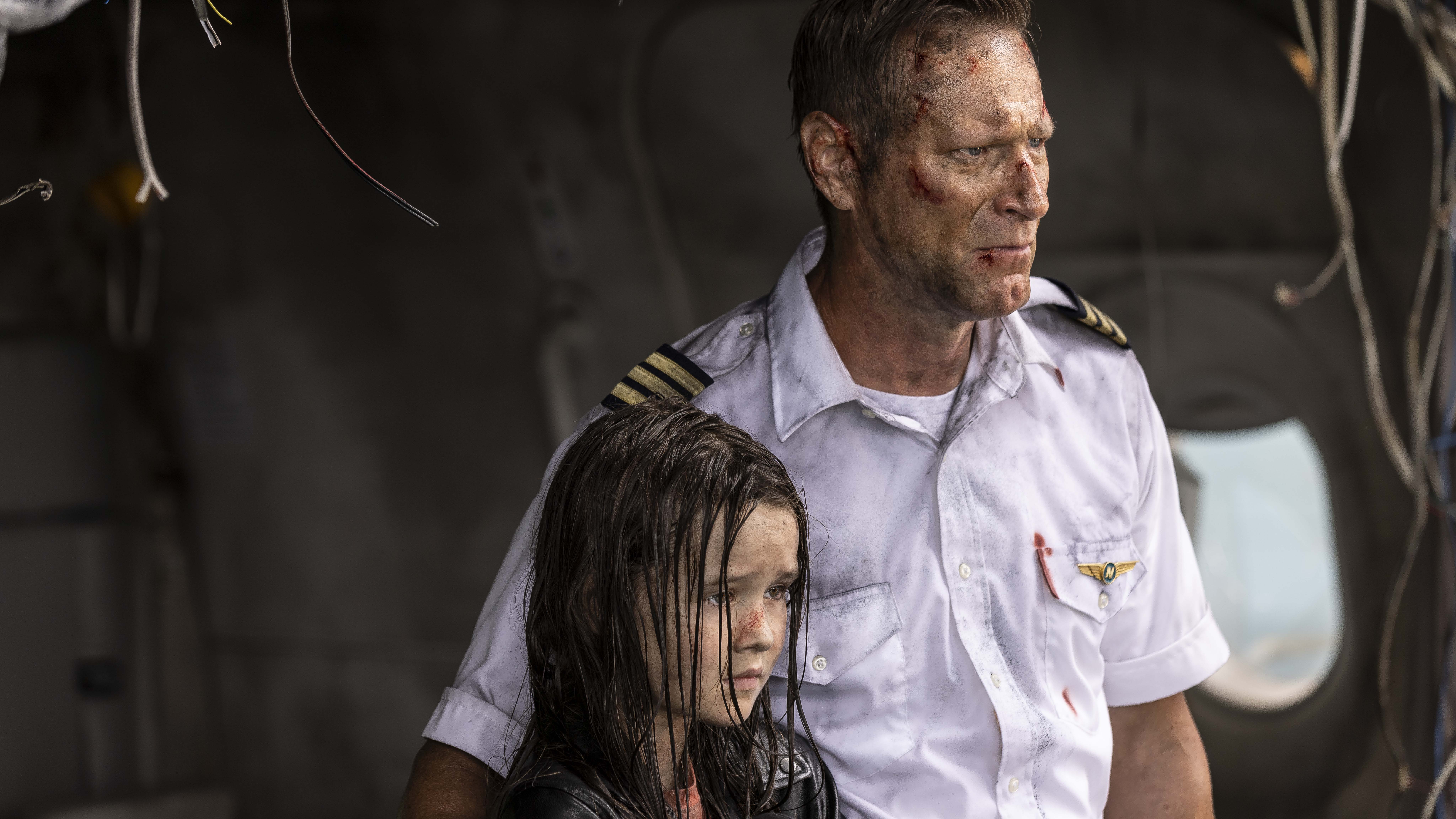
Synopsis: A flight from Los Angeles to Shanghai goes down in the middle of the Pacific. After surviving the crash, the survivors soon discover they’re not alone and they must survive the shark infested waters
Stars: Aaron Eckhart, Ben Kingsley, Molly Belle Wright, Angus Sampson, Kelly Gale, Li Wenhan
Director: Renny Harlin
Rated: R
Running Length: 107 minutes
Movie Review in Brief: Twenty-seven years after Deep Blue Sea, Renny Harlin wades back into shark-infested waters with a starry cast, a six-writer screenplay, and forty-eight producers attached. The plane crash sings. The shark attacks bite. Almost everything in between feels like it was shot in a swimming pool with the lights left on.
Deep Water Review: Jaws Dropped
Renny Harlin made Deep Blue Sea, the rare shark movie that earns its place on the shelf next to Jaws (okay…a shelf down and a little to the right). He also made Die Hard 2, Cliffhanger, and The Long Kiss Goodnight during a stretch in the nineties when he was the genre director Hollywood reached for first. Then came the long, strange downturn (Cutthroat Island, Exorcist: The Beginning, the inexplicable reboot of The Strangers that stretched over the last two years and three films), and now here he is, returning to shark-infested waters twenty-seven years after his one undisputed creature-feature win.
However, Deep Water is not the slam-dunk welcome comeback we hoped for. It’s a goofy, expensive, frequently dumb survival picture that occasionally remembers its director used to be “the” Renny Harlin and briefly lights up with possibility before sinking into the depths again.
Six Cooks, Stock Characters
Los Angeles to Shanghai. Routine flight. Until, of course, it isn’t. The setup mirrors 2025’s No Way Up almost beat for beat, with a downed plane, survivors treading water, and dorsal fins arriving roughly ninety seconds after the impact. The screenplay is credited to six writers. Yes, six. (Pete Bridges, Shayne Armstrong, S.P. Krause, Damien Power, John Kim, Dan Luo, with Armstrong and Krause also splitting story credit.) When you’re counting screenplay credits like sharks, the script is rarely the reason you came.
The character roster reads like a casting sheet someone forgot to flesh out. There’s the troubled first officer, the womanizing octogenarian captain, the recently blended family whose parents look more like Calvin Klein Obsession models than two adults who attend PTA meetings, the obnoxious-passenger-who-is-clearly-going-to-get-eaten-and-deserves-it, the cranky old lady, the nerd, three flight attendants with hearts of gold, and assorted disposables.
There’s also an American sports team and a Chinese e-sports team onboard, though the film never bothers to clarify what sport any of them actually play. Culture clash gets introduced as a side dish before the main course of crash and sharks arrives, and then it’s promptly forgotten. You can guess every fate inside ten minutes of takeoff. The film does not particularly mind that you can.
Cockpit Theater
Aaron Eckhart (The Dark Knight) plays troubled first officer Will Drayton with a level of earnestness that recalls Peter Graves in Airplane! without any of the deadpan self-awareness. His pre-flight scene with a small girl at the gate, in which he gravely explains the wonders of aviation to a stranger’s child, is one rewrite away from a Saturday Night Live sketch. The kid lands a dry one-liner that breaks the spell of the moment, and I don’t think the Eckhart realizes the joke is on him.
Sir Ben Kingsley (Daliland), billed in a fine-print credit as “SBK” (and yes, I had to stop the screener and check), plays Captain Roy Thackeray, a karaoke-loving ladies’ man who, despite being well past any commercial pilot’s mandatory retirement age, is still somehow at the controls of a major international flight. Kingsley sings, gazes out windows with damp eyes, and delivers lines that suggest he is the only person in the cockpit who knows what genre he’s in. Within minutes of meeting three botoxed women in the airport bar, he announces out of nowhere, “You want to know what I’m not good at? Marriage.” Reminder…six writers on this one.
The mostly Australian supporting cast plays it straight and bland, blah-blah-blahs in life jackets. Molly Belle Wright is genuinely cute as young Cora, although the screenplay hands her some baffling decisions in pursuit of parents who are busy joining the Mile High Club. Angus Sampson, who has done sneaky-good work in the Insidious films, is miscast as the obligatory loud and obnoxious passenger. You’re meant to want him eaten, and the film delivers, but the wait is long.
Sharks Win, Sets Lose
Here’s the strange thing. The shark CGI is actually the least bad effects work in the picture, which is the inverse of how this is supposed to go. Harlin clearly carried something useful home from Deep Blue Sea, because these are mean, fast, frenzy-mode bull sharks, and the first time one breaches it genuinely jolted me back into the movie. Fins slicing across the surface still work when it comes to creating suspense and pending dread. It worked in 1975 and it works in 2026.
What sinks the rest of the picture is everything around the sharks. The plane crash itself is the film’s set-piece highlight, all twisting fuselage and panicked passengers, and Harlin stages it with the muscular instinct his nineties work was built on. After that, the seams start showing. The water never reads as ocean. The sky never reads as sky. The geography of the survivors’ situation shifts whenever a script point needs it to. You can practically hear the green-screen tarp flapping in the breeze.
Cinematographer D.J. Stipsen does what he can in a tank and Goya-winning composer Fernando Velázquez (The Orphanage) brings a real sense of menace with his score that doesn’t try to evoke John Williams. Editor Geoff Lamb earns a salute for the crash sequence and a few well-timed shark strikes that earn their gasps.
Credit Where It's Crowded
Now, about that crew. I went down the credit list, and the production has forty-eight listed producers, executive producers, co-producers, and associates. Add up the visual effects houses (El Ranchito, Orca Studios, SPIN VFX, Fin Design, Minimo VFX), and you’re looking at hundreds of digital artists across multiple continents.
Gene Simmons of KISS is one of the producing forces, alongside Arclight Films’ Gary Hamilton. None of this is automatically a problem. Deep Blue Sea, Jaws, and most every other shark film worth naming had producers too. But there’s a point where a film’s credit roll starts to feel like a forensic explanation for why the movie itself feels so un-tended.
When a shark thriller this expensive looks this artificial, somebody in one of those forty-eight chairs should have raised a hand and asked whether more practical sharks, fewer green-screen vistas, and a third-fewer credited names might have helped the thing actually work.
A B-Movie Wearing a Big-Movie Suit
You can take Deep Water one of two ways. You can roll with it as cheerfully dumb shark-attack popcorn for a Friday night, which is honestly the most fun read. Or you can sit with the frustration that a director who once made the best of the Jaws imitators is now turning in something that plays like one of Asylum’s infamous mockbusters with an A-list paycheck. I know I had a fine time. I also know that a few small, smart adjustments (less green screen, fewer producers, a scrap of writing that respected its actors) could have made all the difference. Deep Blue Sea‘s grandkid this is not. But it bites occasionally, for good and for bad.
Looking for something? Search for it here! Try an actor, movie, director, genre, or keyword!

Leave a Reply