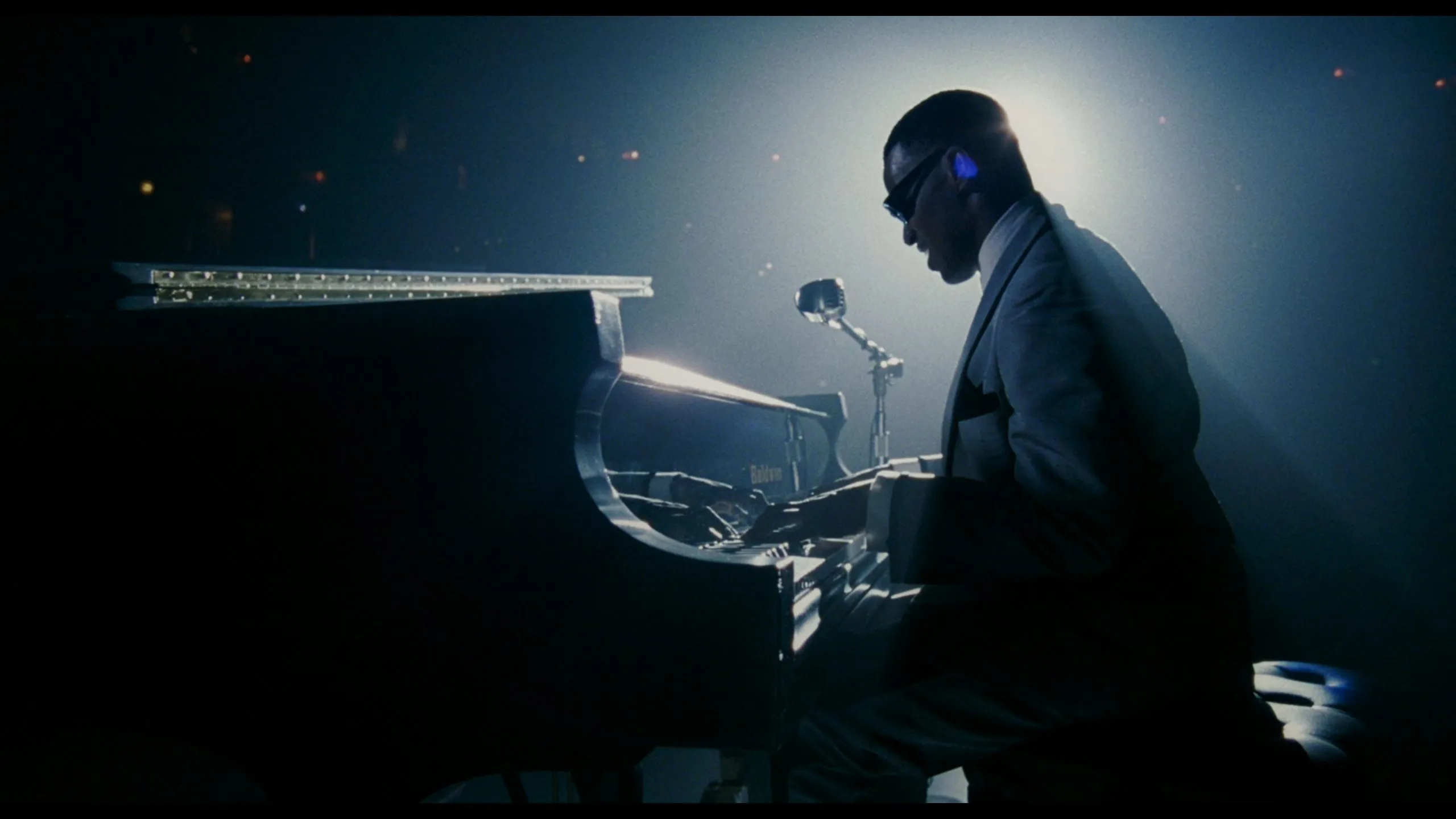

Ray (2004)
4K UHD + Blu-ray · Kino Lorber
Shelf Worthy
In Brief
Taylor Hackford’s Ray reaches 4K UHD for the first time with a new camera-negative scan approved by the director. Jamie Foxx’s Oscar-winning performance remains reason enough to revisit it, while Kino carries forward nearly all of Universal’s supplements.
The Facts
Synopsis: A blind pianist from the rural South rewrites American music by fusing gospel, blues and R&B, while his own demons threaten everything his talent builds.
Starring: Jamie Foxx, Regina King, Kerry Washington, Clifton Powell
Directed by: Taylor Hackford
Rated: PG-13
Running Length: 152 minutes
Buy It Here
The Package
Label: Kino Lorber
Format: 4K UHD + Blu-ray
Release Date: March 31, 2026
Video: 2160p, Dolby Vision and HDR10, 1.85:1. New master from a 4K scan of the 35mm original camera negative, approved by Taylor Hackford
Audio: English DTS-HD Master Audio 5.1 and 2.0
Subtitles: English SDH
Discs: 2 discs: 4K UHD (region free) and Blu-ray (Region A). Reversible art and O-card slipcover on the first pressing
The Film
Taylor Hackford secured the rights to Ray Charles’s life story in 1987, then spent years trying to get the film financed before Philip Anschutz finally stepped in with one major condition: it had to earn a PG-13. Universal didn’t come aboard until after production was complete, acquiring a finished film rather than developing it from the ground up. Charles himself read a Braille version of the script and saw an early cut, but he died in June 2004, just months before the movie reached theaters. By then, Jamie Foxx had already given him one hell of a farewell.
Ray begins in the late 1940s with Ray Charles Robinson (Foxx, Back in Action) traveling to Seattle, a young blind pianist already learning that talent won’t protect him from people eager to take advantage. Flashbacks return to his childhood in Florida, the death of his younger brother, and the gradual loss of his sight, while his mother, Aretha (Sharon Warren), refuses to raise him as helpless. Ahead are fame, addiction, marriage to Della Bea Robinson (Kerry Washington, Django Unchained), affairs, and the musical breakthroughs that will make Ray Charles one of the defining American artists of the 20th century.
Few Best Actor races have ever felt as settled before the envelope was opened. Foxx had made his name as a comedian on In Living Color, but Ray completely changed how audiences looked at him. Prosthetics kept his eyes sealed shut for stretches that could last up to 14 hours, and he performed the piano parts himself. Charles’s own recordings provide the vocals, but Foxx sells the physicality so completely that the seam almost disappears. More importantly, he never turns Charles into a saint. The selfishness is there, along with the heroin addiction, infidelity, temper, ambition, and ability to compartmentalize almost anything that gets between him and the next performance. Foxx understands that greatness and goodness aren’t the same thing. Then Ray sits down at a piano, and the movie catches fire. This is the rare Oscar-winning performance that seems to get better every time you revisit it.
Hackford, who also directed An Officer and a Gentleman, understands musical performance better than many filmmakers who have taken on biopics since. He knows when to watch Foxx’s hands, when to stay on his face, when to cut to the band, and when to let a whole room become part of the performance. Regina King is terrific as Margie Hendricks, the lead Raelette whose relationship with Ray becomes personal, professional, and volatile. Washington has the less flamboyant role as Della Bea, but she gives the movie an emotional counterweight whenever Ray’s appetites start swallowing everything around him.
The problem is scale. At 152 minutes, Ray still feels like it’s rushing because there is simply too much life here, and the movie occasionally turns Charles’s career into a series of milestones it needs to hit before moving on. The private chaos takes up so much oxygen that some of the musical evolution gets compressed. That problem has become even more familiar in the decades since, with movies like Bohemian Rhapsody and Elvis following variations of the rise, addiction, collapse, and redemption structure that Ray helped cement into the modern music-biopic formula. The difference is Foxx. A formula is a lot easier to forgive when somebody disappears this completely inside it.

The Transfer
Video
Kino’s new master comes from a 4K scan of the 35mm original camera negative and was approved by Taylor Hackford. The UHD presents the theatrical cut at 1.85:1 with Dolby Vision and HDR10, marking the film’s first UHD release and providing a new source compared with Universal’s earlier DVD, HD DVD, and Blu-ray editions. Paweł Edelman’s photography moves between brightly lit performance spaces, dim clubs, period interiors, and warmer flashbacks, giving the negative-based restoration a wide range of material to reproduce. The accompanying Blu-ray also uses the new master in 1080p.
Audio
Kino carries forward an English DTS-HD Master Audio 5.1 track and adds a DTS-HD Master Audio 2.0 option. The film won the Academy Award for Best Sound Mixing, with the musical performances obviously doing much of the heavy lifting. Ray Charles’s recordings, band arrangements, crowd ambience, dialogue, and period environments all share the soundtrack. English SDH subtitles are included.
Transfer Notes
Kino presents the 152-minute theatrical cut. Universal previously released Ray on DVD, HD DVD, and Blu-ray, and most of that supplemental package has made the trip. The 4K UHD is region free, while the bundled Blu-ray is Region A. The two U-Control picture-in-picture features, Scene Companion and The Music of Ray, have not been carried over. First pressings include an O-card slipcover and reversible artwork, but no digital copy is included.

Special Features
Audio Commentary by Film Historian and Author Dwayne Epstein (NEW): A newly recorded track included on both discs.
Audio Commentary by Director Taylor Hackford: The archival director commentary, also available on both discs.
Director’s Introduction (1:34): A brief introduction from Hackford.
Stepping Into the Part (10:40): A look at the performances and the work of inhabiting these real figures.
Ray Remembered (4:03): A short tribute.
The Women of Ray (9:55): Focuses on the women in Charles’s life, both on screen and off.
The Filmmakers’ Journey (9:22): Hackford and company discuss the long road to getting the movie made.
Ray: An American Story (28:47): The most substantial documentary in the package.
A Look Inside Ray (3:20): A brief promotional featurette.
14 Deleted Scenes with Optional Director’s Commentary (27:36): Nearly half an hour of material removed from the finished film.
9 Uncut Music Performances (25:33): Full musical numbers without the movie’s dramatic cutaways.
Theatrical Trailer (2:48): The original theatrical campaign.
Nearly every Universal supplement returns, with Epstein’s commentary providing the major new addition. For me, the real prize remains those uncut musical performances. After spending two and a half hours watching Foxx become Ray Charles, getting another 25 minutes at the piano feels less like a bonus feature than an encore.
Shelf Worthy?
Shelf Worthy
This is Shelf Worthy without much debate. Foxx’s performance remains the reason to own Ray, and the music gives it tremendous replay value even when the biopic structure starts feeling crowded. The new 4K master, both audio options, and almost complete archival supplemental package make Kino’s edition the most comprehensive straightforward physical release to date. Anyone particularly attached to Universal’s old picture-in-picture features may want to keep that Blu-ray alongside it. Everyone else can file this one next to the records.
Shelf Worthy: Buy it. This one earns a spot on the shelf.
Stream First: Watch it before you buy.
Completionists Only: For collectors who need every edition.
Kino Lorber provided a copy for review. My opinions are my own.

Reviewed by Joe Botten
Joe Botten is The MN Movie Man, a Twin Cities film critic writing spoiler-free reviews since 2012. He also writes for Loud and Clear Reviews, a Rotten Tomatoes approved site. Find him on Instagram and Letterboxd.
Looking for something?
Search by actor, movie, director, genre or keyword.


Leave a Reply