
Movie Review
I Play Rocky
9/10
TLDR
Peter Farrelly’s I Play Rocky is an absolute crowd-pleaser, with Anthony Ippolito delivering an astonishing performance as a young Sylvester Stallone. Funny, heartfelt, and filled with affection for the original film, it captures the excitement of watching something extraordinary come together against nearly impossible odds. It skips a few chapters I desperately wanted to see, but I was having such a wonderful time that I would have gladly stayed for another hour.
Where to watch: In select theaters now; everywhere November 20
The Facts
Synopsis: The true story of how an unknown actor named Sylvester Stallone wrote Rocky, then refused to sell his screenplay unless he could play Rocky Balboa himself, risking everything for the chance to bring his creation to life.
Director: Peter Farrelly
Stars: Anthony Ippolito, AnnaSophia Robb, Toby Kebbell, P.J. Byrne, Jay Duplass, Matt Dillon, Stephan James, Tracy Letts
Rated: PG-13 for strong language, brief sexual material, and smoking
Running Length: 128 minutes
The Thoughts
I actually gasped when the end credits began rolling on Peter Farrelly‘s I Play Rocky. Not because something shocking had happened or because the movie had pulled a fast one on me. I gasped because I couldn’t believe it was already over. I was so completely wrapped up in the story, entertained by the people telling it, and happy to be spending time with them that I genuinely thought there had to be more. And I would have stayed for every minute of it. That’s an especially impressive achievement when you consider that anyone familiar with the original Rocky already knows how this particular story ends. Farrelly isn’t relying on surprises to keep us interested. He’s counting on our affection for a movie we love, our curiosity about how it came together, and our willingness to root for an underdog even when we know he’s going to win.
The original Rocky is one of those rare movies that has become so thoroughly woven into popular culture that it’s easy to forget how remarkable it actually is. The music, the steps, the training montage, the battered face, and the impossible odds have been referenced and parodied so many times that even people who’ve never watched the movie could probably describe half of it. But beneath all that familiar imagery is a wonderfully human story about a guy who doesn’t necessarily need to win the fight. He just needs to prove that he belongs in the ring. As I Play Rocky reminds us, Sylvester Stallone had considerably more in common with Rocky Balboa than most of us ever realized. In fact, the circumstances surrounding the movie’s creation are so unlikely that they could almost be mistaken for something a Hollywood screenwriter dreamed up.
Before I go much further, I have a confession. It’s only been a few years since I finally watched all the Rocky movies from beginning to end. I’d seen the original, of course, and somehow managed to watch Rocky V when it arrived on VHS without feeling particularly compelled to investigate the three movies I’d missed in between. How’s that for a viewing strategy? Still, the franchise was never entirely absent from my childhood. The Rocky IV soundtrack was a regular fixture in our house, with my dad enthusiastically blasting James Brown‘s “Living in America” on vinyl. I knew the music long before I knew much about Ivan Drago, which is funny when you consider how movies can become part of our lives without us ever sitting down to watch them.
When I finally made my way through the series, I was surprised by how much genuine affection there was for these characters and how consistently that carried from one film to the next. Stallone’s involvement as an actor, writer, director, or some combination of the three gave the franchise something many long-running series eventually lose: a recognizable voice. Characters who barely registered in one installment would return with richer stories, and Rocky himself was allowed to age, make mistakes, and change. Even Creed, Creed II, and Creed III found ways to continue that tradition, while the Netflix documentary Sly made me appreciate Stallone’s determination all the more. So when I heard Farrelly was making a movie about the creation of the original, I was curious but skeptical. Could a film about contracts, studio meetings, and a struggling actor possibly capture even a fraction of the spirit that made Rocky so special? Having seen I Play Rocky, I’m here to tell you it absolutely can.
The Fight Before the Fight
Written by Peter Gamble, I Play Rocky introduces Sylvester Stallone (Anthony Ippolito, The Offer) as a broke, aspiring actor in New York City who’s having a miserable time convincing anyone that he has what it takes to become a leading man. His appearance, his speech, and his inability to fit Hollywood’s preferred mold keep working against him, and the opportunities aren’t exactly piling up. His wife, Sasha (AnnaSophia Robb, The Way, Way Back), recognizes something in him that the industry doesn’t seem particularly interested in finding. Rather than keep waiting for someone to write him the perfect role, she encourages him to create one for himself. Stallone takes her advice, puts pen to paper, and begins writing multiple screenplays that never get much attention, until he creates one about a small-time boxer who gets one extraordinary opportunity to prove he’s worth something.
That screenplay, of course, is Rocky, and producers Robert Chartoff (Toby Kebbell, Dawn of the Planet of the Apes) and Irwin Winkler (P.J. Byrne, Babylon) recognize its potential almost immediately. United Artists sees a promising project, too, although the studio has considerably different ideas about who should star in it. Ryan O’Neal tops the wish list, while Stallone has one rather inconvenient condition: he plays Rocky. The offers for the screenplay keep climbing, eventually exceeding $300,000, an extraordinary amount of money for someone with practically nothing in the bank and a baby on the way. Yet Stallone refuses to budge, insisting that the character he created can only be played by him. He isn’t interested in watching somebody else become famous in a role that could change his life.
What makes this more than a story about an actor demanding the lead is that Stallone’s insistence never feels like ordinary Hollywood ego. This is a man who has spent years being told that he isn’t right for the movies, finally writing something that could give him the opportunity he’s been denied, only to discover that Hollywood wants the story but not the storyteller. There’s something deeply moving about that, particularly when the man refusing a life-changing paycheck can barely afford to turn it down. He believes in Rocky because he understands him, and that conviction becomes the emotional foundation of Farrelly’s film. Both men are fighting to be taken seriously, and neither is willing to accept somebody else’s definition of what they’re capable of accomplishing.

Anthony Ippolito Goes for the Heart
Ippolito is astonishing as the young Stallone, and I can’t remember the last time I watched an actor portray someone so recognizable and so completely forgot I was watching a performance. He never settles for the traditional impersonation, where the familiar voice, posture, and mannerisms do most of the work. Those details are certainly there, including Stallone’s unmistakable nerve-damaged drawl, but Ippolito understands that none of them matter unless we believe in the person underneath. He’s playing a young man who’s terrified of failure but even more terrified of giving up, and the performance moves effortlessly between stubborn confidence, self-doubt, frustration, and humor. At times, it’s almost eerie how convincingly he becomes Stallone, but the real accomplishment is that we care about him long before we start noticing how closely he resembles the real thing.
According to the film’s press notes, Ippolito filmed his audition in his grandmother’s basement on Long Island, with a heavy bag and a cousin holding a lamp. He also gained more than 40 pounds for the role, transforming himself physically while finding the emotional qualities that make Stallone worth rooting for. You may remember Ippolito as a young Al Pacino in The Offer or a young Adam Sandler in Pixels, but this feels like the performance where everything comes together. He has an appealing vulnerability that makes the character’s determination more than a collection of inspirational speeches, and his excitement when someone finally takes him seriously is infectious. Watching him, I kept thinking about how easily the movie could have become a celebrity impression with a big heart attached. Instead, Ippolito gives us the heart first and builds the celebrity around it.
He’s surrounded by a terrific supporting cast, starting with Robb, who gives Sasha a warmth and personality that might easily have been lost in a conventional supportive-wife role. Sasha recognizes her husband’s potential, types his screenplay, and documents the Rocky production through her photography, but Robb also makes their relationship feel like a genuine partnership between two people trying to imagine a future they can’t yet afford. She even learned to use the same Minolta camera Sasha carried during the original shoot. Kebbell and Byrne are equally appealing as Chartoff and Winkler, perhaps the nicest hard-nosed producers Hollywood has ever put on screen. They’re businessmen who understand the risks, but they’re also filmmakers who recognize something special in Stallone’s writing and find themselves caught between his determination and the studio’s resistance.
Jay Duplass is terrific as director John G. Avildsen, a tightly wound filmmaker whose creative instincts occasionally collide with Stallone’s. Duplass reportedly asked Farrelly for the role himself, and I can certainly understand the attraction. Matt Dillon appears as Stallone’s difficult-to-please father, Frank Sr., reuniting with Farrelly decades after There’s Something About Mary, while Stephan James (If Beale Street Could Talk) makes a wonderful Carl Weathers, bringing exactly the confidence and competitive spirit Apollo Creed requires. Kiki Seto appears as Talia Shire, and Tracy Letts (Lady Bird) seems to have cornered the market on playing grumpy Hollywood executives who enter a room already annoyed by everyone in it. It’s a generous ensemble, and Farrelly makes excellent use of their personalities without letting anyone steal the movie away from Ippolito.
Recreating a Classic Without Replacing It
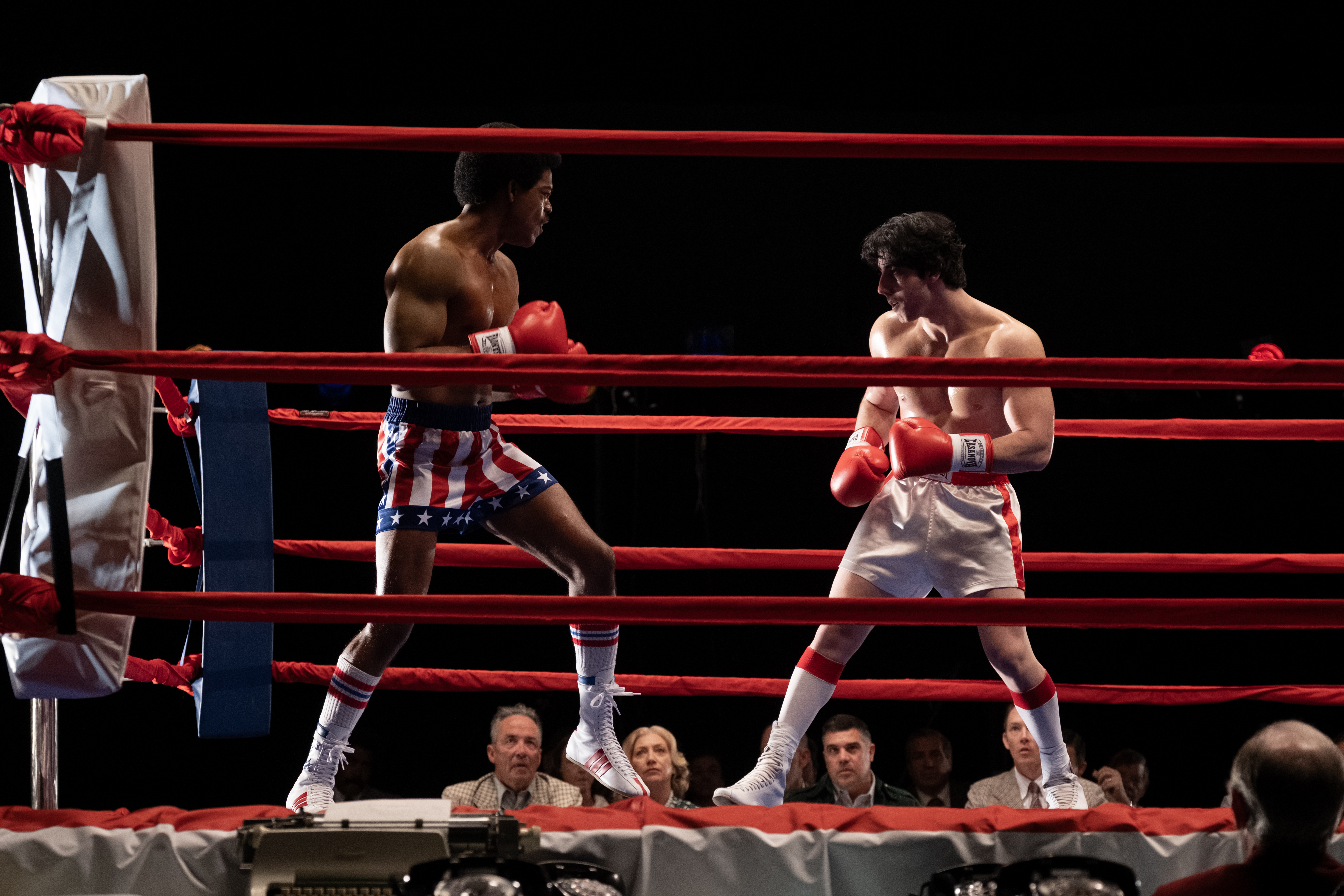
We’ve been getting more movies and television series about the making of other movies and television series lately, from The Offer to Saturday Night, and part of the fun is watching familiar cultural moments come together behind the scenes. But I Play Rocky has a better story to tell than most, and Farrelly is smart enough not to turn it into a two-hour collection of recognizable scenes. There’s an impressive attention to period detail, with New Jersey locations standing in for parts of 1970s New York and Hollywood, and the production even filmed inside the Philadelphia apartment building used in the original Rocky. For the famous run up the steps of the Philadelphia Museum of Art, Farrelly’s crew used the original Steadicam rig, borrowed from its inventor, Garrett Brown, who still lives in Philadelphia. That’s the sort of detail I love, even if most people watching would never know the difference.
The film also revisits moments that have become part of Rocky lore, including the emotional confrontation with Mickey that Stallone improvised against a door frame. Watching these scenes take shape is a treat, particularly when you realize how much of the original film’s personality came from people working with limited money, time, and resources. But Farrelly understands that simply recreating a famous image isn’t enough. The fun comes from watching these people gradually discover that they’re making something special, even though nobody can guarantee that audiences will agree. We see the practical decisions, the moments of inspiration, and the compromises that come with making a movie on a shoestring, all filtered through Stallone’s stubborn determination to protect the character he created.
And what a payoff that determination eventually received. With Avildsen often only allowing one take, Rocky was shot in just 28 days for roughly $1 million, earned more than $117 million at the domestic box office, and won Best Picture over All the President’s Men, Network, Taxi Driver, and Bound for Glory. It was an extraordinary achievement in any year, but especially in 1976, when American filmmakers were producing some of the most ambitious movies of the decade. Here came this little picture about a working-class boxer from Philadelphia, written by an actor nobody wanted to hire, and somehow it took home the biggest prize in Hollywood. Farrelly gives the story an engaging charm without making it feel like a substitute for watching Rocky itself. If anything, I left wanting to revisit the original, this time with an even greater appreciation for the people who brought it to life.
The Bell Rings Too Soon
Which brings me to my one substantial complaint, and it’s a frustrating one because it comes from enjoying the movie so much. For all the obstacles Stallone encounters, I Play Rocky doesn’t generate a tremendous amount of conflict once its central battle has been established. The studio executives don’t want him in the lead, Stallone refuses to sell the screenplay without that condition, and Avildsen occasionally disagrees with his star. But the producers are almost unfailingly supportive, and even the most difficult problems seem to resolve themselves without much lasting damage. I wouldn’t have minded seeing a few more bruises along the way, particularly when we know the production was hardly the smoothest operation in Hollywood history. Farrelly seems determined to keep the mood celebratory, which makes the movie enormously enjoyable but occasionally leaves its larger struggles feeling a little too easily conquered.
There are also some substantial jumps in the storytelling as the film moves through production, leaving relatively little time for Stallone’s home life or the many challenges involved in finishing the movie. What I missed most, however, was everything that happened after the cameras stopped rolling. We don’t really get to experience Rocky becoming a phenomenon, the public discovering it, or Stallone’s astonishing transformation from an actor who couldn’t get hired into one of the most recognizable faces in the world. And we don’t get Oscar night! How do you tell the extraordinary story of Rocky without taking us all the way to the Academy Awards? Stallone losing Best Actor to Peter Finch, who had died just months before the ceremony, would have been fascinating, and the film’s Best Picture victory could have brought everyone who believed in the project together for one last remarkable moment.
I understand that Farrelly isn’t making a cradle-to-grave biopic. He’s telling the story of the fight to get Rocky made, and there’s something entirely reasonable about ending when that battle has been won. The emotional victory is Stallone getting into the ring in the first place, not the awards and money that eventually followed. Still, I wanted more time with these people, especially after watching them put so much into a project whose eventual success they couldn’t possibly have imagined. Even a closing scroll acknowledging what came next, including Stallone and Sasha’s eventual divorce in 1985, might have given the story a little more perspective. I don’t need the movie to turn into a domestic tragedy, but these were real people whose lives continued long after the cameras stopped.
Instead, the ending arrives so abruptly that it almost feels like somebody turned off Titanic immediately after Rose left that handprint on the steamy car window. Yes, we’ve certainly gotten somewhere, but there’s still an awful lot of movie left! Maybe that’s an unfair comparison, and perhaps I’m asking Farrelly to make a film that he never intended to make. Most of the time, I’m begging a two-hour movie to wrap things up, and here I was practically demanding I Play Rocky II before I’d even left my seat. If nothing else, that says something about how completely the movie won me over. I wasn’t disappointed because I wanted to escape. I was disappointed because I didn’t want to leave.

The Final
What ultimately makes I Play Rocky so special isn’t the recreation of famous movie moments or the pleasure of watching talented actors portray familiar Hollywood figures. It’s the reminder that even the films we now regard as untouchable classics were once just somebody’s unlikely idea. Before there was a franchise, a statue in Philadelphia, a hundred training-montage parodies, or a soundtrack my dad could blast through the house, there was a struggling actor sitting down to write a story about a man nobody expected to win. He believed in that character because he understood him, and when the people with the money offered to make his movie without him, he refused to let go. There’s something wonderful about watching that determination gradually bring other people into his corner, particularly when you know just how far their collective gamble would eventually take them.
Ippolito is astonishing, the supporting cast is wonderful, and Farrelly gives the whole thing the humor, affection, and enthusiasm it deserves. It’s a movie about believing in yourself, certainly, but it’s also about the people who recognize something special in you and help make the impossible feel possible. I wish we’d gotten a little more of the story, but that’s a complaint I almost never have about movies these days, and it says more about how much I enjoyed this one than any real failure on its part. Fifty years after Rocky first asked audiences to believe in an underdog, I Play Rocky gives us another one worth cheering for. I knew how the story ended before the movie started. I just wasn’t ready for it to be over.
9/10
Where to watch: In select theaters now; everywhere November 20

Reviewed by Joe Botten
Joe Botten is The MN Movie Man, a Twin Cities film critic writing spoiler-free reviews since 2012. He also writes for Loud and Clear Reviews, a Rotten Tomatoes approved site. Find him on Instagram and Letterboxd.
Looking for something?
Search by actor, movie, director, genre or keyword.


Leave a Reply