Follow along for 31 suggestions to keep you shrieking
31 Days to Scare 2025
I love a horror film. Be it schlocky, classic, groan-inducing, scream-producing, high tech, low budget, or plain crazy, there isn’t much in the genre I won’t see.
Every day in October, you can expect a horror film review, and I’m hoping you’ll get introduced to a few you haven’t heard of.

October 1 ~ The House of the Devil (2009)
In 1983, financially struggling college student Samantha Hughes takes a strange babysitting job that coincides with a full lunar eclipse. She slowly realizes her clients harbor a terrifying secret, putting her life in mortal danger.
A nostalgic throwback to horror films of the ’70s and early ’80s, The House of the Devil put writer/director Ti West (MaXXXine) on the map with a terrifically spooky tale involving a babysitter, a big dark house, and satanists. Working with his friends and filmmaking crew (keep an eye out for indie horror staple AJ Bowen, and a pre-fame Greta Gerwig), West keeps things simple and wrings maximum fear from shadows, silence, and the horrors we invent in our heads about what might be waiting for Jocelin Donahue’s (Doctor Sleep) character at the top of the stairs.
Watching it again recently, I was glad to see how well it holds up. The performances are pitched just right—hovering close to camp but never tipping into parody—and West delivers the scares with sneaky precision, hitting the audience when they least expect it.
It’s one of those rare movies that’ll make you want to turn on every light in the house. Only the truly brave will watch this one in the dark.

October 2 ~ Evil Dead Rise
A twisted tale of two estranged sisters whose reunion is cut short by the rise of flesh-possessing demons, thrusting them into a primal battle for survival as they face the most nightmarish version of family imaginable.
I wasn’t exactly heartbroken when the studio skipped screening Evil Dead Rise for critics ahead of its 2023 release. Honestly, I didn’t need my fellow reviewers hearing me yelp at every jump scare or catching me squirming at the relentless, goo-drenched violence. It felt right to see it a few weeks into its run, tucked away with my partner in an empty theater, hiding behind our jackets for most of the 96-minute runtime.
Directed by Irish filmmaker Lee Cronin, Evil Dead Rise marks the fifth entry in the Evil Dead franchise and was originally slated for HBO Max—until early test screenings hinted at a hit. Good call. Made for just $17 million, the film pulled in $147 million worldwide, reigniting interest in the series. (Evil Dead Burn is already set for July 2026, with another in development.)
Set in a crumbling Los Angeles apartment complex, Evil Dead Rise drops the Necronomicon into the middle of a strained reunion between two estranged sisters—one of whom, single mother Ellie, becomes the epicenter of a possession-fueled nightmare that tears through her family. What follows is a full-on sensory assault: grotesque practical effects, gallons of blood, bone-snapping body horror, and a suffocating dread that never lets up. But it’s not just the gore that hits—it’s the fear. Cronin keeps the tension razor-sharp and the scares unpredictable. Lily Sullivan is compelling as the reluctant protector, while Alyssa Sutherland turns in a terrifying performance as the possessed matriarch from hell. The filmmakers don’t hold back, and the result is raw, relentless, and wildly entertaining in the most deranged way.

October 3 ~ The Bad Seed (1956)
Rhoda Penmark seems like your average, sweet eight-year-old girl. After her rival at school dies in mysterious circumstances at the school picnic, her mother starts to suspect that Rhoda was responsible. However, if she is correct what should she do about it?
Serving as the blueprint for every evil-child thriller from The Omen to The Good Son, 1956’s The Bad Seed still packs a wicked punch. Shot in black and white but offering blood-red chills, it’s a nifty psychological thriller that hasn’t lost its edge. Adapted from the hit 1954 play (itself based on the best-selling novel), director Mervyn LeRoy wisely brought over much of the original stage cast—including Nancy Kelly and Patty McCormack, both electric in their roles. Kelly’s nervy work won her a Tony and she wound up an Oscar nominee too, and McCormack earned an Oscar nomination for her unnerving turn as pint-sized sociopath Rhoda.
Despite some controversy at the time over the subject matter, the film became one of Warner Bros.’ biggest hits of the year. The ending was softened for movie audiences, but I think it works beautifully—especially as delivered by Kelly in full breakdown mode. Yes, its stage origins are still visible in places, but that doesn’t stop this from being a taut, eerie classic. The Bad Seed was nominated for four Academy Awards—still a rarity for horror—and remains a shining example of the genre’s prestige potential. If you’re looking for something a little twisted to watch with your parents over the holidays, cue up this classy creepfest and let Rhoda do the rest.

October 4 ~ Still of the Night (1982)
A Manhattan psychiatrist probes a patient's murder and falls for the victim's mysterious mistress.
Still of the Night may have slipped under the radar since 1982, but this Hitchcockian thriller still delivers some genuine chills. Director Robert Benton was fresh off his Kramer vs. Kramer triumph when he wrote this specifically for Meryl Streep, giving her a memorable role (complete with a killer monologue) just before she became MERYL STREEP. Roy Scheider plays the psychiatrist pulled into a murder investigation, and both leads are excellent even when the script doesn’t always serve them well.
The film hasn’t aged perfectly—Scheider’s character makes some baffling ethical choices, and the pacing drags in spots—but Benton’s old-fashioned camera work keeps things genuinely suspenseful. Those dark hallway scenes might be predictable by the third go-round, but they still get your heart racing. The final ten minutes are particularly effective, showcasing Streep’s impressive scream queen credentials.
Released amid the slasher boom of the early ’80s, this sophisticated mystery offered audiences a classier alternative. While it lacks the substance of Benton’s Oscar winners, Still of the Night remains a stylish, well-crafted thriller that deserves rediscovery—especially for Streep completists curious about her early work.

October 5 ~ Cocaine Bear
An oddball group of cops, criminals, tourists and teens converge on a Georgia forest where a huge black bear goes on a murderous rampage after unintentionally ingesting cocaine.
Cocaine Bear. Now that’s a title.
You know what you’re signing up for when you buy a ticket to a film (very loosely) inspired by the true story of a black bear that stumbled upon a duffel bag containing roughly 75 pounds of cocaine. In reality, the bear overdosed and died without harming anyone. But screenwriter Jimmy Warden (Borderline) and director Elizabeth Banks (Skincare) ask the question we’re all really here for: What if that bear had survived—and gone on a drug-fueled rampage?
The result is gleefully ridiculous, and Banks leans into the madness with just the right mix of comedy, chaos, and creature-feature thrills. At a tight 95 minutes, Cocaine Bear delivers a wild blend of scares, gore, laughs, and WTF moments that somehow adds up to a far more entertaining film than it has any right to be.
The cast—featuring Keri Russell (Antlers), O’Shea Jackson Jr. (Long Shot), and the late Ray Liotta (Marriage Story) in one of his final roles—plays it completely straight, which is exactly what sells it. No winking, no mugging, just full commitment, as if they’re in a lost Spielberg monster movie with an extremely illegal twist.
Sure, it’s already inspired low-budget imitators like 2024’s Crackcoon (which is somehow getting a sequel), but there’s nothing cheap about Cocaine Bear. It’s bloody, bold, and surprisingly well-made—a cult classic in the making.

October 6 ~ The Thing (1982)
A research team in Antarctica is hunted by a shape-shifting alien that assumes the appearance of its victims.
It’s hard to believe now, but when The Thing—John Carpenter’s icy blend of sci-fi and horror—hit theaters in June 1982, it landed with a thud. Despite a popular director, an excellent cast, groundbreaking special effects, and a major studio backing it, the film was met with negative reviews and disappointing box office returns. That summer, audiences wanted heartwarming aliens (E.T.) and haunted suburban homes (Poltergeist)—both of which would go on to earn Oscar nominations for visual effects over Rob Bottin’s grotesque, brilliant creature work here.
Based on John W. Campbell Jr.’s 1938 novella Who Goes There?, The Thing had previously been adapted as The Thing from Another World in 1951 (also worth watching). Carpenter’s version follows a group of American researchers in Antarctica who discover a shape-shifting extraterrestrial that assimilates and imitates other life forms. As paranoia sets in, the men realize they can no longer trust each other—any one of them could be the Thing.
This was a major step up for Carpenter and his longtime collaborators. He re-teamed with cinematographer Dean Cundey (their first big studio film after Halloween) and cast his Escape from New York star Kurt Russell—who spent about a year growing out his hair and beard for the role—alongside a terrific ensemble of character actors. The result plays like a sci-fi horror film wrapped in a slow-burn Agatha Christie whodunnit. The mood is stark, the suspense suffocating, and Ennio Morricone’s ominous score only deepens the sense of isolation as the body count rises.
A prequel, also titled The Thing, was released in 2011 and tells the story of the Norwegian team that first discovers the alien. It’s a bit paint-by-numbers, but not without merit—especially if you’re in the mood for a double feature. Just watch the prequel second.
If you’re a fan, track down one of the film’s many physical releases—they’re packed with special features and retrospectives that make revisiting this now-classic even more rewarding.

October 7 ~ Unsane
A young woman is involuntarily committed to a mental institution, where she is confronted by her greatest fear - but is it real or a product of her delusion?
If you enjoyed Steven Soderbergh’s 2025 thrillers Presence and Black Bag, you owe it to yourself to check out his overlooked 2018 gem Unsane. One of several films he made during his so-called “retirement,” Unsane was part experiment, part statement—Soderbergh proving he could still reinvent himself on the fly. And he did.
In July 2017, word broke that Soderbergh had secretly shot a film over ten days the previous month, starring Claire Foy (First Man) and Juno Temple (Cracks). Even more surprising, he’d filmed most of it on an iPhone 7 Plus in 4K using the FiLMiC Pro app. For a few trickier shots—like those requiring a telephoto lens or in cars where vibration made the phone unusable—he used a Panasonic Lumix GH5. The finished product, released through his Fingerprint Releasing banner, is a taut, stripped-down thriller that turns its DIY aesthetic into an advantage.
Shot largely in chronological order, Unsane follows Sawyer Valentini (Foy), a young woman trying to rebuild her life after escaping a stalker. When she seeks therapy for her lingering paranoia, she’s tricked into signing herself into a psychiatric hospital—one that turns out to be a front for an insurance scam. As Sawyer’s grip on reality frays, she’s confronted by the possibility that her stalker is now working inside the facility. Or is that just another delusion?
The lo-fi visuals and confined settings heighten the unease, giving the whole film a raw, documentary-like tension. Familiar faces in the cast blur the line between safety and threat, and Soderbergh keeps the audience guessing about what’s real and what’s medication-fueled paranoia. At a brisk 98 minutes, it moves fast, delivering sharp jolts and a few genuinely unnerving turns.
Foy, even with a slightly uneven American accent, anchors the film with a fierce, layered performance—shifting from confusion to fury to sheer survival instinct as the walls close in. Soderbergh’s unpolished, handheld style keeps everything intimate and unpredictable, making Unsane a tense, clever experiment that doubles as an effective psychological horror film.
It’s the kind of movie that feels tailor-made for a weeknight watch—smart, scary, and satisfyingly off-kilter.
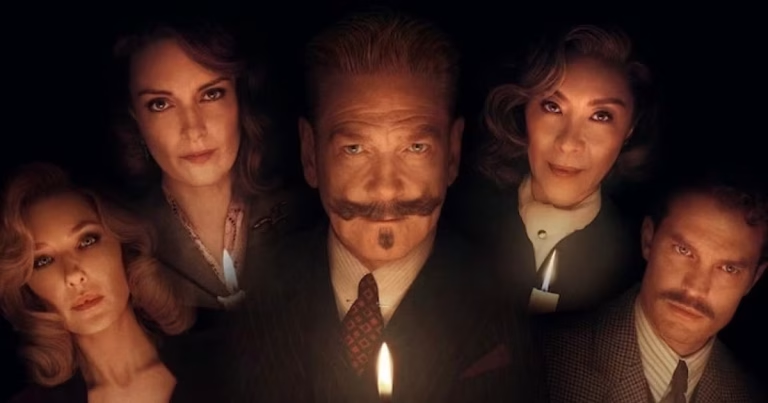
October 8 ~ A Haunting in Venice
In post-World War II Venice, Poirot, now retired and living in his own exile, reluctantly attends a seance. But when one of the guests is murdered, it is up to the former detective to once again uncover the killer.
Kenneth Branagh’s follow-up to his popular 2017 remake of Murder on the Orient Express was Death on the Nile—a film delayed nearly four years from its original 2019 release. By the time it hit theaters in 2022, reshoots and reshuffling had taken some of the wind out of what once looked like a promising reboot of Agatha Christie’s famous detective, Hercule Poirot.
The silver lining? Production on the third installment began just nine months later, allowing A Haunting in Venice to arrive right on time for Halloween 2023. Loosely based on Christie’s 1969 novel Hallowe’en Party, the film feels like a revitalization of the series, trading sun-drenched opulence for a gothic, rain-soaked séance that gives Poirot’s world a much-needed jolt of eerie atmosphere.
Branagh reunites with cinematographer Haris Zambarloukos to give the film a distinct, expressionistic look. It’s visually lush and heavy on mood—perfect for a story involving ghosts, trauma, and hidden motives. He’s also assembled another enviable cast of potential suspects and victims: Jamie Dornan, Tina Fey, Kelly Reilly, and Michelle Yeoh.
The supernatural twist is a welcome change of pace. It adds suspense without overwhelming the mystery. Unlike Death on the Nile, which dragged toward a grim finale, this one moves with purpose and real tension. The scares are solid, and the isolation of the Venetian palazzo creates a pressure cooker vibe.
As always with Christie, the solution is devilishly clever, borderline absurd, and impossible to guess unless you’re clairvoyant—so don’t waste your time trying to solve it early. Just sit back and enjoy the unraveling of secrets, where death seems to be knocking from every hallway and rooftop.
Branagh seems re-energized here, and I’m glad to see him continuing with these adaptations. A Haunting in Venice is a stylish, spooky crowd-pleaser—and with more Christie works in development, I’m excited to see where he takes Poirot next.
October 9 ~ Eden Lake
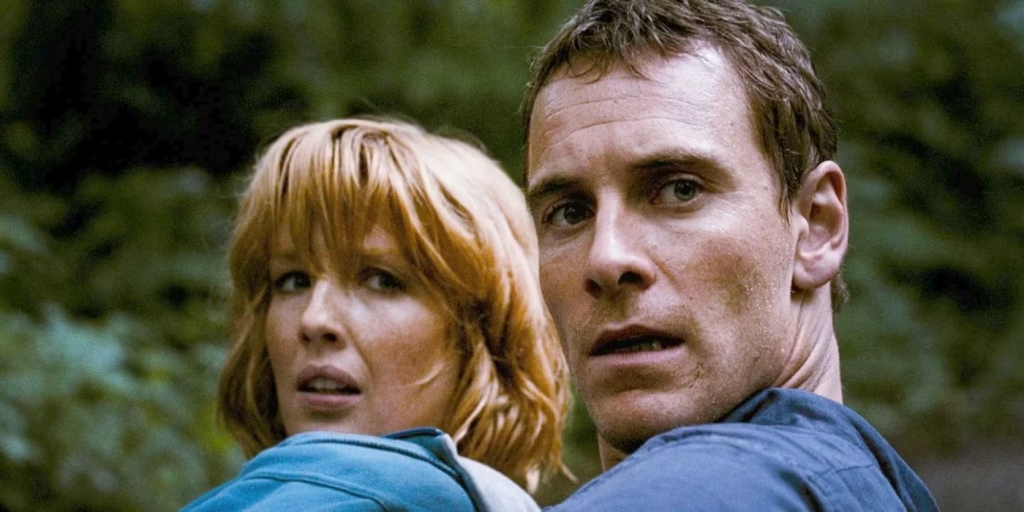
When a couple goes to a remote lake for a romantic getaway, their quiet weekend is shattered by an aggressive group of kids. Rowdiness quickly turns to rage as the teens terrorize them, and a weekend outing becomes a battle for survival.
Long before Michael Fassbender became an Oscar-nominated star and Kelly Reilly landed a leading role on Yellowstone, they headlined Eden Lake, a lean and very, very mean 2008 thriller that’s as gut-wrenching now as it was back then. I stumbled on it by accident one night, deep in the Netflix scroll, not expecting much. Ninety-one minutes later, I was floored. This film is grim, unrelenting, and refuses to let anyone—on screen or in the audience—off the hook.
Fassbender and Reilly play a couple looking for a quiet weekend in the English countryside, only to be terrorized by a gang of local teens whose casually cruel pranks quickly spiral from obnoxious to lethal. What begins as a confrontation between adults and misbehaving kids turns into a vicious cycle of retaliation, testing just how far people will go when civility breaks down. As the violence escalates, any illusion of moral high ground vanishes—and so does your ability to look away.
The film was written and directed by James Watkins, who most recently adapted and directed the 2024 U.S. remake of the truly repugnant 2022 Danish film Speak No Evil. Here, Watkins keeps things razor-sharp and unapologetically bleak. The performances are raw, the pacing tight, and the dread relentless. Reilly and Fassbender are outstanding, giving the rising horror realism and emotional heft.
This is a tough watch, but an exceptionally well-made one. It’s also a rare thriller that earns its grim impact honestly. If you can stomach its brutality and refusal to pull its punches, Eden Lake is unforgettable—and hard to shake.

October 10 ~ In the Tall Grass (2019)
After hearing a young boy's cry for help, a sister and brother venture into a vast field of tall grass in Oklahoma but soon discover there may be no way out...and that something evil lurks within.
By the time I was growing up in the ’80s, Stephen King had already published many of his classics. Through the ’90s, Hollywood kept adapting everything he wrote—even the scraps. As King’s work matured, it became more cerebral, interconnected, and harder to adapt cleanly to screen, which is why his name on a project still carries weight.
In 2012, King teamed up with his son Joe Hill (an award-winning horror author in his own right) for a short, creepy novella about a pregnant woman and her brother who hear a child crying from within a vast field—and then become trapped in something far stranger. With its contained setting, slim page count, and eerie premise, In the Tall Grass seemed tailor-made for a quick, chilling screen adaptation.
The 2019 Netflix film, directed by Vincenzo Natali, delivers some of that potential. It’s an okay time-waster with a few solid scares, and it’ll give longtime King fans flashbacks to his Children of the Corn days. But this isn’t in the league of the Halloween staples. The plot leans into repetition—on purpose, thanks to its time-loop element—but that also makes the 101-minute runtime feel padded.
The acting is decent, but no one has a meaningful arc. What you see is what you get from the first scene. And yes, even here, Patrick Wilson finds a reason to sing. Of course he does.
It’s not boring, and it’s got atmosphere to spare, but I found myself wishing He Who Walks Behind the Rows would show up and take things to the next level.
The original novella was unsettling in its simplicity. The film, while faithful in parts, tries to do too much without ever getting under your skin. Still, if you’re in the mood for something moody, strange, and a little off the beaten path—and you’re a King completist—it’s worth a watch. Just don’t expect a hidden gem, and you might have a good time getting lost in the grass.

October 11 ~ The Town That Dreaded Sundown (2014)
65 years after a masked serial killer terrorized the small town of Texarkana, the so-called "moonlight murders" begin again. Is it a copycat or something even more sinister? A lonely high-school girl may be the key to catching him.
The original VHS clamshell for 1976’s The Town That Dreaded Sundown always freaked me out as a kid. Despite starring Dawn Wells (aka Mary Ann from Gilligan’s Island), it was strictly off-limits in my house. Years later, I’d finally catch up with Charles B. Pierce’s strange but effective retelling of the real-life “Phantom Killer” murders in 1940s Texarkana. So when a requel (remake/sequel) that took a big, boldly brazen swing quietly dropped in 2014, I was more than curious.
Barely released in theaters—allegedly earning less than $125K—it gained traction once it hit VOD just in time for Halloween. Produced by Jason Blum and Ryan Murphy, directed by Alfonso Gomez-Rejon (a frequent Murphy collaborator on Glee and American Horror Story), and written by Roberto Aguirre-Sacasa (Riverdale, Pretty Little Liars, Glee), this version leans hard into slasher territory with a sharp meta edge.
Set in the “real” Texarkana, where the original film is treated as part of the town’s actual lore, the story follows Jami Lerner (Addison Timlin), a high schooler who survives a copycat Phantom attack at the town’s annual drive-in screening of the ’76 movie. As more murders follow, Jami gets pulled into a tangled mystery involving local secrets, lost history, and a killer (or killers) with their own twisted reasons for reviving the legend.
Clocking in at a tight 86 minutes, it’s fast, nasty, and surprisingly stylish. The cast is stacked—Gary Cole, Veronica Cartwright, Anthony Anderson, Edward Herrmann, and Denis O’Hare all show up—and Gomez-Rejon gives the whole thing a slick, heightened look that balances grit with a touch of pulp surrealism. It’s bloody, creepy, and often genuinely tense. And while it may not have many deep tricks up its sleeve, it knows how to keep the viewer on edge.
Sure, the twisty ending stretches logic a bit, but the ride getting there is strong enough to forgive it. The film plays like a love letter to regional horror, remixing old urban legends with modern genre energy.
It might not be a classic, but 2014’s The Town That Dreaded Sundown is a spooky, self-aware slasher that knows exactly what kind of movie it wants to be—and delivers. If you missed it the first time, it’s absolutely worth revisiting when Halloween rolls around.

October 12 ~ House of Wax (2005)
A group of teens are unwittingly stranded near a strange wax museum and soon must fight to survive and keep from becoming the next exhibit.
I first saw House of Wax at a drive-in over Fourth of July weekend in 2005, and it’s one of the only times I truly understood what it must’ve felt like to experience a horror movie that way in its heyday. The film itself? Schlocky, yes—but in the best way. Directed by Jaume Collet-Serra in his feature debut, this loose remake of the 1953 Vincent Price classic (itself a remake of 1933’s Mystery of the Wax Museum) trades atmosphere for slick, gory thrills—and leans all the way into early-2000s slasher energy.
The setup is familiar: a group of pretty young things—including Elisha Cuthbert, Chad Michael Murray, Jared Padalecki, and Paris Hilton—get stranded near a creepy, nearly abandoned town whose main attraction is a wax museum… made entirely of wax, from the statues to the building itself. Of course, it’s all a front for something far more twisted, as the group is picked off one by one by a masked killer (or two) with a thing for preservation.
Collet-Serra prioritizes mood and grotesque practical effects over award-worthy performances—and that’s perfectly fine, because this movie knows exactly what it is. The cast does what’s asked of them, and surprisingly, most of them are solid. Even Hilton, who drew plenty of snark from horror fans pre-release, proves to be a good sport about her image. Her much-hyped death scene? Genuinely great. When it happened, our drive-in erupted in cheers, honks, and flashing headlights—a rare moment of communal catharsis that only a movie like this could deliver.
There’s no denying House of Wax is ridiculous, but it never apologizes for it—and that commitment is what makes it work. The kills are gloriously over-the-top, the villain reveal lands with just the right amount of pulp, and the final sequence—set in a melting wax building that turns into a literal house of horrors—is the kind of stylish chaos that sticks with you. Collet-Serra shows flashes of the visual flair that would define his later work in films like Orphan and The Shallows.
Is it a classic? No. But it is a sleek, unapologetically gory slice of early-2000s horror that delivers exactly what it promises—and then some. It’s stylish, fast-paced, and surprisingly well-crafted beneath all the wax and blood. If you’re a fan of the era’s slashers or just in the mood for a horror movie that knows how to entertain, House of Wax is more than worth a revisit. Bonus points if you grab the Scream Factory Blu-ray—it turns this glossy guilty pleasure into a full-on collector’s delight.

October 13 ~ Dead Again (1991)
In 1990s Los Angeles, a detective investigates a mute amnesiac woman—only to uncover a chilling link to the 1949 execution of composer Roman Strauss for his wife's murder, and a past life connection that could cost them both their lives.
The 1989 release of Henry V launched Kenneth Branagh into the spotlight, earning Oscar nominations for both directing and starring. So when his follow-up two years later turned out to be a Los Angeles-set neo-noir involving reincarnation, hypnosis, and scissor murders—it was, to put it mildly, a bold sidestep.
Dead Again (1991) is a bit of a relic—one of those rare early-’90s studio thrillers that swings for the fences with style, big performances, and a genuinely wild premise. Written by Scott Frank (Out of Sight, Logan), plays like a pulp cocktail of Hitchcock, Poe, and gothic melodrama. Branagh and then-wife Emma Thompson star in dual roles: in one timeline, they’re a glamorous ’40s couple whose love ends in murder; in the other, he’s a ’90s P.I. helping a mute amnesiac (also Thompson) who may be connected to that old crime. Are they doomed lovers repeating a deadly fate—or just lookalikes caught in something stranger?
Frank’s script piles on the twists, red herrings, and past-life regression sessions, landing on a resolution that’s deliberately outrageous—and might require an immediate rewatch to fully track. Branagh stages it all with full-throttle sincerity, which is part of the film’s charm. This is a director reaching big, wearing his influences on his sleeve (Hitchcock’s Rebecca, Spellbound, even a dash of Vertigo) and clearly enjoying every ornate detour.
The accents wobble (sometimes hilariously), and the slo-mo climax teeters into camp. But Branagh commits fully, and the film’s energy, twists, and lush style make it hard to resist. With memorable turns from Andy García (Jennifer 8) and Derek Jacobi (Gladiator II), and a clever cameo you’ll want to keep an eye out for, plus a killer Patrick Doyle score, Dead Again is a stylish, twisty thriller worth rediscovering—especially for fans of big-swing studio genre films from the ’90s.

October 14 ~ Bram Stoker's Dracula (1992)
Centuries-old vampire Count Dracula comes to England to seduce his barrister Jonathan Harker's fiancée Mina Murray and wreak havoc in the foreign land.
As a kid raised on horror and monsters, I was beyond excited to see Bram Stoker’s Dracula in theaters in 1992. After a teaser trailer was pulled for being too intense, I lived off magazine articles and Entertainment Tonight updates. Too young to go alone, my dad took me, and I expected a bloody vampire tale that would top them all. I walked out thrilled by the fangs and frights—but bored by everything in between. Of course, I knew nothing then about film or the artistry on display in Francis Ford Coppola’s lush adaptation of the classic tale.
Rejecting CGI in favor of old-school techniques, Coppola filled the screen with in-camera effects, reverse motion, miniatures, superimpositions, and practical tricks that make the visuals feel eerie and grounded. Shadows move with impossible intent, monsters writhe unnaturally, and it all feels like a surreal art-directed nightmare made real.
Coppola assembled a cast of unexpected choices who find their footing in surprising ways. Gary Oldman is magnificent as the eternal Count, equal parts seductive and sorrowful. Winona Ryder plays the woman who may be the reincarnation of Dracula’s lost love, and her presence pushes him to a dangerous obsession. Keanu Reeves struggles with his accent but otherwise serves the story well, while Anthony Hopkins gives Van Helsing a sharp, almost unhinged edge.
Eiko Ishioka’s costume design deservedly won an Oscar, as did the eerie sound editing and makeup effects, all of which contribute to the film’s spellbinding atmosphere. At its heart, the film plays more like a tragic romance than a straightforward horror flick—likely why audiences were initially divided. But over the years, it has rightfully been reclaimed as a bold and visionary work of art. For fans of gothic horror or daring visual storytelling, Dracula is a must-see—then and now.

October 15 ~ Hereditary (2018)
When Ellen, the matriarch of the Graham family, passes away, her daughter’s family begins to unravel cryptic and increasingly terrifying secrets about their ancestry. The more they discover, the more they find themselves trying to outrun the sinister fate they seem to have inherited.
By the time Hereditary hit theaters in June 2018, A24 had already cemented its reputation as a studio that took creative risks and unearthed bold, unconventional films. After winning Best Picture with Moonlight in 2016 and gaining a devoted following for its offbeat approach to horror (The Witch, It Comes at Night), expectations were high for whatever came next. But even by A24’s standards, Ari Aster’s feature debut was something different—something shocking.
I went into Hereditary mostly blind. A24’s marketing was intentionally cryptic, keeping the film’s major twists under wraps so that audiences could experience them raw. And I’m so glad they did. What unfolded on screen wasn’t just another creepy movie—it was a full-blown nightmare built around grief, guilt, and generational trauma. Hereditary doesn’t just unsettle you. It gnaws at you from the inside.
Aster begins with a portrait of a family unraveling after the death of their matriarch, and what initially feels like a moody drama slowly mutates into something darker, more occult, and completely unpredictable. Just when you think you understand where the story is going, it shifts—violently. The film is stacked with jaw-dropping turns that hit like gut punches, and the sense of dread only builds with each passing scene.
Technically, it’s an astonishing piece of work—especially for a debut. Aster’s command of tone is razor-sharp, and the attention to visual detail (especially the eerie dollhouse aesthetic) makes everything feel both intimate and nightmarishly unreal. But the film’s true powerhouse is Toni Collette. Her performance as Annie is raw, fearless, and devastating. It’s one of the best of the decade, in any genre. The fact that it was overlooked by the Oscars speaks more to their resistance to horror than the quality of her work.
Hereditary is not an easy watch. It’s brutal, deeply emotional, and at times almost unbearably tense. But it’s also a masterclass in slow-burn horror—a film that earns every scream, every chill, and every haunted glance. When it’s over, you may not fully understand what just happened, but you’ll know you saw something unforgettable. And, if you’re like me, you’ll still be thinking about that ending long after the lights come up.

October 16 ~ Rogue (2007)
When a group of tourists stumble into the remote Australian river territory of an enormous crocodile, the deadly creature traps them on a tiny mud island with the tide quickly rising and darkness descending. As the hungry predator closes in, they must fight for survival against all odds.
It’s always a bit of a mystery how a solid creature feature like Rogue can slip so far under the radar on release. Here’s a sharp, nerve-racking survival horror film from writer/director Greg McLean—still riding high off Wolf Creek—that got dumped into just 10 U.S. theaters before heading straight to video. And yet, what a sleeper this turned out to be.
Set in the remote, stunning landscape of Australia’s Northern Territory, Rogue starts as a laid-back river cruise through Kakadu National Park and slowly tightens the screws. McLean takes his time setting up character and place, lulling you into thinking this might be a talky travelogue—until a giant saltwater crocodile violently capsizes the film into full-blown monster mayhem. The setup is simple: a group of tourists stranded on a shrinking island, stalked by a territorial predator. The execution? Damn effective.
The creature effects—some assisted by Wētā Workshop—are used sparingly but with bite. A jaw here, a ripple there, and then sudden, savage attacks that remind you this isn’t some goofy B-movie. This croc is a beast. McLean’s restraint works in his favor, building dread without overexposing the monster.
Radha Mitchell and Michael Vartan are easy to root for in the leads, and supporting turns by Sam Worthington and a very young Mia Wasikowska hint at the careers ahead. Best of all, the characters act like real people—scared, resourceful, sometimes selfish—making their choices feel earned. And when the inevitable final showdown arrives, it’s a pulse-pounder.
You may have to dig a bit to find Rogue—though it’s currently streaming on The Criterion Channel for October—but it’s worth the hunt. Easily one of the best “man vs. nature” thrillers of the 2000s. Just don’t be surprised if you find yourself shouting “Don’t go in the water!” more than once.

October 17 ~ Mimic (1997)
A genetically engineered insect created to eliminate disease-carrying cockroaches in Manhattan was designed to die off quickly. However, three years later, the species has survived and evolved into human-mimicking monsters who are out to destroy their only predator...mankind.
Before Guillermo del Toro became a three-time Oscar-winning filmmaker and international cinematic treasure, he was just an ambitious genre director from Mexico trying to make his mark in Hollywood — and Mimic was supposed to be his big break. But instead of a smooth rise, his sophomore feature became a case study in studio interference and creative frustration.
When Mimic arrived in 1997, del Toro was still riding the acclaim from his eerie 1992 debut Cronos, but making his first English-language film under the thumb of Dimension Films (and the infamously meddling Harvey Weinstein) nearly derailed his career. Del Toro has since described the experience as “horrible” — and while the theatrical cut was compromised, his 2011 director’s cut restores much of what made the film special in the first place.
Inspired by a short story by Donald A. Wollheim, Mimic stars Mira Sorvino (fresh off her Oscar win for Mighty Aphrodite) as an entomologist who bioengineers a new species of insect to stop a deadly cockroach-borne disease. But what begins as a noble act of genetic intervention spirals into horror as the creatures adapt, evolve, and — as the title implies — start mimicking human form. Set mostly in New York’s labyrinthine subway tunnels, the film turns into a gooey, claustrophobic creature feature with del Toro’s fingerprints all over it: grotesque beauty, insect fetishism, rich world-building, and an eerie blend of science and myth.
Despite a talented cast that includes Jeremy Northam, Charles S. Dutton, and a young Josh Brolin, Mimic underperformed at the box office and earned mixed reviews. But time has been kind to it — especially in its restored form. It’s now appreciated as an early glimpse of del Toro’s vision: his talent for atmosphere, his fascination with monsters (both literal and human), and his refusal to settle for cheap scares when deeper emotions are available.
And if the director hadn’t suffered through the making of Mimic, would he have returned to the more personal roots of The Devil’s Backbone and later made Pan’s Labyrinth, The Shape of Water, or Frankenstein? Maybe not. Either way, this flawed, fascinating film is a crucial stepping stone in one of the most interesting careers in modern cinema — and one worth digging up from the sewers.

October 18 ~ The 'Burbs
An overstressed suburbanite and his neighbors are convinced that the new family on the block is part of a murderous Satanic cult.
By this point in 31 Days to Scare 2025, we’ve braved ghosts, slashers, demons, and things with way too many legs. Let’s take a breather — and maybe laugh a little while we’re at it.
Joe Dante’s The ‘Burbs isn’t a traditional horror film, but it’s got enough dead bodies, dark basements, and suburban paranoia to earn its place in the month’s lineup. It’s also one of those cult classics that’s aged into something oddly comforting — a perfect mix of black comedy, neighborhood menace, and Tom Hanks doing his best “normal guy slowly unraveling” routine.
Fresh off his first Oscar nomination for Big, Hanks stars as Ray Peterson, a bored suburbanite on vacation who starts to suspect his creepy new neighbors — the Klopeks — are up to something sinister. Strange noises at night, suspicious trash bags, backyard digging… it’s all a little Rear Window meets Scooby-Doo, with Hanks, Bruce Dern (a deranged ex-military neighbor), and Rick Ducommun (the resident loudmouth) forming a bumbling investigative team determined to get to the bottom of it all.
Carrie Fisher plays the long-suffering wife who just wants her husband to stop spying on people, Corey Feldman watches everything from his porch like he’s hosting the whole thing, and Henry Gibson, Courtney Gains, and the gloriously unnerving Brother Theodore round out the mysterious Klopek family. The entire film is shot on Universal’s iconic Colonial Street backlot, giving it a timeless, slightly artificial quality — like a stage play wrapped in fog and creeping dread.
Dante, who mastered the “something’s wrong in suburbia” vibe with Gremlins, brings that same energy here. It’s silly, yes — but there’s genuine tension bubbling under the cartoonish antics. You can feel the influence of classic EC horror comics and Hitchcock thrillers, even as the film gleefully leans into slapstick and satire.
And sure, The ‘Burbs didn’t set the world on fire when it opened in 1989. Critics were lukewarm, audiences unsure. Turner & Hooch, released five months later, would be the bigger movie for Hanks released that same year. But like the creepy house at the end of the street, The ‘Burbs never really went away. Over the years, it’s become a beloved oddball — the kind of movie you rediscover on late-night cable or finally rent after staring at the VHS box every Friday night as a kid (guilty).
It’s not scary in the traditional sense, but The ‘Burbs taps into a deeper fear: that the seemingly quiet lives next door might be hiding something far weirder than you’d expect. And really, what’s more Halloween than that?

October 19 ~ A Nightmare on Elm Street 4: The Dream Master (1988)
Freddy Krueger returns once again to terrorize the dreams of the remaining Dream Warriors, as well as those of a young woman who may be able to defeat him for good.
When it comes to long-running horror franchises, everyone has their favorites. And for fans of A Nightmare on Elm Street, opinions run deep. Setting aside the still-unmatched originality and genuine scares of the 1984 original, you’ll hear passionate defenses of nearly every entry in the series. Dream Warriors (1987) is often hailed as the franchise’s second coming, and while it does solidify key pieces of the Freddy Krueger mythos, a recent rewatch reminded me just how uneven it really is.
Which brings us to A Nightmare on Elm Street 4: The Dream Master (1988), a film that surprised me by how well it holds up. In fact, it might just be the most visually ambitious entry in the series outside of the original. Released a little over a year after #3, while the film doesn’t reinvent the Freddy formula, it embraces the surreal possibilities of dream logic with a colorful, kinetic energy that feels like pure late-’80s pop horror. Freddy isn’t just haunting dreams anymore—he’s starring in music videos.
New Line’s habit of hiring a new director for each installment was both a blessing and a curse, but Dream Master benefited greatly from the studio rolling the dice on a young Renny Harlin. His stylish direction turns the film into a showcase of nightmare-fueled set pieces that blend practical effects, MTV aesthetics, and inventive transitions. Harlin would go on to direct Die Hard 2, Cliffhanger, and Deep Blue Sea, but Dream Master feels like the movie where he first flexed his blockbuster muscles.
Scripted in part by future Oscar-winner Brian Helgeland, the film benefits from a cleaner narrative than its predecessor, and some surprisingly strong character work—especially for final girl Alice Johnson, played by Lisa Wilcox. With Patricia Arquette opting not to return as Kristen (Tuesday Knight took over), Wilcox steps into the spotlight and delivers a performance that evolves from shy wallflower to dream-powered warrior. Her Alice may not have the legacy of Heather Langenkamp‘s Nancy, but she holds her own and then some.
The film also makes some bold (if brutal) decisions early on, killing off surviving characters from Dream Warriors in quick succession (RIP Kincaid!). This allows the new cast to shine, and with the likes of Toy Newkirk, Brooke Theiss, and Danny Hassel onboard, the movie leans into its high school melodrama and ensemble energy without losing steam.
Is it scary? Sometimes. But The Dream Master excels more in style and energy than straight-up terror. Freddy is in full wisecracking form here, and while the balance of humor and horror may not be to every fan’s taste, Englund’s performance remains magnetic. If nothing else, the cockroach kill alone earns the film a place in horror history.
If you’re revisiting Elm Street this Halloween, don’t sleep on this one. The Dream Master doesn’t require extensive franchise homework and gives you all the dreamy chaos and killer visuals you could want—wrapped in a gooey glowing bow. It might not be the best, but it could be the most fun. It also struck a nerve with audiences—The Dream Master was a box office smash, becoming the highest-grossing film in the franchise at the time, a record it held until 2003’s Freddy vs. Jason. Proof that even four movies deep, Freddy still had plenty of nightmares left to deliver

October 20 ~ Hush (2016)
A deaf and mute writer living in the woods must fight for her life in silence when a terrifying masked killer appears at her window.
I remember it well — a cold, quiet night, sifting through Netflix for something really scary. I was burnt out on sequels and recycled scares. Just as I was about to give up, Hush slid across the screen, and that familiar jolt hit: this might be the one. And 81 minutes later, it absolutely was — sharp, suspenseful, unexpectedly emotional — and it introduced me to the confident, crafty hand of Mike Flanagan, a filmmaker I’ve followed ever since.
Co-written with his wife and star, Kate Siegel (Hypnotic), Hush takes the familiar home-invasion formula and adds one brilliant twist: the final girl is Deaf and mute. Maddie is a reclusive horror novelist living alone in the woods, targeted randomly by a masked intruder. He assumes her silence will make for an easy kill — but he’s in for a fight.
Flanagan’s direction is lean and deliberate, building tension with smart visual storytelling rather than cheap jump scares. Siegel is excellent, grounding Maddie with resilience and heart, and John Gallagher Jr. (Underwater) is all jittery menace as her attacker. There’s a surprising amount of restraint here — gore is used sparingly, the pacing never lags, and the horror always serves the story. It’s also sneakily connected to Flanagan’s Midnight Mass, which shares not just cast members but also Maddie’s fictional novel, making this feel like the start of a larger, eerie universe.
Amazingly, Hush was one of three horror films Flanagan directed in 2016 — alongside the dark fantasy Before I Wake and the shockingly good studio sequel Ouija: Origin of Evil — cementing a banner year that showcased his range and firm grasp on character-driven genre work.
Originally released on Netflix in 2016 after premiering at SXSW, Hush quietly became a cult favorite, and in 2024 finally received the collector’s treatment via Shout! Factory — complete with a tension-amplifying black-and-white “Shush Cut,” approved by Flanagan himself.
Hush is a tight, tense thriller that proves how far smart direction and sharp writing can go — no bloat, no filler, just pure, focused fear. And yes, it’s even better if you watch it alone.

October 21 ~ Dressed to Kill (1980)
After witnessing a homemaker murdered by a mysterious woman, a high-class call girl not only becomes a suspect but also the real killer's next target.
It’s easy to forget just how prolific Brian De Palma was from the mid-’70s to early ’90s — one look at his IMDb page from Carrie (1976) to Carlito’s Way (1993) and you’ll see a filmmaker who rarely slowed down. After the underrated The Fury and the oddity that was Home Movies, De Palma kicked off the scorching summer of 1980 with Dressed to Kill — a stylish, controversial thriller that plays like Hitchcock turned up to 11.
A huge hit at the box office (despite protests and eventual censorship), Dressed to Kill wrapped De Palma’s career-long obsession with Hitchcock in a glossy, violent, explicitly adult package. It’s also one of the sleekest, most unnerving thrillers of the era — infamous for a murder scene in an elevator that’s up there with the shower in Psycho. Seriously: I still hesitate when elevator doors open to an empty hallway.
Angie Dickinson plays a bored NYC housewife whose life — and the movie — abruptly pivots in one of the most memorable mid-film twists ever. Nancy Allen, De Palma’s wife at the time, carries much of the second half as a call girl who witnesses the murder and is pulled into a mystery she’s ill-equipped to solve. Keith Gordon (as Dickinson’s son) is a great, atypical teen hero, while Michael Caine, cast as the psychiatrist, feels slightly misaligned — not bad, just off enough to be distracting.
Rewatching the film reveals just how meticulous De Palma’s direction is. Tiny clues, misleading angles, and dramatic flourishes build to a third act that’s lurid, strange, and often brilliant. He’s playing with cinematic language in ways that are both showy and purposeful — nowhere more evident than in the wordless museum stalking sequence or Pino Donaggio’s dreamy, icy score that lingers long after the film ends.
But for all its thrills and craft, Dressed to Kill is not without baggage. Even at the time, its depiction of gender identity and mental illness raised serious red flags. Today, its outdated and deeply problematic portrayal of a transgender-coded character is rightfully criticized. Still, the film’s technical bravura and place in cinematic history (and controversy) make it an essential entry for serious horror and thriller fans — if approached with modern awareness.
Love it or hate it, Dressed to Kill is unforgettable: seductive, shocking, and crafted by a filmmaker in total control of the camera… if not the conversation.

October 22 ~ P2 (2007)
A businesswoman is pursued by a psychopath after being locked in a parking garage on Christmas Eve.
I’ve had my eye on this one for a while, but always hesitate with scary Christmas films in October — like I’m tempting winter in early. But it’s time P2 got a proper level-up. This nervy little shocker may have flopped when it hit theaters in November 2007 (it opened on over 2,000 screens and barely cleared $1,000 per theater), but it deserves better than the half-remembered shrug it got on home video.
Directed by Franck Khalfoun (Night of the Hunted) in his feature debut, P2 was co-written with Alexandre Aja (Crawl) and Grégory Levasseur (Oxygen) — the team behind High Tension — and inspired by real-life attacks in Paris parking garages. Shot mostly in a real Toronto garage at night, it leans into its claustrophobic setting with impressive effectiveness. Despite what sounds like a one-note premise, the film keeps things tight, tense, and surprisingly believable for most of its quick runtime.
Rachel Nichols (unfairly underrated) plays Angela Bridges, a businesswoman working late on Christmas Eve who finds herself trapped underground by Thomas, a socially awkward security guard played with eerie sincerity by American Beauty’s Wes Bentley. Bentley (The Best of Enemies), often cast in off-kilter roles, fully commits here — he’s both pathetic and chilling, a man convinced his twisted affections are noble.
What should’ve been a quiet night turns into a brutal game of survival as Angela dodges cameras, stalks through icy concrete, and battles both her captor and her rising panic. The script cleverly expands the limited environment and adds just enough narrative fuel to keep the chase from feeling repetitive. And yes, there’s blood — but the violence never tips into torture-porn territory. Instead, Khalfoun and company opt for a more classical tension, aided by a Bernard Herrmann-inspired score from tomandandy and an ironically cheery blast of Christmas music (including a deliciously twisted use of Elvis’s “Blue Christmas”).
Shot with a chilly style by Maxime Alexandre and anchored by Nichols’s (Alex Cross) physical, committed performance, P2 isn’t just seasonal horror — it’s smart, efficient, and unafraid to go pitch-black. Maybe it got lost in the holiday shuffle, or maybe it was always destined to be a buried gem. Either way, this is one Christmas slasher that earns its spot on your Halloween watchlist — and maybe again come December, when the snow falls and the parking garages feel just a little too quiet.

October 23 ~ Zodiac (2007)
Between 1968 and 1983, a San Francisco cartoonist becomes an amateur detective obsessed with tracking down the Zodiac Killer, an unidentified individual who terrorizes Northern California with a killing spree.
Few true crime cases have chilled a city—or a country—like the Zodiac Killer: a faceless predator who struck at random, then taunted police and the public with cryptic letters, ciphers, and chilling threats. In late 1960s San Francisco, a place once synonymous with peace and possibility, fear crept into every unlocked door and shadowed street corner.
Zodiac isn’t just a thriller—it’s a masterfully restrained descent into obsession. Adapted by James Vanderbilt from Robert Graysmith’s investigative books, the film chronicles the decades-long hunt for the Zodiac Killer, transforming a string of brutal crimes into a corrosive psychological puzzle that consumes everyone who tries to solve it. Set in the Bay Area throughout the late ’60s and ’70s, the story follows how the killer’s cryptic threats and horrifying attacks ensnared detectives, journalists, and civilians alike. Director David Fincher, himself a Bay Area native, brings a forensic precision to every frame, with unnerving detail and tonal control. His famously exacting process (some scenes were reportedly filmed over 70 times) results in a film that feels both hauntingly period-authentic and eerily modern. The casting is pitch-perfect: Jake Gyllenhaal (Prisoners) as cartoonist-turned-sleuth Robert Graysmith, Mark Ruffalo as Inspector Dave Toschi, and Robert Downey Jr. (Doolittle) as brilliant but self-destructive reporter Paul Avery form the film’s unraveling core trio.
What makes Zodiac so effective isn’t the depiction of the killings—though each one is staged with chilling tension—but the unraveling that follows. The horror comes from watching these men slowly lose themselves to the unanswered questions. As time stretches on and leads go cold, the case becomes less about catching a killer and more about how the need to know can become its own kind of madness.
Though Zodiac earned critical acclaim, it struggled commercially, grossing $84 million globally after opening just weeks before 300 reshaped box office expectations. Its slow-burn pacing and lack of a tidy resolution made it a tough sell to audiences expecting more conventional thrills. But over the years, its legacy has only grown. What once felt like an outlier in Fincher’s filmography is now considered one of his most finely tuned achievements. Is it a murder mystery? A procedural? A character study? Zodiac is all of these—and something more elusive. It’s not about closure. It’s about the cost of chasing it.

October 24 ~ Poison Ivy (1992)
A seductive teen befriends an introverted high school student and schemes her way into the lives of her wealthy family.
She wanted a family. She took one instead.
Before she was America’s comeback queen, Drew Barrymore was the girl the tabloids wouldn’t stop watching. By 17, she’d been institutionalized, emancipated, and largely written off by Hollywood. But then came Poison Ivy—a sultry Sundance premiere that bombed theatrically, but found a second life on cable and home video, seducing a generation of curious viewers with its eerie blend of teenage angst and erotic menace. It was marketed as a teenage Fatal Attraction, but what emerged was something stranger, more unsettling: part psychological thriller, part twisted coming-of-age story, and all mood.
Directed by Katt Shea (a Roger Corman alum), Poison Ivy slithers into the world of Sylvie (Sara Gilbert), a private school loner who brings home a magnetic streetwise girl she nicknames Ivy (Barrymore). At first, Ivy is just cool and confident—the kind of girl Sylvie wishes she could be. But Ivy doesn’t just want to be Sylvie’s friend. She wants her home, her life, her father. And when she sets her sights on Tom Skerritt’s brooding dad (and Cheryl Ladd’s fragile mother), things take a dark and deadly turn. The film’s flirtation with taboo—manipulation, betrayal, illicit desire, even a hint of queerness—gives it a slow-burn sleaze that’s both trashy and hypnotic.
Though its plot hinges on classic erotic thriller tropes (forbidden lust, gaslighting, a fatal fall from a balcony), Poison Ivy plays closer to horror. There’s something quietly terrifying about Ivy’s transformation—from scrappy outsider to sociopathic infiltrator—and Barrymore, still teetering between adolescence and adulthood, brings both vulnerability and cold calculation. She isn’t a femme fatale in the Sharon Stone or Glenn Close mold—she’s more dangerous because she doesn’t fully understand how dangerous she is. The result is a character you fear, pity, and weirdly root for…until it’s too late.
Premiering at Sundance in 1992, the film was initially misunderstood—either dismissed as exploitative or praised as subversive. New Line Cinema, unsure of how to market it, gave it a limited theatrical release (just 20 theaters, where it grossed under $2 million). But on VHS and late-night cable, Poison Ivy found its audience. It became a cult hit, particularly among young women drawn to its shadowy depiction of female friendship, envy, and blurred boundaries. Despite lukewarm critical reviews at the time, it’s since been reassessed as a kind of twisted Gen-X fable—one where no one is truly innocent, and desire always comes with a cost.
Of course, Poison Ivy would eventually spawn three increasingly softcore sequels, each more detached from the original’s moody ambition. Barrymore herself never returned (nor did director Shea, who regretted giving Ivy such a definitive ending), but the legacy was already sealed. Ivy, the damaged girl who just wanted to belong, remains one of the most haunting “bad girls” in ’90s cinema.
Not quite horror, not exactly erotic thriller, Poison Ivy exists in a shadowy in-between space—where teenage fantasies curdle into nightmares, and love becomes a weapon. It’s messy, lurid, and undeniably watchable. Like Ivy herself, it lingers longer than you’d expect.

October 25 ~ Extremely Wicked, Shockingly Evil, and Vile (2019)
A chronicle of the crimes of Ted Bundy, from the perspective of his longtime girlfriend, Elizabeth Kloepfer, who refused to believe the truth about him for years.
After suffering through Netflix’s wildly inaccurate Monster: The Ed Gein Story, the algorithm threw me this 2019 Bundy film as a palette cleanser—and honestly, it worked. Director Joe Berlinger (of Paradise Lost fame) and screenwriter Michael Werwie take a smarter approach: not by glamorizing the violence, but by framing the story through the eyes of Bundy’s longtime girlfriend, Liz Kendall. Based on her memoir The Phantom Prince, the film is more about denial and emotional manipulation than body counts.
Zac Efron is unnervingly effective as Bundy, playing him with just enough charm and restraint to keep you second-guessing. Lily Collins delivers one of her best performances as Liz, a woman caught between love, guilt, and slow-burning realization. The film’s real horror lives in what isn’t shown—details of the crimes are delivered offhand, which only makes them more haunting.
Some criticized the film for not focusing enough on the victims, but Berlinger’s perspective is purposeful: this isn’t Bundy fanfiction. It’s about how evil presents itself as ordinary—and how long someone will hold onto a lie to avoid the truth.
It’s not flashy, but it’s quietly devastating. And if you’re looking for horror that sticks with you, this one lingers.

October 26 ~ Orphan (2009)
A husband and wife who recently lost their baby adopt a 9-year-old girl who is not nearly as innocent as she appears.
What looked like just another “evil child” horror movie turned out to be one of the nastiest, most genuinely shocking thrillers of its era. Orphan, directed by Jaume Collet-Serra (House of Wax, The Shallows, The Commuter), delivers a slick, skin-crawling ride that hits harder than you’d expect—thanks largely to a killer performance by Isabelle Fuhrman (The Novice) and a script that isn’t afraid to get weird, wild, and downright vicious.
After the tragic loss of their unborn child, a grieving couple (Vera Farmiga and Peter Sarsgaard) open their home to Esther, a precocious 9-year-old from a nearby orphanage. But it doesn’t take long before strange accidents, manipulations, and increasingly violent behavior start tearing the family apart. Farmiga gives a raw, escalating performance as a mother trying to trust her instincts, while Sarsgaard plays the sort of oblivious dad horror films feast on. Still, the movie belongs to Fuhrman, whose unnerving turn as Esther is the kind of breakout that feels impossible to top—until she returned 13 years later in a prequel that somehow managed to match the original’s audacity.
Yes, Orphan leans into some familiar beats early on—but then it takes a sharp left turn into something truly unhinged. Collet-Serra commits to the chaos with style, letting the tension boil until it explodes in a finale that still holds up as one of the more audacious climaxes in modern horror.
Slick, savage, and smarter than it lets on, Orphan might look like standard-issue thriller fare—but behind those pigtails and ribbons lies a devilishly original spin on a tired subgenre. A perfect watch for fans of The Good Son or The Bad Seed, but with a twist that leaves both in the dust.

October 27 ~ The Belko Experiment (2016)
In a twisted social experiment, eighty Americans are locked in their high-rise corporate office in Bogotá, Colombia, and ordered by an unknown voice coming from the company's intercom system to participate in a deadly game of kill or be killed.
Before he was rebooting Krypton and making Gen Z swoon over Superman’s kindness (can I get an eyeroll, please?) James Gunn penned The Belko Experiment, a delightfully nasty slice of corporate horror that swaps team-building exercises for brutal survival. Set in a remote office building in Bogotá, Colombia, 80 employees of Belko Industries show up for what seems like a typical day—until the building locks down, a disembodied voice comes over the intercom, and they’re told to kill or be killed. Literally.
The rules are simple: kill two coworkers or suffer the consequences. Refuse again, and your company-implanted “anti-kidnapping tracker” explodes inside your skull. What follows is a blood-splattered, high-stakes experiment in moral breakdown as panic sets in, alliances form, and that one guy from accounting finally shows his true colors.
Directed by Wolf Creek’s Greg McLean, but very much stamped with Gunn’s DNA, the film is anchored by John Gallagher Jr. as a decent everyman caught between survival and sanity. His office romance with Leandra (Adria Arjona) adds emotional weight, while Tony Goldwyn, John C. McGinley, and Melonie Diaz shine as archetypes slowly unraveling under pressure. Gunn originally planned to direct himself but stepped back due to personal reasons—though his creative control remained intact (explaining the presence of his perpetually-employed brother Sean, here as a cafeteria stoner spouting watercooler conspiracy theories).
It’s Battle Royale dressed in business casual, with exploding heads, gnarly deaths, and a final act that takes things just far enough into nihilistic territory without tipping into parody And while it never quite delivers the social satire it teases, it’s a tight, mean, well-cast bloodbath that punches way above its budget.
If you missed this when it dropped, now’s the time to clock in. Just don’t get too attached to your coworkers.

October 28 ~ Watcher (2022)
A young American woman moves with her husband to Bucharest, and begins to suspect that a stranger who watches her from an apartment window may be a serial killer.
I wasn’t sold on Watcher when I first caught it after its 2022 release. Despite strong Sundance buzz and praise for star Maika Monroe, something didn’t land for me on that initial viewing. But on a recent rewatch, it totally clicked. Writer/director Chloe Okuno (working from Zack Ford’s original script) crafts a chilly, elegant thriller that feels more confident and layered the second time around — the kind that quietly gets under your skin and doesn’t let go.
Set in a gloomy, unfamiliar Bucharest, the film follows Monroe as Julia, a woman who’s relocated for her husband’s job (Karl Glusman) and is quickly left adrift — cut off by language, ignored by her partner, and haunted by the feeling that someone across the way is watching her. When a string of grisly murders hits close to home, Julia begins to believe the man staring at her may be responsible… but no one takes her seriously.
It’s not a thrill-a-minute ride. Okuno takes her time building mood and tension, using long silences, muted colors, and a deep sense of isolation to keep the suspense simmering. That slow build, which might feel glacial on first watch, is exactly what makes the film so effective on a second viewing — it draws you in quietly, until the final act delivers a sharp, unnerving jolt.
Monroe is excellent here — she’s been a horror favorite since It Follows, and this further cements her status (with Longlegs only adding to her genre royalty). Her slightly dazed delivery works in the film’s favor, especially as her sense of safety (and sanity) steadily erodes. Burn Gorman is unsettling as the maybe-stalker across the street, and Glusman is perfectly irritating as the kind of husband who always thinks he knows better.
Okuno has a sharp eye and steady hand, and it’s no surprise she was originally slated to direct Woman of the Hour before stepping away. Watcher draws favorable comparisons to Hitchcock’s European-set thrillers — especially in the way it frames paranoia and doubt through windows, mirrors, and male skepticism — but the lens is very much modern. It’s a story about the fear of not being believed, the unease of constantly being watched, and what happens when your instincts are right all along.
Watcher didn’t fully land for me the first time, but it’s proof that some films benefit from space — and a second look. If you’re a fan of deliberately paced, psychological thrillers with a sting in the tail, this one deserves a spot on your list.
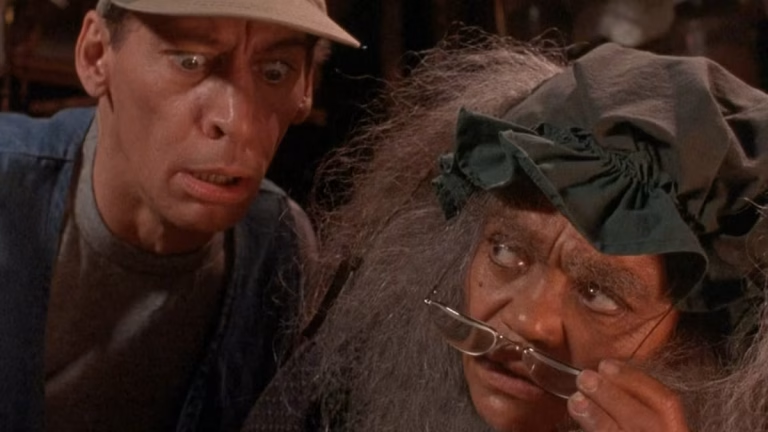
October 29 ~ Ernest Scared Stupid (1991)
Ernest accidentally unleashes an ugly troll that plots to transform children into wooden dolls in the town of Briarville, Missouri.
I admit, I have a soft spot for the dumb charm of Ernest P. Worrell — Jim Varney’s dopey, sad-sack character who somehow vaulted from regional commercials to full-fledged movie star status. His appeal wasn’t about matinee looks or action-hero toughness. It was comfort entertainment, plain and simple — the kind of affable goofball energy that made kids laugh and grownups smile (or groan). After Ernest Goes to Camp was a surprise hit and Ernest Saves Christmas brought some holiday warmth, things got a little weirder with Ernest Goes to Jail. But it’s Ernest Scared Stupid where the series fully embraced its cartoonish chaos — and frankly, it’s never been more fun.
This fourth entry in the Ernest cinematic universe (yes, it’s a universe) was the last to be produced under Disney’s Touchstone Pictures label before the series went fully independent. (Five more films followed, including Ernest Rides Again, but none worth revisiting unless you’re a diehard fan… or a completionist with a lot of free time.)
In Ernest Scared Stupid, our well-meaning but perpetually unlucky hero accidentally unleashes a centuries-old troll named Trantor on his hometown just in time for Halloween. The troll turns children into wooden dolls (yep, it’s that kind of movie), and it’s up to Ernest — armed with milk, the heart of a child, and one very good dog — to stop him. Along the way, he tangles with slime, gets fired, builds a troll trap out of garbage, and learns the true power of unconditional love. You know, classic Ernest stuff.
In Ernest Scared Stupid, our well-meaning but perpetually unlucky hero accidentally unleashes a centuries-old troll named Trantor on his hometown just in time for Halloween. The troll turns children into wooden dolls (yep, it’s that kind of movie), and it’s up to Ernest — armed with milk, the heart of a child, and one very good dog — to stop him. Along the way, he tangles with slime, builds troll traps out of garbage, and learns the true power of unconditional love. You know, classic Ernest stuff.
Aimed squarely at kids, the film still carries a juvenile glee that works for grown-ups — especially those watching with nostalgia… or a slight buzz. It’s silly, loud, and full of weird Dutch angles and Varney’s signature mugging, but his physical comedy chops are undeniable, and even the goofiest bits are delivered with real commitment. Add Eartha Kitt as a wild-eyed, velvet-voiced cat lady and you’ve got the kind of oddball Halloween treat that sticks with you.
It’s not high art, but it is high-energy, low-stakes spooky fun — made better by creature effects courtesy of the Killer Klowns from Outer Space team. Throw it on while carving pumpkins or handing out candy, and revel in a time when “milk defeats monsters” made perfect sense. Dumb, dated, and somehow… just right.

October 30 ~ The Haunting of Hill House (2018)
Flashing between past and present, a fractured family confronts haunting memories of their old home and the terrifying events that drove them from it.
Sure, a tight 90-minute movie can scare the hell out of you—but a TV series? Ten full episodes? That’s a whole other level of commitment. But Mike Flanagan’s The Haunting of Hill House, loosely based on Shirley Jackson’s classic novel (adapted into films in 1963 and 1999), proves that horror can stretch out, dig deeper, and still hit like a sledgehammer.
This isn’t just a standout limited series—it’s one of the most emotionally layered and visually daring ghost stories ever put on screen. I’ve watched it twice. I’ll watch it again. It lingers.
Flanagan doesn’t merely adapt Jackson—he recasts her haunted house as a gravitational force, pulling a family apart across decades. Hill House still looms, but the show’s soul is in the Crain siblings: fractured, distant, still echoing with things left unsaid. Some cope. Some collapse. Some don’t make it out at all.
The cast is excellent across generations. Victoria Pedretti’s Nell is luminous and tragic, with Violet McGraw’s younger version matching her beat for beat. Kate Siegel and Mckenna Grace give Theo a razor-sharp presence. And Carla Gugino—as Olivia, the mother drifting toward madness—is unforgettable. Flanagan knows exactly how to use her. Timothy Hutton and Henry Thomas, as older and younger Hugh, ground the supernatural in something painfully human.
Then there’s Episode 6—a masterclass in craft. Shot to look like one long take, it bends time and space like memory does: fluid, unreliable, eerie. If you’re into “how did they do that?” TV, this is your moment
Don’t let the “ghost story” label fool you. Yes, it has one of the most effective jump scares in TV—or film—history. But it also might make you cry. It might make you call your family. That’s the magic trick: it terrifies you, then sucker-punches you in the heart.
So if you haven’t seen it yet, take tomorrow off. Watch the whole thing in one sitting. And when the shadows stretch and the house starts to breathe, just remember—Hill House has been waiting for you.

October 31 ~ Night of the Living Dead (1968)
A ragtag group of Pennsylvanians barricade themselves in an old farmhouse to remain safe from a horde of flesh-eating ghouls that are ravaging the Northeast of the United States.
Hard to believe we’ve reached the end of another 31 Days to Scare. Thanks for sticking with me—what a ride. Today’s pick might seem like a no-brainer (pun intended), but I’ve got a confession: I only saw George A. Romero’s Night of the Living Dead for the first time this past year. I’d seen the sequels, the remake, and plenty of knockoffs—but somehow, I missed the original.
Maybe it was the public domain status, maybe the endless parodies dulled its edge. But when I finally sat down to watch it, I was stunned. It’s raw. It’s relentless. And over 50 years later, it’s still deeply unsettling.
Romero made this for around $100K with no stars, no studio backing, and nothing but pure creative will. And yet it reshaped the genre. This is the true DIY miracle of horror—a film that launched modern zombies into pop culture, sparked a franchise, and proved that indie filmmakers could punch just as hard as the majors.
Shot in stark black-and-white, it feels more like a newsreel than a movie. That grit gives it weight. You’re not watching fiction—you’re witnessing the collapse of something familiar. The social commentary isn’t subtle, especially with Duane Jones (in a rare, then-groundbreaking lead role for a Black actor) carrying the film’s emotional and moral center. The final moments are a gut-punch, and the horror doesn’t fade with the credits.
What Romero created wasn’t just a new kind of monster. He cracked open the genre to reveal how horror could reflect our fears, our failures, and the cracks in the world we think we know.
Even now, Night of the Living Dead feels dangerous. Alive. It reminds us that true horror doesn’t need gloss—it needs guts.
So if you haven’t seen it—or if it’s been a while—tonight’s the night. Close out October with the one that started it all. Just be ready. Once they rise, they don’t go back in the ground quietly.