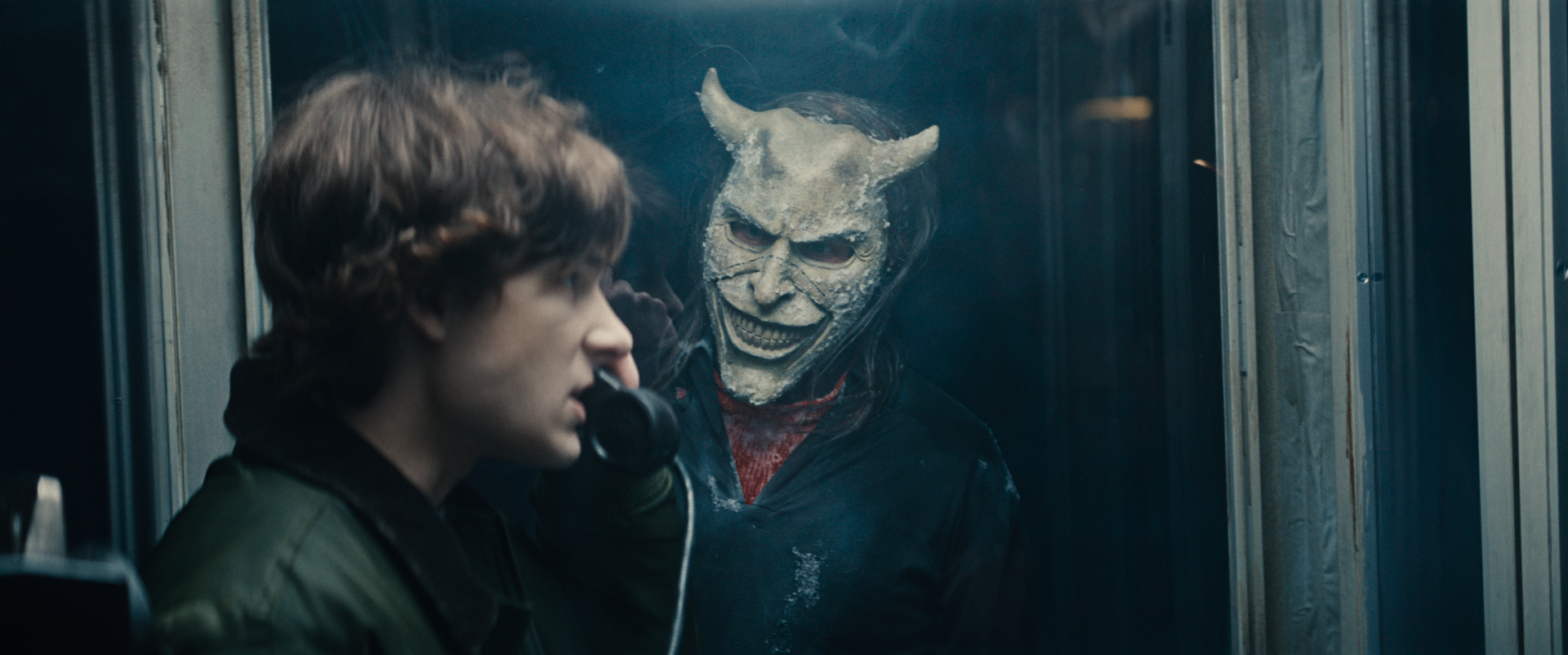
Four years ago, Scott Derrickson and C. Robert Cargill adapted Joe Hill’s short story into The Black Phone, a raw horror film capturing childhood vulnerability with uncompromising honesty. The film earned $160 million worldwide, established Ethan Hawke’s Grabber as an iconic horror villain, and felt complete. Finney Blake killed his abductor and walked into freedom. The end. Which makes Black Phone 2 all the more frustrating in how thoroughly it misunderstands what made the original resonate.
The sequel wasn’t on Derrickson (Sinister) and Cargill’s (The Gorge) radar until Hill—Stephen King’s son—offered an irresistible hook: “A phone rings, Finney answers, and it’s the Grabber calling from hell.” That single image sparked Black Phone 2, though the author contributed no additional story material. Admittedly, the premise is a bold swing—and one that flattens what made the original special.
Here’s where things go wrong: the Grabber has become a blatant Freddy Krueger knockoff, complete with dream stalking, one-liners, and absurd supernatural powers. The original’s claustrophobic terror expands into a frozen campground slasher borrowing liberally from A Nightmare on Elm Street, Friday the 13th, and the obscure 1983 film Curtains. While Derrickson openly acknowledges these influences, acknowledgment doesn’t transform homage into originality. Black Phone 2 leans hard on nostalgia, but rarely feels like it knows why it’s revisiting this story in the first place.
That’s not to say it’s completely empty. Set in 1982, the sequel finds Finney (Mason Thames, Regretting You) numbing trauma through marijuana and avoiding the ringing phones that once saved his life. Meanwhile, sister Gwen (Madeleine McGraw, Toy Story 4) experiences disturbing visions of three boys hunted at Alpine Lake winter camp. When the Grabber begins phoning from beyond the grave, the siblings must confront evil that’s grown more powerful in death.
McGraw delivers the film’s strongest performance with impressive range, driving the narrative as she embraces psychic abilities while Finney runs from his. Thames has matured since the original, trading innocent vulnerability for wounded anger and becoming oddly less dimensional in the process. Hawke (Boyhood) returns with unwavering commitment, yet the character has devolved into pure rage and sadism. The first film’s unsettling ambiguity vanishes entirely; now he’s simply a vengeful ghost seeking to hurt Finney by tormenting Gwen.
The supporting cast provides welcome additions. Demián Bichir (A Better Life) brings dignified weight as Mando, a cryptic camp supervisor. Miguel Mora returns—not as Robin, who died in the first film, but as Robin’s brother Ernesto, a preppy honors student contrasting sharply with his late brother’s toughness. Mora impressively creates a completely different character, and his sweet romance with Gwen provides the sequel’s most genuine emotional moments.
The wintry camp is eerie and well-designed, with flickering lights and long shadows doing much of the work. Production designer Patti Podesta (Dark Harvest) recreates period locations meticulously, while cinematographer Pär M. Ekberg (Slingshot) shoots on Super 8 and Super 16, creating unsettling analog dream sequences that evoke analog horror’s unstable, dangerous quality. The climactic frozen lake confrontation built on a custom 100-by-100-foot painted floor demonstrates ambitious scope. But these set pieces feel like islands in a choppy sea.
Yet the film’s graphic violence against children and teenagers crosses into genuinely uncomfortable territory. The original skirted problematic ground but maintained restraint. Here, Derrickson lingers on twisted deaths of young victims in ways that feel exploitative rather than horrifying. These aren’t the kind of deaths audiences cheer; they’re sick, gratuitous, and unnecessary for a story already dealing with supernatural stakes. The violence undermines rather than enhances the emotional core.
Craft alone can’t overcome flawed vision and the film spends too much time explaining itself. The screenplay front-loads excessive exposition—who’s calling, what the rules are, how evil works now—that grinds momentum before the film properly starts. Derrickson clearly wanted something bigger, more violent, tapping into teenage volatility. But The Black Phone succeeded precisely through intimate scale—one boy, one basement, one desperate fight for survival. Expanding to winter camp slasher territory with supernatural dream rules represents creative regression rather than evolution. A black phone ringing in a dream should feel ominous. Here, it often feels like plot machinery grinding away.
Still, scattered moments remind you why Derrickson is so good when he trusts the nightmare. A phone booth attack revealing lost souls; a kitchen confrontation making the Freddy connection explicit; an extended climax on treacherous ice earning comparisons to A Nightmare on Elm Street 3: Dream Warriors. But then we’re yanked back into sequel logic, where every choice feels geared toward setting up a third film.
The first Black Phone succeeded through Derrickson’s willingness to let personal trauma infuse horror with authentic emotional weight. This sequel tries replicating that alchemy but can’t escape becoming exactly what it pays homage to. Horror thrives this year—Sinners, Final Destination: Bloodlines, and Weapons prove the genre’s creative health. Black Phone 2 confirms what instinct already suggested: even Joe Hill’s brilliant hook couldn’t justify answering this call.