SPOILER-FREE FILM REVIEWS FROM A MOVIE LOVER WITH A HEART OF GOLD!

From the land of 10,000 lakes comes a fan of 10,000 movies!

Leviticus (2026) Review: Scared Straight to Death

Synopsis: Two teenage boys must escape a violent entity that takes the form of the person they desire most – each other.
Stars: Joe Bird, Stacy Clausen, Jeremy Blewitt, Ewen Leslie, Davida McKenzie, Nicholas Hope, Zamira Newman, Mia Wasikowska
Director: Adrian Chiarella
Rated: R
Running Length: 89 minutes
Movie Review in Brief: Leviticus has one of the year’s best horror hooks, a monster that wears the face of whoever you love, plus a few genuinely great scares. The script underneath it never gets fleshed out, and the central romance lacks heat. Promising, eerie, and unfinished.

Leviticus Review: A Killer Hook Looking for a Stronger Spine

Here we are in Pride month, and the horror shelf has given us something that feels both timely and a little too familiar in the way timely things sometimes can. Leviticus, the Australian supernatural chiller from writer/director Adrian Chiarella, comes with a premise sharp enough to draw blood: two teenage boys are trapped in a violent religious community and hunted by an entity that takes the form of the person they desire most. In their case, that means each other.

That’s a great hook for a horror film. Not a good hook. A great one.

It’s also, unfortunately, the kind of hook that can make a movie look more complete than it is. Leviticus has a terrific monster idea, two strong young leads, a handful of jolts that landed on me with embarrassing precision, and a clear emotional reason for existing. What it doesn’t have is a plot sturdy enough to carry all of that weight to the finish line.

The Monster Is the Metaphor

Chiarella isn’t being coy about what he’s working through here, and he shouldn’t be. The title itself points to one of the biblical texts most often weaponized against queer people, and the film takes that weaponization seriously. The horror doesn’t come simply from a creature stalking teenagers. It comes from a community that has already taught those teenagers to fear themselves before anything supernatural enters the room.

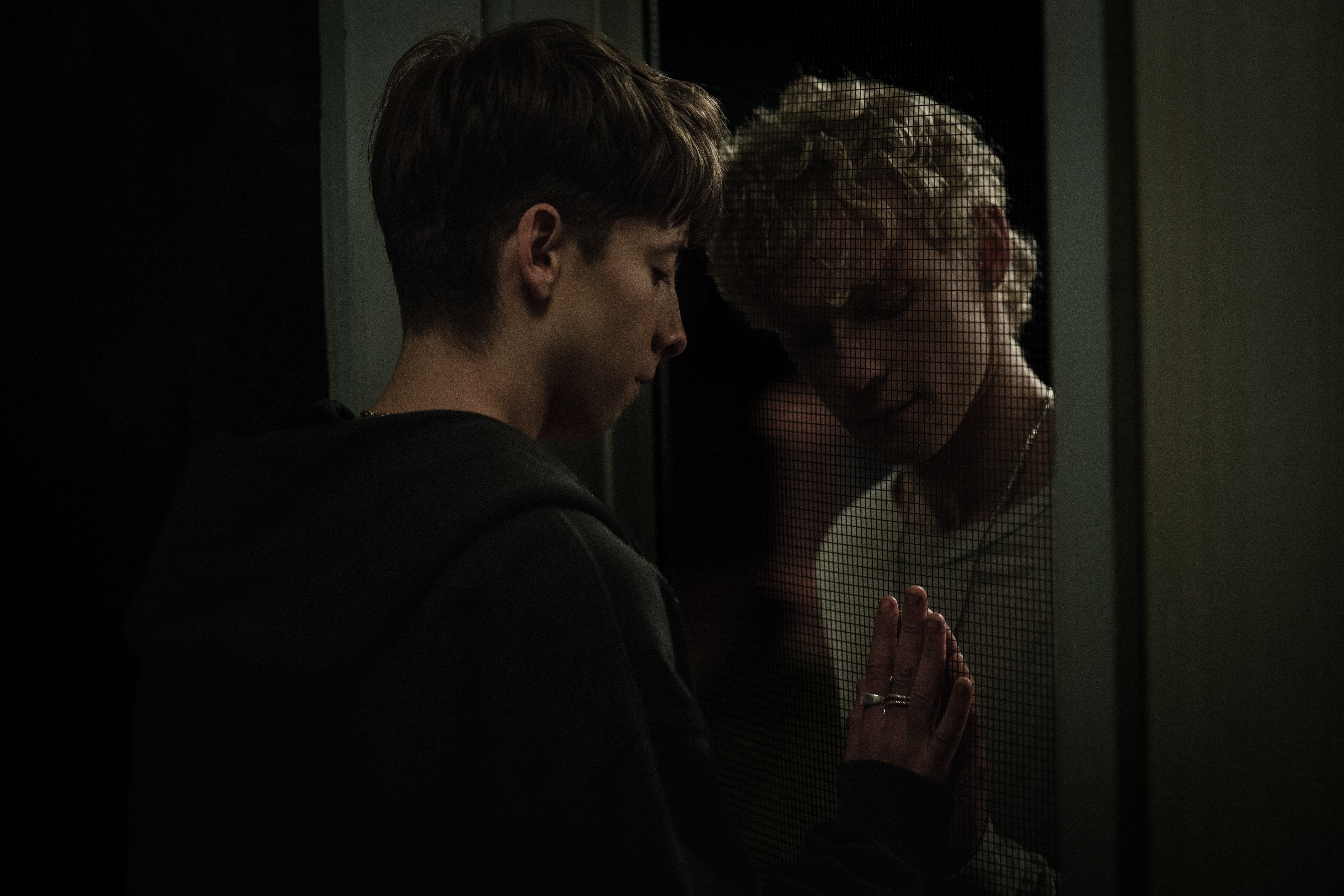
Ryan and Naim, played by Stacy Clausen (Thrash) and Joe Bird (Talk to Me), are young men trying to understand feelings they’ve been told are dangerous, shameful, or spiritually fatal. Their attraction isn’t framed as cute rebellion or teen-movie angst. It’s treated as something intimate, terrifying, and real. That’s where Leviticus is at its best. When it lets these boys sit inside the confusion of wanting someone, fearing that want, and then seeing that desire literally turn monstrous, the movie finds a nasty little pulse.

The press notes describe the entity as taking the form of the person each boy desires most, and that idea gives the film its strongest charge. Horror has always been good at turning private shame into a public threat. Here, desire becomes the thing that chases you, corners you, and punishes you for having a body and a heart. That’s potent material.

It’s also a tough needle to thread. If the metaphor is too vague, it becomes mush. If it’s too blunt, it becomes a lecture with fangs. Chiarella mostly avoids the latter, but he doesn’t always escape the former.
Two Leads Doing the Heavy Lifting

The reason Leviticus works as often as it does is Bird and Clausen. Both actors have to play terror on several levels at once: fear of the monster, fear of the adults around them, fear of each other, and fear of what the other might reveal. That’s a lot to ask, especially when the screenplay doesn’t always hand them clean emotional transitions.

Bird is especially good at letting panic sit behind the eyes before it spills out. He gives Naim a guarded sadness that makes him feel older than he should, like someone already trained to make himself small. Clausen’s Ryan pushes more forcefully against the walls around him, but that force is brittle. You can feel the performance working against the character’s need to look unbothered.

Together, while I didn’t fully buy the chemistry between them, they give the film the emotional clarity the script sometimes lacks. Their scenes have a tenderness that sneaks up on you, even when the movie around them is busy assembling its mythology. You believe the connection on a level of pure need. You believe why the monster would choose this shape. Most importantly, you believe why that shape would hurt.

Mia Wasikowska‘s presence adds an interesting layer, and the supporting cast has moments that suggest a fuller world just outside the frame. But too many secondary characters remain frustratingly underdeveloped. They enter with the promise of importance, retreat into the background, then return when the plot needs another push. That’s fine for machinery. It’s less satisfying for people. I would have loved another 3-4 scenes with Wasikowska’s character, though what we do get is striking.

The Scares Know What They're Doing

For all my problems with the script, Chiarella knows how to stage a scare. Leviticus has several gotcha moments that made me jump in a way I didn’t appreciate and fully respected. The film understands silence. It understands negative space. It understands how long to hold on a frame before the audience starts scanning the corners.

That matters, because modern horror viewers have become annoyingly good at spotting the trap. We know the camera drift. We know the music drop. We know the empty doorway isn’t empty for long. Leviticus still manages to spring a few traps with real force, and that’s not nothing.

The atmosphere is equally strong. There’s a chill to the film that isn’t just visual. The religious setting feels closed-in and airless, the kind of place where everyone’s watching and nobody’s listening. Chiarella uses that pressure well. Even before the monster becomes an immediate threat, the world itself feels unsafe.

You can also see the filmmaker’s influences. It Follows hangs over this movie like a neon sign, not only in the idea of a relentless form-shifting danger, but in the way the threat turns intimacy into a curse. That comparison is impossible to avoid, and Leviticus doesn’t always benefit from it. The earlier film had a dream logic that still felt internally complete. This one has a mythology that feels sketched in pencil.

A Movie Full of Why

This is where the frustration sets in. Leviticus keeps raising questions it doesn’t seem prepared to answer. I don’t need every horror movie to hand me a binder of rules and explanations. In fact, please don’t. Mystery is valuable. Ambiguity is often the point. But I do need to feel that the movie knows more than it’s telling me.

Too often, Leviticus feels like it’s improvising around its own premise. Characters make choices that seem designed less by psychology than by the need to arrive at the next set piece. Relationships are hinted at without being shaped. The community’s larger structure remains fuzzy when specificity would have made it more frightening. Even the boys’ emotional journey, strong as it is in individual moments, sometimes lacks the connective tissue needed to make the arc fully land.

There’s real talent here. Chiarella has the eye, patience, and nerve for horror. But a strong concept can only carry a film so far, especially when the concept is this loaded. Leviticus is dealing with queer fear, religious harm, adolescent desire, and the violence of repression. Those themes deserve more than implication. They deserve dramatic follow-through.

Crafting the Fear: Sound, Image, and Atmosphere

What the screenplay struggles to fully articulate, the film’s technical team often communicates instinctively. Cinematographer Tyson Perkins leans into a dry, desaturated palette that drains warmth from the rural setting, turning the landscape into something spiritually and emotionally parched. The visual flatness is intentional, reinforcing the idea of a world where individuality is pressed out of frame and difference cannot help but stand apart.

Jed Kurzel’s (Overlord) score does some of the film’s most effective storytelling. His sharp, stinging cues elevate the jump scares and give even quieter moments a low, anxious hum, as if something is always just about to break through. It’s the kind of score that doesn’t simply accompany the horror—it actively pressures it forward.

Costume design from Zohie Castellano and physical detail work in tandem with that unease. Small choices, like isolating Naim visually from his peers, subtly underline the character’s emotional reality without the script needing to spell it out. These touches help build a cohesive atmosphere, one where repression isn’t just thematic, it’s baked into how the film looks and sounds.

None of this fixes the gaps in structure, but it does explain why Leviticus works as often as it does moment to moment. Even when the story falters, the craft rarely does.

A Scary Idea Still Looking for Its Ending

Leviticus is a promising and often creepy feature debut with one of the better horror premises of the year.  Bird and Clausen give it a bruised emotional center, and Chiarella delivers several genuinely excellent scares. Still, the film ultimately feels underwritten, more like the outline of a knockout than the knockout itself. I admire the idea. I respect the craft. I just wish the story had found an ending for its characters instead of leaving so much of them trapped in the margins.

Looking for something?  Search for it here!  Try an actor, movie, director, genre, or keyword!

Subscribe to Blog via Email

Enter your email address to subscribe to this blog and receive notifications of new posts by email.

Join 5,235 other subscribers
Where to watch Leviticus