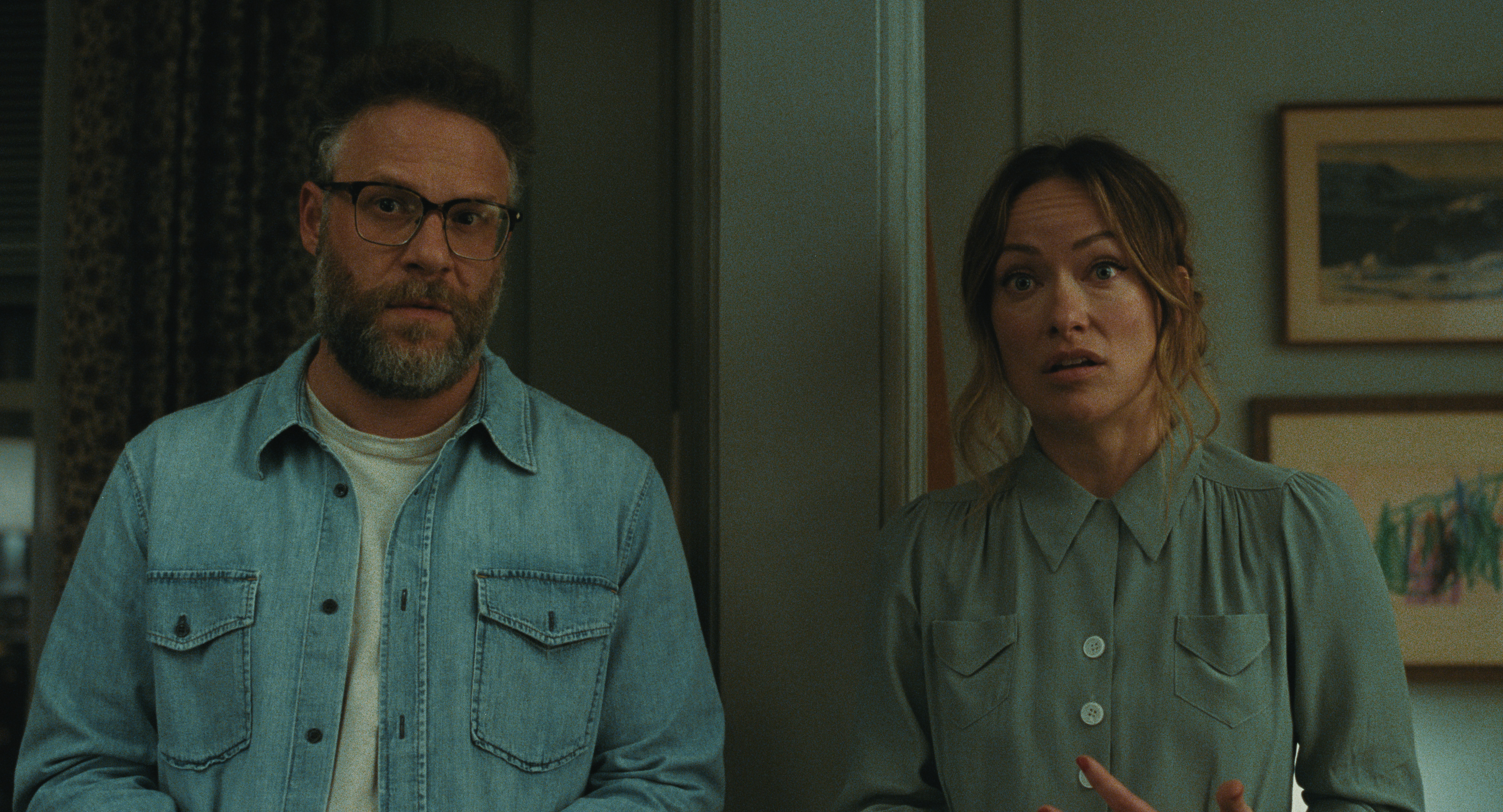
Synopsis: Joe and Angela’s marriage is on thin ice. When Angela invites their enigmatic upstairs neighbors for a dinner party, the night spirals into unexpected places.
Stars: Seth Rogen, Olivia Wilde, Penélope Cruz, Edward Norton
Director: Olivia Wilde
Rated: R
Running Length: 107 minutes
Movie Review in Brief: Olivia Wilde crafts an elegant, sharply acted dinner-party comedy that looks terrific and features sensational work from Penélope Cruz. Unfortunately, the marriage at its center never feels compelling enough to support the emotional weight the screenplay asks us to invest.
The Invite Review: When the Spark Never Shows Up
The road to The Invite has been almost as interesting as the dinner party at its center. What began as Cesc Gay’s Spanish stage play became the 2020 Spanish film The People Upstairs (Sentimental), then inspired remakes in Italy (Neighbors), Switzerland (The Neighbours from Upstairs), France (Maybe More), Russia (Indecent Guests), South Korea (The People Upstairs), and now the United States. That’s a remarkable batting average for a story built almost entirely around four people talking in an apartment.
Olivia Wilde’s American adaptation arrives with plenty of momentum behind it. It premiered at Sundance, sparked a bidding war before A24 secured distribution, and has been greeted with glowing reviews from most critics. That enthusiasm isn’t difficult to understand. The performances are excellent more often than not, the filmmaking is elegant, and it gives adult audiences the kind of dialogue-heavy relationship comedy Hollywood rarely makes anymore. Yet for all its intelligence and technical polish, The Invite never convinced me that the marriage at its center was worth fighting for.
A Marriage Already Beyond Saving
Failed musician Joe (Seth Rogen, Good Fortune) comes home expecting another ordinary evening with his wife Angela (Olivia Wilde, DC League of Super-Pets), only to discover she’s invited their mysterious upstairs neighbors, Piña (Penélope Cruz, The 355) and Hawk (Edward Norton, A Complete Unknown), over for dinner. Joe has every intention of confronting them about their famously enthusiastic love life. Angela would rather survive the evening without a public argument.
Of course, that’s not how the night unfolds.
The dinner gradually shifts from awkward pleasantries to confessions, flirtation, and conversations most couples would probably prefer to avoid altogether. Rashida Jones and Will McCormack‘s screenplay wisely lets the tension build through dialogue instead of plot mechanics, and because the film unfolds almost entirely in one apartment, it feels closer to a stage production than a conventional comedy. There’s more than a little John Cassavetes in its DNA, with four adults peeling away emotional layers until nobody has much left to hide.
The funniest moments land because they’re painfully recognizable. The dramatic ones don’t always earn the same honesty. That became my biggest hurdle. The film spends so much time convincing us Joe and Angela are miserable together that it forgets to show us why they ever fell in love in the first place.
Four Great Actors... Two Convincing Couples
I almost wish I had never learned Amy Adams was originally attached to play Angela back when Jonathan Dayton and Valerie Faris were slated to direct. It’s impossible not to wonder what that version of the film might have looked like. Adams has always excelled at finding warmth inside frustration, and that quality may have made Joe and Angela’s relationship feel more worth saving.
That’s not really a criticism of Wilde’s performance. Directing yourself is one of the hardest balancing acts in filmmaking, and while she certainly handles Angela capably, the performance occasionally feels like it exists a half-step behind everyone else. Her comedic rhythm isn’t quite as sharp as the three actors surrounding her.
Rogen, meanwhile, gets some of the film’s biggest laughs playing one of the prickliest characters of his career. Joe rides the edge of becoming genuinely insufferable during the opening stretch before softening once guests arrive. Few actors throw away a sarcastic one-liner better than Rogen, and several of his funniest responses happen almost underneath the larger laughs.
Norton continues proving he’s one of cinema’s secret comedy weapons. Hawk’s sincere fascination with interior decorating, rugs, and domestic bliss becomes unexpectedly hilarious because Norton never winks at the audience. He’s relaxed for most of the evening before delivering a late monologue that suddenly reframes everything we’ve been watching.
Then Cruz takes over. The Oscar winner doesn’t steal The Invite. She patiently waits until the movie belongs to her.
This may be Cruz’s finest performance in years. Piña initially appears to be the confident outsider stirring the pot, but Cruz builds the character piece by piece until every conversation begins orbiting around her emotional intelligence. By the time she receives her showcase near the film’s conclusion, she’s operating on an entirely different level. If we’re talking awards months from now, Supporting Actress feels like exactly the conversation this performance deserves.
Every Corner of the Apartment Tells a Story
One thing Wilde absolutely nails is the filmmaking itself.
Working with cinematographer Adam Newport-Berra, she transforms a comfortable San Francisco apartment into a constantly shifting emotional battlefield. Characters stand at opposite edges of the frame when emotional distance matters. Hallways suddenly feel impossibly narrow whenever conversations become uncomfortable. It’s impressive visual storytelling inside a space that could easily have become repetitive. The production was intentionally shot in chronological order on 35mm film, a choice Wilde believed would allow the relationships to evolve naturally as filming progressed.
Production designer Jade Healy deserves equal praise. Every room feels intentionally designed without calling attention to itself. The muted greens and blues reflect Angela’s emotional state while giving the apartment a sophisticated warmth that slowly begins feeling like a trap.
Devonté Hynes contributes a wonderfully restrained score, weaving isolated string arrangements through the conversations without ever overwhelming them. Editors Ant Boys and Yorgos Mavropsaridis also know precisely when to let scenes breathe and when to tighten the screws. Costume designer Arianne Phillips gets subtle storytelling points as well. Hawk and Piña’s darker wardrobe contrasts beautifully against Joe and Angela’s softer blues, visually separating two very different philosophies about relationships before anyone says a word.
A Sharp Observation That Cuts Too Deep
The film opens with Oscar Wilde’s famous line: “One should always be in love. That is the reason one should never marry.” It’s a terrific thesis statement for the conversation Olivia Wilde wants to have. The problem is that the screenplay rarely argues the opposite side.
Long-term relationships are messy. Couples repeat the same arguments. Somebody always loads the dishwasher wrong. The person you love most probably does something every single day that drives you crazy. That’s part of the agreement.
The Invite often treats those ordinary frustrations as proof the relationship has already failed. The grievances Joe and Angela carry feel surprisingly small compared to the enormous decisions they’re willing to entertain once temptation enters the room. I kept waiting for a deeper wound to emerge, something that justified the emotional weight the screenplay places on their marriage. Instead, many of the conflicts feel self-inflicted.
More Heat Than Heart
Perhaps that’s where this material plays differently in its various international versions. Every culture approaches marriage differently, and perhaps this story resonates more naturally elsewhere. This American adaptation certainly isn’t lacking intelligence. It simply left me unconvinced by the problem it wanted me to care about most.
That’s frustrating because so much of The Invite works. Wilde directs with confidence. The ensemble is outstanding, particularly Norton and Cruz. The production design, cinematography, editing, and score elevate what could have felt like photographed theater into something genuinely cinematic.
By the time the credits rolled, I admired The Invite more than I loved it. That’s still enough to make the reservation worthwhile. It’s a beautifully prepared dinner party where everyone at the table is fascinating except the couple hosting it.
Looking for something? Search for it here! Try an actor, movie, director, genre, or keyword!

Leave a Reply