The Social Reckoning
Synopsis: Facebook engineer Frances Haugen teams with Wall Street Journal reporter Jeff Horwitz to expose the company’s internal secrets.
Stars: Mikey Madison, Jeremy Allen White, Jeremy Strong, Bill Burr, Wunmi Mosaku, Betty Gilpin, Billy Magnussen
Director: Aaron Sorkin
Rated:R
Running Length: 112 minutes
Movie Review in Brief: Aaron Sorkin’s companion to The Social Network trades the founding for the fallout, and it’s a genuine surprise. Mikey Madison proves her Oscar was no fluke, Jeremy Strong builds a Zuckerberg entirely his own, and scrambled timelines make a story you already know feel suspenseful.
The Social Reckoning makes logging off look reasonable
Facebook used to ask what was on your mind. Somewhere along the way, getting under your skin became better business. The Social Reckoning takes that change personally, and Aaron Sorkin turns corporate defensiveness into surprisingly entertaining combat. I liked this far more than I imagined I would, or could. Following The Social Network sounded like an invitation to spend two hours comparing an accomplished filmmaker with David Fincher. Instead, I found myself absorbed in the people trying to make a powerful company answer an inconvenient question: what did you know?
Sorkin, now writing and directing, shifts the attention from Facebook’s creation to the consequences of its success. Engineer Frances Haugen (Mikey Madison, Anora) believes the platform can do better and has internal documents to support that belief. Wall Street Journal reporter Jeff Horwitz (Jeremy Allen White, The Iron Claw) needs access to those documents. Their investigation, inspired by the 2021 Facebook disclosures, requires her trust in him before he can ask the public to trust her evidence.
Madison has nothing left to prove
As a Demi Moore Oscar supporter for her work in The Substance, I’m prepared to make an admission that may require another beer. Madison is terrific here. Her first film after winning Best Actress gives her a substantially different challenge, and she meets it without treating the role as an acceptance-speech encore. Frances’s intelligence comes through in the way she processes information, while her uncertainty belongs to what sharing it might cost. Those competing impulses make the whistleblower feel like a person making a difficult decision.
Madison makes moral courage feel like a dangerous daily choice in the way she gives Frances enough conviction to proceed and enough vulnerability to make that proceeding matter. Sorkin encouraged her to build the character from his screenplay rather than imitate Haugen, and the distinction pays off. The performance has the freedom of dramatic interpretation without losing the seriousness of the woman’s position. Frances still believes in the place she’s exposing, which makes her disillusionment more interesting than simple contempt.
White is an excellent partner for her. His reporter’s limited grasp of tech terminology lets the audience learn alongside him, but his persistence keeps those explanations moving. Their chemistry comes from competing needs rather than easy agreement. Jeff wants a story he can publish; Frances needs to know the person publishing it understands her risk. The relationship gives the investigation emotional stakes that a stack of incriminating documents couldn’t provide by itself.
The boss has rehearsed his answer
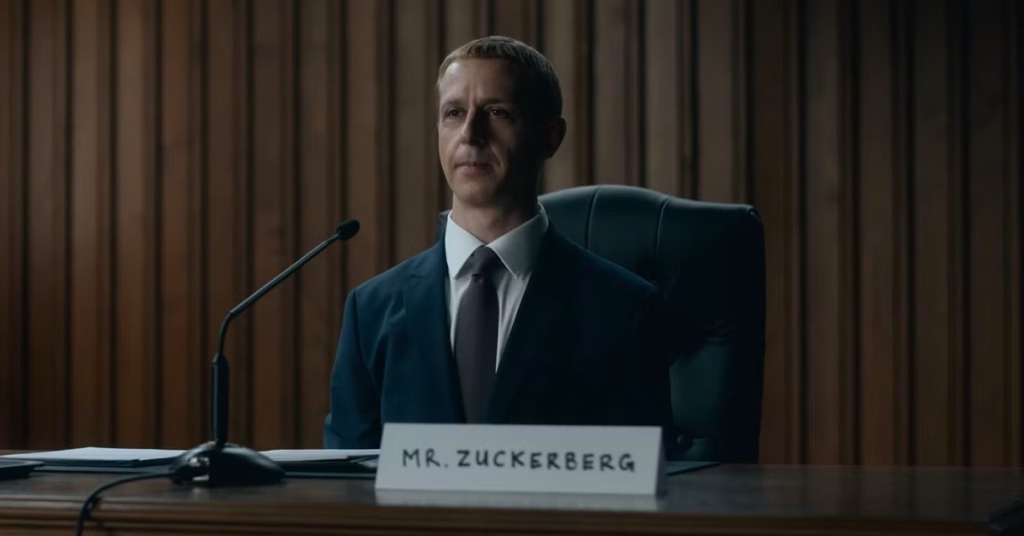
Mark Zuckerberg (Jeremy Strong, The Apprentice) occupies a different world, insulated by the company his younger self built. Strong makes the role his own, bringing an older, more entrenched version of that snarky tech-bro energy. The arrogance now has an organization to protect it. Even when challenged, Zuckerberg expects his explanation to settle the matter, and Strong makes that entitlement both funny and deeply irritating.
The supporting cast gives him plenty to resist. Crisis strategist Raya Akinola (Wunmi Mosaku, His House & Sinners) brings persuasive warmth to the job of making him publicly palatable. Former colleague Charlie Garrigan (Bill Burr, Leo) has the familiarity to challenge him and the irritation to enjoy it. Christina (Betty Gilpin, Office Romance), Jeff’s bureau chief, supplies newsroom pressure, while Teddy Marks (Billy Magnussen, Game Night) guards Facebook’s public image. Each has a different reason to control what gets said.
That’s where Sorkin’s sharp writing earns its keep. Information becomes a bargaining tool, and the conversations have objectives beyond delivering another quotable comeback and the cast turns damage control into a contact sport. Knowing the broad history doesn’t flatten the suspense, because the shifting timelines make us work out how these encounters connect. The uncertainty lies in the route through familiar events, and I enjoyed being kept on my toes.
Glass offices and uncomfortable questions
Returning cinematographer Jeff Cronenweth provides visual continuity without making a museum exhibit of the earlier film. The first forest meeting between Frances and Jeff puts trees between us and the pair, giving a conversation the feeling of possible surveillance. Production designer Jon Hutman’s glass office offers a useful contradiction: everything looks transparent, yet access to Zuckerberg and his decisions remains tightly controlled. The newsroom’s comparatively modest surroundings make the imbalance tangible.
Susan Lyall’s costumes distinguish Frances’s practical priorities from the polished people managing Facebook’s image. Editor Alan Baumgarten keeps the changing timelines in conversation with one another. Alexandre Desplat’s mix of chamber orchestration and electronics brings a different musical personality to this companion piece, letting tension build around the dialogue. Desplat had big sonic shoes to fill with Trent Reznor and Atticus Ross’s Oscar-winning score from the first film still so popular, but the craft supports the actors rather than competing for the last word.
A very good reason to keep asking
I can see how Sorkin’s faith in articulate, principled people might feel familiar, and the film’s arguments can announce themselves with a bit too much righteous gusto. But investigative journalism earns its appeal here by building trust and turning private knowledge into public evidence. The Social Reckoning makes that process exciting while asking why a company should get to define responsibility on its own terms.
Madison and White make the investigation worth following even when you know what their work will uncover. Their uneasy partnership gives the reporting a human cost, while Strong and the supporting cast make Facebook’s efforts to manage the fallout sharply entertaining. Sorkin’s emphatic arguments leave limited room for ambiguity, but the changing timelines kept me engaged with how the evidence would emerge. The film has a position, and the performances give it more life than a lecture could.
The earlier film asked who deserved credit for Facebook. This one asks who will accept responsibility for its damage. That’s a worthwhile conversation, and this fantastic cast gives it enough friction to keep it from becoming homework. I went in expecting a difficult follow-up and came out wanting another round of Sorkin’s questions. Zuckerberg may have rehearsed his answers, but he hasn’t earned the right to end the conversation.
Looking for something? Search for it here! Try an actor, movie, director, genre, or keyword!

Leave a Reply