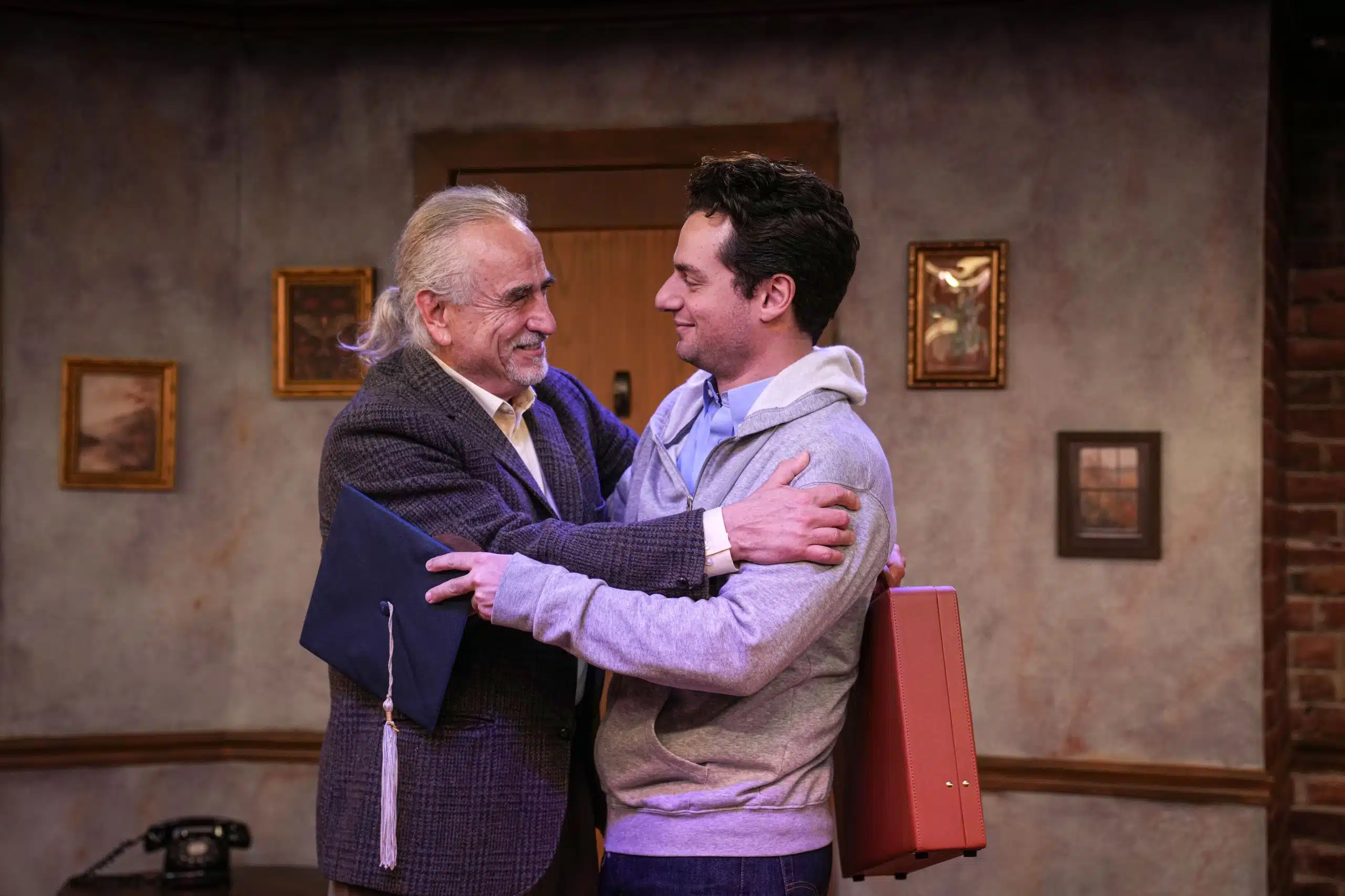


Tuesdays with Morrie
Synopsis: Sportswriter Mitch Albom is busy, successful and long out of touch with his favorite college professor, Morrie Schwartz, until he sees Morrie on television talking about living with ALS. One visit turns into fourteen Tuesdays of conversation about love, work, family, forgiveness and how to live, as Morrie faces the end of his life. A two-actor drama based on Albom’s bestselling memoir.
Starring: Gabriele Angieri (Morrie Schwartz), Ryan London Levin (Mitch Albom)
Written By: Mitch Albom and Jeffrey Hatcher, based on Albom’s memoir
Directed By: Serena Brook
Design: Nayna Ramey (scenic), Rich Hamson (costumes), Sue Ellen Berger (lighting), Russ Haynes (sound), Abbee Warmboe (properties). Stage manager: Thomas Schumacher
Production Type: Professional (includes members of Actors’ Equity Association)
Venue: Playhouse Theatre, Chanhassen Dinner Theatres, Chanhassen
Running Length: 1 hour, 50 minutes, including one 20-minute intermission
Content Advisory: Best suited for audiences 13 and up. CDT does not admit anyone under 5.
Now Playing: Through November 29, 2026
Performance Reviewed: Thursday, October 29, 2026, at 7:30 p.m. (opening night)
In This Performance: Full cast
Show Review in Brief: Mitch Albom and Jeffrey Hatcher’s two-hander finds a warm home in Chanhassen’s intimate Playhouse, led by a sincere Gabriele Angieri and an engaging Ryan London Levin. After a somewhat tentative first act, the production settles in beautifully and lands its emotional punches. Bring the Kleenex.

3.5 out of 5 Spotlights
Review:
Getting to Tuesdays with Morrie at Chanhassen Dinner Theatres is an experience all its own. You walk past the fireplace glowing in that impressive lobby, drift by the Hogarth Lounge and stop just short of Brindisi’s Pub, where a ramp slopes down to a fork in the road. Hang a right and you’ll wind up at The Club, once the fourth theater in the building and now the room where wedding receptions dance until close. Hang a left and you’ve found the Playhouse, the coziest space in the house. Somewhere along the way, a family of stone otters will watch you pass. Say hi. Depending on the season, they may even be dressed festive.
Build in a little time to wander because the walls provide their own preamble. Photos from 58 years of productions stretch toward the ceiling, turn up in bathrooms and fill random corners throughout the building. Look closely and you can watch people grow up in them, child actors returning decades later as adult leads. There’s something wonderfully surreal about spotting a familiar face from years ago when you’re minutes away from seeing that same actor walk onstage. I can’t imagine a more fitting warm-up for Tuesdays with Morrie, a play about looking backward while you’re still learning how to live in the present.
Tuesdays with Morrie at Chanhassen Goes Back to Class
Mitch Albom’s bestselling memoir reaches the Playhouse in an adaptation by Albom and Twin Cities playwright and screenwriter Jeffrey Hatcher, whose screen credits include Mr. Holmes and The Good Liar. Hatcher has a knack for cutting through excess and getting straight to an emotion without squeezing it too hard. You can feel that influence as Albom’s book, also adapted into an Emmy-winning TV movie starring Jack Lemmon and Hank Azaria, becomes a stripped-down two-hander for the stage.
Albom originally wrote the book in part to help pay Morrie Schwartz’s medical bills. Publishers weren’t exactly lining up for a sportswriter’s reflections on life and death, and its first printing numbered only 20,000 copies. Millions of sales later, the book had become a phenomenon. The play followed in 2002, and Albom has said the stage version comes closer to what actually happened than either the book or movie. “The play is what happened,” he has said. Two people meet every Tuesday. They talk. We listen. Chanhassen is giving the piece a brief five-week run in its most intimate room, much as it did for years with Love Letters, with plenty of matinees for school groups whose first encounter with Mitch and Morrie may have come through required reading.

A First Act Still Finding Its Footing
At roughly 90 minutes, not counting a 20-minute intermission, Tuesdays with Morrie doesn’t waste much time getting to those Tuesdays. We first meet Albom (Ryan London Levin) as an adult looking back before he becomes the squirmy Brandeis University freshman who wanders into a class taught by Morrie Schwartz (Gabriele Angieri). Something clicks. Mitch starts taking every class Morrie offers, graduates, promises to stay in touch and promptly lets 16 years go by.
Their reunion comes through television. Mitch, a failed jazz pianist who has reinvented himself as a sportswriter, catches Morrie on Nightline and learns his old professor is dying from ALS. He gets on a plane. One visit turns into another, and soon Tuesday becomes their day, a tape recorder sitting between them as they work through love, marriage, fear, ambition, death and everything else Mitch has spent years being too busy to think about.
Levin and Angieri have to create that whole world by themselves. Mitch’s wife, Janine, is heard only as a recorded voice, and when a doctor is needed to deliver difficult news, Levin briefly becomes him. There’s nowhere for either actor to hide, and Levin is rarely offstage. On opening night, the first act was still working toward the rhythm the play needs. Some exchanges felt tentative while others pushed a little too hard, although that hesitation sometimes worked for Levin. Mitch is trying to figure out how to speak to someone who once knew him so well but has become almost a stranger.
Then came intermission, and when the lights went back down something had shifted. Levin and Angieri seemed to settle into each other, and suddenly you weren’t watching two actors establish a relationship. You were watching two people who had been meeting on Tuesdays forever. The conversation loosened up, the pauses became more comfortable and the affection between them stopped needing to announce itself. That’s when the play really started to land.
Pass the Kleenex
Levin and Angieri make a smart pairing: one restless, one patient; one still climbing, the other returning to a role he already knows well. Levin continues to become more comfortable taking command of a Twin Cities stage, and Mitch gives him plenty to carry. He has to be narrator, participant, younger student and older professional, sometimes shifting between them within seconds. He’s particularly effective once Mitch realizes these weekly visits aren’t simply interviews for something he may write someday. Time is running out, and no amount of note-taking is going to slow it down.
Angieri previously played Morrie on tour in 2017, but there’s nothing dusty about the performance. He isn’t simply slipping back into something he figured out nine years ago. You can see Morrie thinking, and that matters in a play filled with lines engineered to hit your tear ducts directly. Angieri gives those sentiments weight without turning Morrie into a greeting card. His humor remains intact, as does his curiosity. Even as Morrie’s body deteriorates, Angieri keeps the person inside it fully present, and that sincerity is what allows the final scenes to hit as hard as they do.
And yes, they hit. Tuesdays with Morrie knows exactly what kind of emotional experience it is offering, and bringing along a travel pack of Kleenex is not the worst idea you’ll have all week. Near the end of opening night, I noticed a woman at a neighboring table reach into her purse. Without taking her eyes off the stage, she pulled out a package of tissues, handed it to the person beside her and closed the purse again. Tears were already running down her own cheeks. No notes.
Director Serena Brook makes her Chanhassen directorial debut here while simultaneously playing Miss Hannigan in Annie on the Main Stage, and she understands the advantage of having Morrie only a few feet away from the audience. Morrie stays close while Mitch is the one who gets to move. When he’s uncomfortable, he wanders, and when the conversation becomes too personal, there’s somewhere for him to go. Morrie, increasingly limited physically, remains the center Mitch keeps circling back toward.
A stage adaptation can’t reproduce every memory and observation Albom packs into the book, but it can do something the book cannot. It can put these two men close enough that they occasionally seem to be talking directly to you. Brook notes in the program that this is intentional, and in the Playhouse, where there may be only a few feet separating actor and audience, it works.

A Small Room With Room to Move
The Playhouse occupies its own corner of the building, though it’s easier to picture its location if you imagine the Main Stage sitting almost directly overhead. Nayna Ramey’s set rises barely a foot from the floor and stretches the playing space across the back wall. A sideboard sits at far right, leaving most of the usable space down front, and Brook takes advantage of the section that reaches toward the tables, treating it almost like a thrust and bringing the actors closer whenever the scene benefits from it. For such a small room, the production rarely feels visually static.
That gives lighting designer Sue Ellen Berger plenty to work with. When Mitch slips into narration, Berger can separate the two men without sending either one offstage, leaving Morrie visible behind him somewhere between memory and the present. Rich Hamson’s costumes chart the passage of time more subtly. Levin remains essentially in the same clothes, with pieces added or removed as needed, while Angieri’s wardrobe tells a different story. Morrie layers up as his body weakens, his decline measured in cardigans, blankets and increasing physical assistance. It’s simple, practical storytelling that never draws attention away from the men at its center.
This may be a play rather than a musical, but sound designer Russ Haynes still has plenty to manage. Recorded voices, telephone calls, piano notes and small environmental cues slip into the production without demanding attention. A few of those moments were still being fine-tuned on opening night, particularly where a ring ended or a piano stopped, but the overall design understands its job. It supports the room rather than trying to fill it. Both actors are miked and were easy to hear, although Levin and Angieri project so well that amplification seems almost unnecessary until somebody nearby drops a fork or goes hunting for the last cube of ice in a glass. It is dinner theater, after all.
Class Dismissed, Lesson Learned
Chanhassen gave Tuesdays with Morrie only one day of previews before opening night, and a two-person play lives or dies on rhythms that can take longer than a single performance to develop. The encouraging thing is that the production I saw seemed to discover those rhythms right in front of us. By act two, Levin and Angieri had found the play’s pulse. The stiffness disappeared, the exchanges breathed and Tuesdays with Morrie became exactly what Albom has said the stage version should be: a seat in the room for those Tuesdays. With most of its five-week engagement still ahead, there’s every reason to believe that connection will only deepen.
There’s also one date on the calendar that carries some extra weight. Morrie Schwartz died on November 4, 1995, and the anniversary of his death falls right in the middle of this Chanhassen production. A professor who gave his last class more than three decades ago still has a room full of strangers in Minnesota hanging on his words. In her program note, Brook leaves audiences with one of Morrie’s questions: “Are you trying to be as human as you can be?” Judging by the tears around me, Morrie’s final class was still reaching its students. Maybe that’s why Mitch’s 16-year absence feels especially meaningful by the end. He waited until time was running out to knock on his professor’s door again, then spent every Tuesday he had left trying to make up for it.
Tuesdays with Morrie continues at Chanhassen Dinner Theatres through November 29. Thirty-one years later, Morrie still has something to teach us. All we have to do is show up and listen.
Dinner and a Show
What We Ordered: My mom and I each started with the Winter Margarita, made with Don Julio Blanco, Grand Marnier, lime, cranberry and pomegranate, finished with a green sugar rim. For dinner, I had the Famous Chicken Chanhassen, an oven-roasted chicken breast with Minnesota wild rice stuffing, the signature Hollandaise and steamed vegetables. Mom went lighter with the Pear Salad, topped with fennel, dried cranberries, pears, toasted pecans and shaved pecorino. We saved room for dessert, sharing the Sea Salt Caramel Cheesecake and a Raspberry Tackle made with Raspberry Ripple and Baileys.
Service and Timing: Our server, Nancy, was terrific. Everything moved at an easy pace, dinner was finished about ten minutes before curtain and dessert arrived during intermission, so nothing ever felt rushed.
Worth It?: For me, the meal is part of the full Chanhassen Dinner Theatres experience, especially when the timing works this smoothly. Show-only tickets are available as well, so check with the box office if you’d rather skip dinner.
The meal isn’t part of the Spotlight rating.
Where to See Tuesdays with Morrie
Through November 29 in the Playhouse at Chanhassen Dinner Theatres. Dinner and show: Wednesday matinees (dinner 11 a.m., show 1 p.m.) and evenings (5:30 and 7:30 p.m.), Thursdays (5:30 and 7:30 p.m.), Saturday matinees (11 a.m. and 1 p.m.) and Sundays (4:30 and 6:30 p.m.). No show on Thanksgiving. And no, despite the title, there are no Tuesday shows. Show-only tickets go on sale 10 days before each performance. Tickets at chanhassendt.com or 952-934-1525.
Disclosure: I attended the October 29 opening-night performance as a guest of Chanhassen Dinner Theatres, which provided tickets and dinner for me and my guest. I performed at Chanhassen in its 2009-2010 production of Oklahoma!
Quoting this review? Please credit: Joe Botten, Off Screen/On Stage (TheMNMovieMan.com)
Leave a Reply