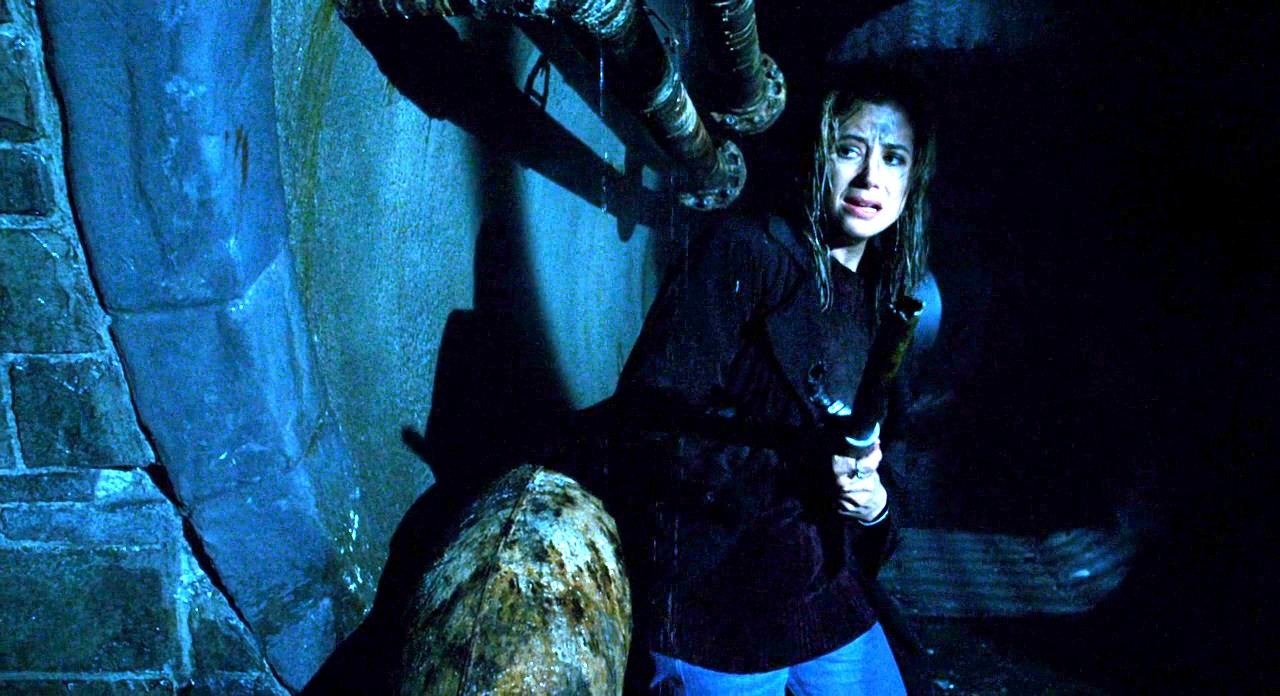

Mimic (1997)
4K UHD + Blu-ray (3-Disc Special Edition) · Kino Lorber
Shelf Worthy
In Brief
Both versions of Guillermo del Toro’s bruising Hollywood debut receive their own 4K UHD in Kino Lorber’s three-disc set, newly scanned from the original camera negative and approved by the director. Watching them side by side only makes the Director’s Cut look better.
The Facts
Synopsis: To stop a plague killing New York’s children, two scientists release a genetically engineered insect designed to die out. Three years later, something in the city’s subway tunnels has kept evolving, and it has learned to blend in.
Starring: Mira Sorvino, Jeremy Northam, Charles S. Dutton, F. Murray Abraham
Directed by: Guillermo del Toro
Rated: R
Running Length: 111 minutes (Director’s Cut), 105 minutes (Theatrical Cut)
Buy It Here
The Package
Label: Kino Lorber
Format: 4K UHD + Blu-ray (3-Disc Special Edition)
Release Date: March 17, 2026
Video: 2160p, Dolby Vision and HDR10, 1.85:1. New masters of both cuts from a 4K scan of the 35mm original camera negative, approved by Guillermo del Toro
Audio: English DTS-HD Master Audio 5.1 and 2.0
Subtitles: English SDH
Discs: 3 discs: 4K UHD (Director’s Cut), 4K UHD (Theatrical Cut), Blu-ray (both cuts and the extras). 4K discs region free, Blu-ray Region A. Slipcover and reversible art on the first pressing
The Film
Guillermo del Toro has joked that two terrible things happened to him in the late 1990s: his father was kidnapped and he made a movie with the Weinsteins. The kidnapping, he said, made more sense. The movie was Mimic, his first Hollywood feature, and you really can’t talk about it without talking about the fight over who got to make it.
A deadly disease spread by cockroaches is killing children across New York City. Entomologist Dr. Susan Tyler (Mira Sorvino, Butter) and Dr. Peter Mann (Jeremy Northam, Eye in the Sky) stop the outbreak by creating the Judas Breed, a genetically engineered insect designed to wipe out the disease carriers and conveniently die off afterward. Nature, unsurprisingly, doesn’t read the fine print.
Three years later, something has been growing in the subway tunnels. Charles S. Dutton (Alien 3) joins the story as transit officer Leonard, Giancarlo Giannini (Casino Royale) plays a shoeshine man searching for his missing grandson and F. Murray Abraham (The Phoenician Scheme) appears as Susan’s mentor. A young Josh Brolin (Whalefall) is lurking around the edges, too.
It’s a great monster-movie setup, but getting it onto the screen became a battle almost immediately. Del Toro and co-writer Matthew Robbins (Crimson Peak) originally conceived the creatures differently, while Dimension Films kept pushing the movie toward louder scares and more conventional horror beats. Second-unit material was imposed on the production, del Toro was threatened with replacement and Sorvino, coming off her Oscar win, reportedly put her own position on the line to support him.
You can feel that tug-of-war in the theatrical cut. There are stretches where the movie wants to breathe, letting Dan Laustsen’s camera wander through dripping tunnels and grimy rooms, only to get yanked toward another jolt. The studio clearly wanted a giant-bug movie. Del Toro was trying to make something stranger.
What survives is unmistakably his. Insects. Clockwork. Religious imagery. Children navigating threatening adult spaces. Monsters that become more interesting the closer you look at their biology. New York, actually played by Toronto, becomes a wet, rotting maze of subway platforms, abandoned tunnels and cathedral-like darkness. You can see the filmmaker who would eventually make The Shape of Water, Nightmare Alley and Frankenstein trying to push through the machinery of a studio production that didn’t entirely trust him yet.
Sorvino gives the movie a sturdy center, and Dutton makes everything better simply by showing up. Northam gets saddled with more exposition, while the creature work remains the star whenever the Judas Breed crawls into view. The designs are disgusting in just the right way, rooted in real insect behavior before stretching into something much nastier.
Neither version magically turns Mimic into a lost masterpiece. Some characters remain thin, bits of story still feel compromised and the movie never completely escapes its production history. But the Director’s Cut lets del Toro’s rhythms breathe more naturally and makes his intentions considerably easier to see.
The theatrical cut is the movie Dimension wanted to sell. The Director’s Cut is the one I actually want to watch.

The Transfer
Video
Kino gives each version of Mimic its own triple-layer 4K UHD rather than placing both cuts together through seamless branching. Both were newly mastered from 4K scans of the 35mm original camera negative and approved by Guillermo del Toro. Each is presented in native 2160p at 1.85:1 with Dolby Vision and HDR10.
The Director’s Cut contains some material that survives only in HD and therefore had to be upscaled for inclusion. Kino identifies that limitation with a card at the beginning of the feature rather than pretending every frame comes from the same source. The separate UHDs also give each version substantial disc space rather than forcing two cuts to share one encode.
Audio
Both cuts include English DTS-HD Master Audio 5.1 and 2.0 options with English SDH subtitles. The older Lionsgate Director’s Cut Blu-ray included a 7.1 presentation that has not been carried over to this edition. Kino does not include a Dolby Atmos remix.
Transfer Notes
The Director’s Cut runs 111 minutes, while the original theatrical version runs approximately 105. Until this release, American Blu-ray collectors primarily had access to the Director’s Cut through Lionsgate’s 2011 edition and Paramount’s 2021 reissue. Kino restores the theatrical cut to physical circulation as well, making direct comparison considerably easier.
The third disc is a Region A Blu-ray containing HD versions of both cuts plus the supplemental package. Both 4K UHDs are region free. First pressings include a slipcover and reversible artwork.

Special Features
Audio Commentary by Director Guillermo del Toro (Director’s Cut): The essential listen, included on the Director’s Cut UHD and Blu-ray. Del Toro speaks candidly about the studio-mandated material, second-unit work and the battle to regain some control of the movie.
Audio Commentary by Horror Cinema Expert Arne Venema and Cinema Author Stefan Hammond (NEW) (Theatrical Cut): Included with the theatrical version, covering the production history, Kyle Cooper’s opening titles and some fascinating roads not taken.
Video Prologue with Guillermo del Toro (1:05): A very brief introduction that immediately establishes his feelings about the experience.
Reclaiming Mimic (14:31): Del Toro discusses the movie he wanted to make, the ending he never got to shoot and his later attempt to reshape the finished film.
A Leap in Evolution (9:35): A look at the creature design and the concepts that changed during production.
Back Into the Tunnels (5:22): Vintage EPK interviews and behind-the-scenes footage.
3 Deleted Scenes (5:11): “Lunch at the Park,” “Kidnapped” and an alternate ending.
6 Animated Storyboards (6:04): Early boards accompanied by temp music, offering another glimpse at del Toro’s original planning.
Gag Reel (2:20): Flubs, goofs and a few appearances from the director.
Theatrical Trailer: The original marketing campaign.
The supplemental package carries forward the material from Lionsgate’s 2011 Director’s Cut release while adding a new commentary specifically for the theatrical version. More importantly, having both cuts and del Toro’s own commentary in the same package turns the set into a pretty fascinating before-and-after look at studio interference. Del Toro’s commentary (always a must-listen whenever it shows up on a disc) is practically a crash course in surviving Hollywood.
Shelf Worthy?
Shelf Worthy
There’s one important condition attached to this Shelf Worthy recommendation: watch the Director’s Cut first. Nearly 30 years later, del Toro finally gets the last word.
The theatrical version is historically valuable, and having it back on disc makes this set more complete, but seeing both makes it pretty clear which one I’d reach for again. Del Toro’s longer cut doesn’t fix every problem, but it gives the atmosphere more room, smooths some studio-imposed rough edges, and feels considerably closer to the filmmaker trying to break through underneath. Del Toro fans and creature-feature collectors should have no trouble justifying the purchase. Casual horror viewers can absolutely stream it first, but collectors interested in how movies change when studios start pulling at them will get even more out of the comparison.
Shelf Worthy: Buy it. This one earns a spot on the shelf.
Stream First: Watch it before you buy.
Completionists Only: For collectors who need every edition.
Kino Lorber provided a copy for review. My opinions are my own.

Reviewed by Joe Botten
Joe Botten is The MN Movie Man, a Twin Cities film critic writing spoiler-free reviews since 2012. He also writes for Loud and Clear Reviews, a Rotten Tomatoes approved site. Find him on Instagram and Letterboxd.
Looking for something?
Search by actor, movie, director, genre or keyword.


Leave a Reply