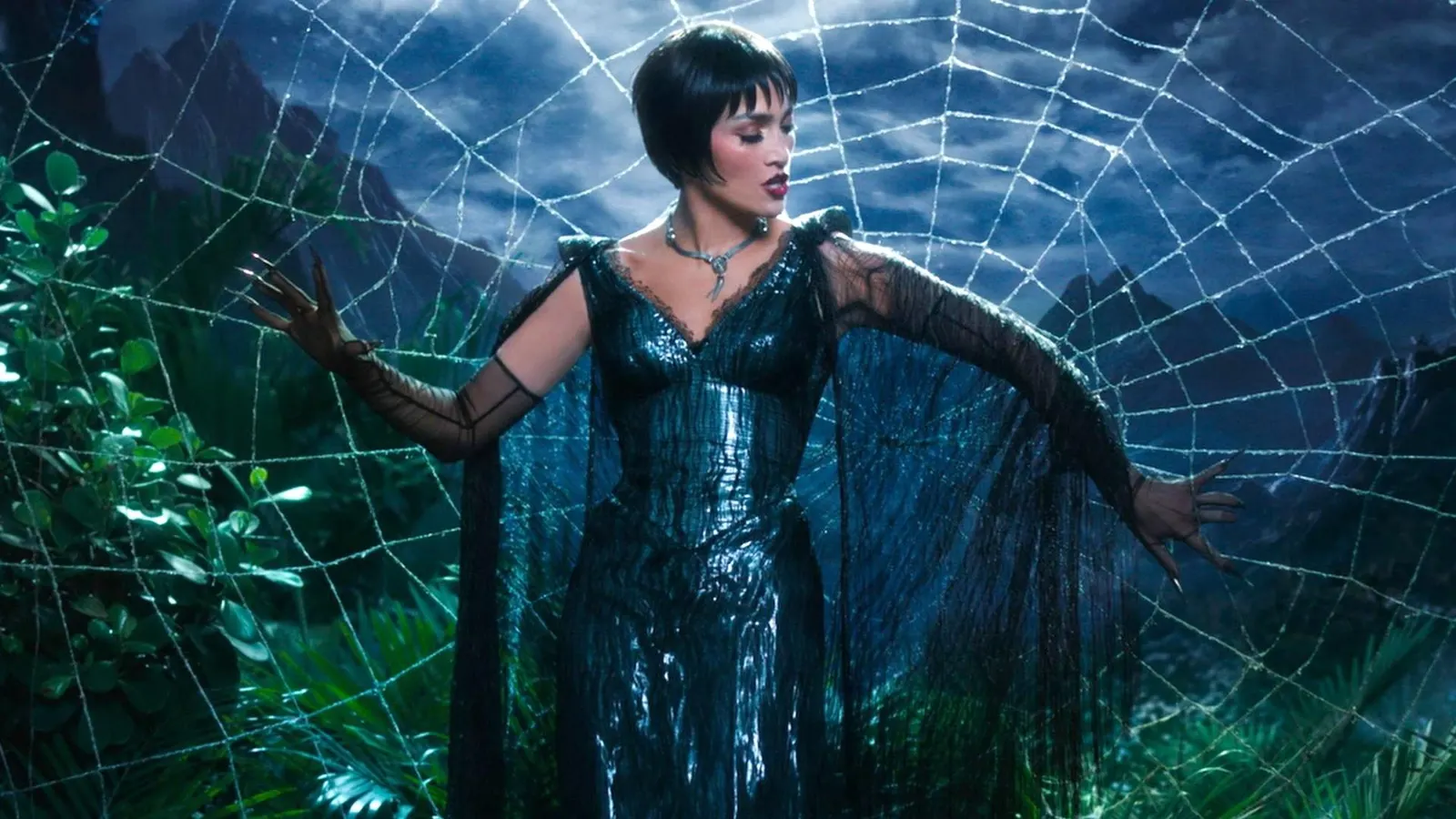

Kiss of the Spider Woman (2025)
4K UHD + Blu-ray · Kino Lorber
Stream First
In Brief
Kino Lorber gives Bill Condon’s 2025 musical its disc debut with Dolby Vision, Dolby Atmos and a new director commentary. Jennifer Lopez and Tonatiuh still dazzle, but the movie never completely solves the divide between its prison drama and musical fantasy.
The Facts
Synopsis: Locked in the same cell during Argentina’s dictatorship, a hardened political rebel and a romantic window dresser forge an unlikely bond through one man’s retelling of a glamorous old movie musical.
Starring: Jennifer Lopez, Diego Luna, Tonatiuh
Directed by: Bill Condon
Rated: R
Running Length: 128 minutes
Buy It Here
The Package
Label: Kino Lorber
Format: 4K UHD + Blu-ray
Release Date: June 30, 2026
Video: 2160p, Dolby Vision and HDR10, 1.85:1
Audio: English Dolby Atmos
Subtitles: English SDH
Discs: 2 discs: 4K UHD (region free) and Blu-ray (Region A). Slipcover and reversible art on the first pressing
The Film
It’s been a good year to be a Kiss of the Spider Woman collector. Criterion brought Héctor Babenco’s 1985 drama to 4K in January, and five months later Kino Lorber followed with Bill Condon’s 2025 musical adaptation. Condon’s version opened theatrically in October 2025 and hit digital a month later, so this marks its first physical-media release. Revisiting it at home didn’t change much from my original theatrical review: two knockout performances are still fighting against a movie that never completely figures out how to connect its two halves.
The story is set in 1983, during the final days of Argentina’s military dictatorship. Political prisoner Valentín (Diego Luna, Elysium) shares a cell with Molina (Tonatiuh, Carry-On), a gay window dresser who survives their confinement by disappearing into the movies in his head. His favorite is an old Hollywood musical starring screen goddess Ingrid Luna (Jennifer Lopez, Hustlers), and every time Molina resumes the story, Condon, borrowing a page from his adaptation of Chicago, trades prison concrete for chrome, sequins and fantasy.
Lopez has been waiting a long time for a role like this, and she goes after it with everything she has. The dancing is sharp, the glamour fits her perfectly and she gives the songs enough emotional muscle to keep Ingrid from becoming only an icon in fabulous costumes. “Where You Are” is worth the rental on its own. It’s the kind of number that makes you wish the entire movie could maintain that same voltage.
Tonatiuh may be even better. Molina could easily become a bundle of mannerisms, but Tonatiuh never lets that happen. The flamboyance is part of the character’s armor, not the punchline, and the loneliness underneath it gradually becomes harder to hide. Luna is shakier in the musical material, especially early on, but he gets stronger once the movie settles into the quieter relationship between Valentín and Molina. As was the case in Babenco’s film, their slow thaw is the real heart of the film.
Condon, who directed the live-action Beauty and the Beast, makes the divide between those worlds obvious. Prison scenes are cramped, gray and handheld. Molina’s fantasies open everything up with old-school studio lighting, elaborate choreography and Colleen Atwood costumes that practically announce their own entrances. Individually, both approaches work. The trouble is the distance between them.
Condon drops much of the material sung inside the cell in the stage version and keeps most of the musical numbers inside Molina’s fantasy world. That gives the movie a very clean visual concept, but it also keeps slamming on the brakes. The prison scenes become straight drama, the musical arrives, the movie lifts off, then we go back behind bars and the energy drops with it. The stage show’s constant back-and-forth between reality and imagination gets flattened into two modes that don’t always feed each other.
That’s frustrating because the idea underneath it all still works beautifully. Molina’s imagination is one thing the regime can’t confiscate. Movies become memory, fantasy, escape and eventually a language through which these two very different people learn how to understand one another. Condon dedicates the film to Fred Ebb, Terrence McNally and Chita Rivera, Broadway’s original Spider Woman, and that affection is all over the screen.
The film may be uneven, but its belief in the movies as a lifeline is hard to resist. Molina survives by turning a prison cell into a movie palace, and for a few numbers, Condon manages the same trick.

The Transfer
Video
Kino presents Kiss of the Spider Woman in 2160p at 1.85:1 with both Dolby Vision and HDR10. The movie’s two visual worlds give the 4K presentation very different material to work with. Tobias Schliessler’s prison photography leans heavily on shadow, muted color and low light, while Molina’s fantasy sequences favor bright studio lighting, saturated color and elaborate costume work.
Kino did not provide information about how the film was captured or the resolution of the digital intermediate, so there is no advertised source-master detail beyond the finished 4K presentation itself.
Audio
The disc includes an English Dolby Atmos track with optional English SDH subtitles. That format makes sense for a musical built around the contrast between intimate dialogue and large orchestral numbers. John Kander and Fred Ebb’s songs, along with Sam Davis’ score, receive the expanded multichannel presentation, while the prison material remains much more dialogue-driven.
Transfer Notes
This is the film’s first U.S. physical-media release, arriving roughly seven months after its digital debut. The region-free 4K UHD is paired with a Region A Blu-ray, while first pressings include a slipcover and reversible artwork (I do love that red cover!). A DVD edition was released on the same date.
Collectors should also pay attention to the year on the package. Criterion’s recent 4K edition is Héctor Babenco’s 1985 film, while Kino’s release is Bill Condon’s 2025 musical adaptation.

Special Features
Audio Commentary by Director Bill Condon (NEW): Included on both discs and exclusive to this release, making it easily the most substantial supplement.
Deleted Scene (2:06): One brief cut sequence, included on the Blu-ray.
Teaser (2:02) and Theatrical Trailer (2:30): Both included on the Blu-ray.
For a movie this elaborate, the extras are surprisingly (and maybe a little disappointingly) thin. There’s no making-of documentary, no choreography featurette, and no new cast interviews. Condon’s commentary is the reason to dig in, but beyond that, one deleted scene does not a special edition make.
Shelf Worthy?
Stream First
This is a pretty easy Stream First, and the bare extras package is part of the reason. Jennifer Lopez fans, musical-theater collectors and anyone who fell hard for the movie in theaters will find more reason to buy, especially with Condon’s commentary and the Atmos presentation. But if you were mixed on the film the first time around, there isn’t enough new material here to fundamentally change the equation.
Everyone else should rent it, wait for “Where You Are,” and see whether the rest of the movie can hold that spell. Molina would absolutely tell you to watch it. Owning it is another story.
Shelf Worthy: Buy it. This one earns a spot on the shelf.
Stream First: Watch it before you buy.
Completionists Only: For collectors who need every edition.
Kino Lorber provided a copy for review. My opinions are my own.

Reviewed by Joe Botten
Joe Botten is The MN Movie Man, a Twin Cities film critic writing spoiler-free reviews since 2012. He also writes for Loud and Clear Reviews, a Rotten Tomatoes approved site. Find him on Instagram and Letterboxd.
Looking for something?
Search by actor, movie, director, genre or keyword.


Leave a Reply